- Animals
- ›Chordates
- ›Vertebrates
- ›Cartilaginous Fishes
- ›Sharks and Rays
- ›Sharks
- ›Squalean Sharks
- ›Angel Sharks
- ›Angel Sharks
- ›Squatina
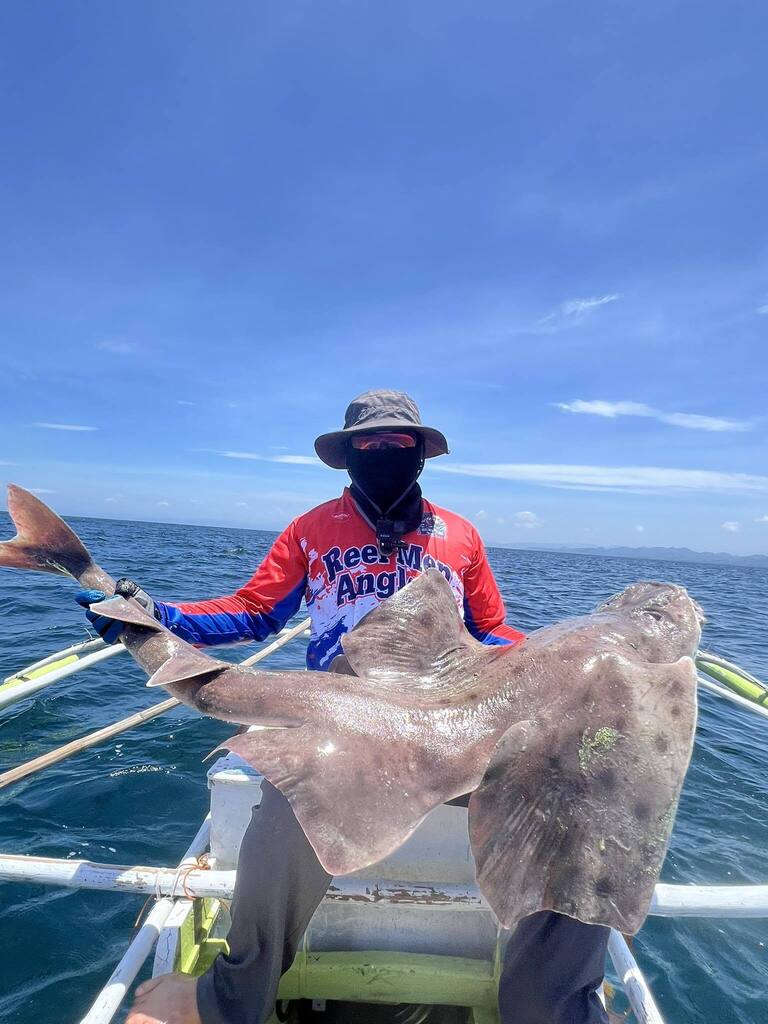
Philippines angelshark
Squatina caillieti
The Philippines angelshark (Squatina caillieti) is a species of angelshark, family Squatinidae, known only from a 33 cm (13 in) long immature female caught in the Philippines, where it is the only known representative of its family. It has a flattened body and head with greatly expanded pectoral and pelvic fins, and is greenish above with brown spots. Identifying traits of this species include the spiracles, which are more widely spaced than the eyes and bear papillae (nipple-shaped structures) on the posterior inner rims, and the relative positions of the two dorsal fins. Additionally, S. caillieti lacks fringes on its barbels, enlarged thorns along the middle of its back, and ocelli ("eyespots") on its fins.
From the article Squatina caillieti on Wikipedia (CC BY-SA), quoted section by section
Description
Like other angel sharks, S. caillieti has a flattened, ray-like form with greatly enlarged pectoral and pelvic fins. The horizontal edges of the broad, rounded head bear enlarged folds of skin. The large nostrils are teardrop-shaped and preceded by flaps of skin enlarged into two cylindrical barbels that overhang the mouth. The eyes are horizontally oval and placed relatively close together. Behind the eyes are crescent-shaped spiracles, which are spaced further apart than the eyes and bear prominent papillae (nipple-shaped structures) along their posterior inner rims. The mouth is wide and terminally placed on the snout, with furrows at the corners and the center of the upper lip forming a rounded arch. The upper and lower jaws contain 10 and 9 tooth rows respectively on either side; the teeth are small, conical, and sharp. The five pairs of gill slits are laterally situated on the head. The pectoral fins have straight leading margins and rounded outer corners, that form an angle slightly over 120°. The anterior lobes of the pectoral fins are free from the head. The pelvic fins are roughly triangular and about three-quarters as long as the pectoral fins; the pelvic fin rear tips are approximately even with the origin of the first dorsal fin. The two dorsal fins are similar in shape, with the first slightly larger than the second. …
Range & habitat
The single S. caillieti specimen was collected by trawl from a depth of 363–385 m (1,191–1,263 ft), southeast of the island of Luzon. It is the only species of angel shark known to occur in the Philippines.
Wikipedia: “Distribution and habitat”
What it does
The conservation status of S. caillieti has not yet been evaluated by the International Union for Conservation of Nature (IUCN).
== References ==
Wikipedia: “Human interactions”
Where it lives
Recorded sightings
—
geo-referenced records in GBIF, from museums, herbaria and field observers.
Drag the globe to turn it. Dots are where records exist, not a range map; darker means more records.
In the stacks
Searching the stacks…
Every page naming Squatina caillieti in the Biodiversity Heritage Library →
This page is assembled live from iNaturalist, GBIF, Wikipedia, the Source Library and the Internet Archive. It is not yet part of the hand-edited codex. iNaturalist taxon 607533.