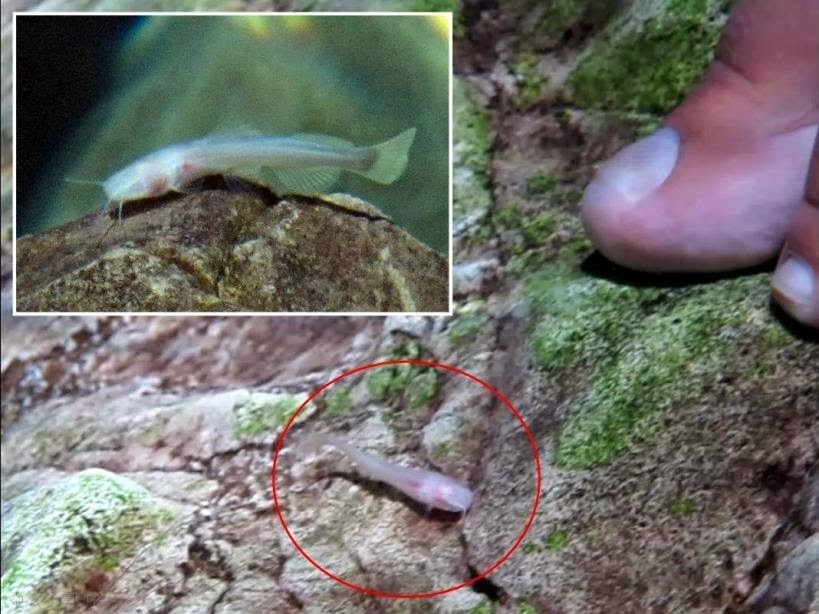
Rhamdiopsis krugi
Rhamdiopsis krugi Bockmann & Castro, 2010
Also calledBagre cego (por) · bagrinho cego (por) · bagrinho-cego (por)
First described in: Bockmann, F. A.; Castro, R. M. C. (2010). The blind catfish from the caves of Chapada Diamantina, Bahia, Brazil (Siluriformes: Heptapteridae): description, anatomy, phylogenetic relationships, natural history, and biogeography. <em>Neotropical Ichthyology.</em> 8(4): 673-706.
Descriptions from checklists and floras indexed by GBIF
biology_ecology
Habitat. Rhamdiopsis krugi inhabits the upper phreatic zone of a large karstic area (over 300 km 2) including limestones and quartzites, which is connected to surface through caves. The catfishes are expected to occur in the aquifers between the caves (Mendes, 1995 c; Trajano, 1997 b, 2001 a; Trajano & Bockmann, 2000). It is known to live in lentic waters (Trajano & Bockmann, 1999 a, 2000; Trajano, 2001 a) formed by the water table inside the caves, varying from large, partially illuminated lakes as in the Poço Encantado cave (lake with 110 m X 50 m, 20 - 65 m deep; Fig. 15) to isolated pools as in the Lapa do Bode and Gruta Natal caves (Mendes, 1995 a; Trajano, 1997 b). It is probable that the lakes inside Poço Encantado, Lapa do Bode, and Gruta Natal are connected to each other via aquifers because their variations in water level follow those observed in the rio Una (Karmann et al., 2002). Whereas the Poço Encantado lake is located inside the main, large hall (about 40 m) of the cave, Lapa do Bode is a horizontal, predominantly dry cave, with numerous labyrinthic passages 2.0 wide and 2.5 high, in average. In the Lapa do Bode cave, R. krugi is found in three isolated pools; durin
The blind catfish from the caves of Chapada Diamantina, Bahia, Brazil (Siluriformes: Heptapteridae): description, anatomy, phylogenetic relationships, natural history, and biogeography
conservation
Conservation notes. Given the relatively low population density of R. krugi in the lake of the Poço Encantado cave, swimming and diving in that place were prohibited by municipality law (Trajano, 1997 b; Trajano & Bichuette, 2006). Despite R. krugi being known to occur in a considerable wide area, inhabiting at least two other caves of the region, the species is endangered due to several factors. The habitats where R. krugi live have low water circulation, favoring the accumulation of garbage and debris (Trajano & Bichuette, 2006). The Chapada Diamantina is situated in the semiarid of northeastern Brazil, the poorest region of the country, which is chronically devastated by the problem of drought. The disordered exploration of the subterranean waters in that region - there are about 2000 artesian wells - may lead to the progressive lowering of the water table level (M. E. Bichuette & E. Trajano, pers. comm.). Furthermore, conservation priorities should be directed to R. krugi because pollution of the waters of the aquifer that feeds the habitats where it lives has already been documented through geochemical studies (Trajano & Bichuette, 2005 b, pers. comm.).
The blind catfish from the caves of Chapada Diamantina, Bahia, Brazil (Siluriformes: Heptapteridae): description, anatomy, phylogenetic relationships, natural history, and biogeography
description
Description. Table 1 presents morphometrics of holotype and paratypes. See Fig. 1 for general body shape. Body relatively elongate, its cross-section roughly circular predorsally, gradually becoming more compressed caudally. Lateral profile of trunk above pectoral fins strongly convex (produced by wide swimbladder), slightly convex from this point to pelvic-fin origin, and approximately straight from this point to end of trunk. Caudal peduncle relatively narrow and very compressed, gradually merging with caudal fin in dorsal view. Anterior dorsal profile of body gently convex, with a discrete hump between posterior limit of head and dorsal-fin origin. Dorsal profile of head gently convex, almost straight, continuous with dorsal profile of trunk. Dorsal profile of trunk posterior to dorsal-fin base straight to base of caudal fin. Ventral profile of head slightly convex. Abdominal region outlined by a distinct convexity. Ventral trunk contour slightly concave or rectilinear from pelvic-fin origin to anal-fin origin, almost straight along anal-fin base, and straight to base of caudal fin. Posterior body depth gradually decreasing caudally. Large triangular hiatus in hypaxial musculatu
The blind catfish from the caves of Chapada Diamantina, Bahia, Brazil (Siluriformes: Heptapteridae): description, anatomy, phylogenetic relationships, natural history, and biogeography
diagnosis
Diagnosis. Rhamdiopsis krugi differs from its two congeners, R. microcephala (Lütken) and R. moreirai Haseman, by the following characteristics: 1) ethmoid cartilage discontinuous (vs. continuous) (Fig. 4); 2) eyes absent and optic foramen atrophied (vs. eyes present and non-atrophied optic foramen) (Figs. 1 - 2, 4 b); 3) longer barbels, as expressed by the length of maxillary barbel with 32.2 - 43.3 % SL (vs. 21.2 - 29.3 % SL in R. microcephala, and 18.9 - 28.6 % SL in R. moreirai) (Figs. 1 - 3, 12 - 13); 4) supraorbital and infraorbital sensory canals not connected to each other anteriorly (vs. united) (Figs. 3 b, 4 a); 5) presence of s 7 branch and pore of the supraorbital laterosensory canal (vs. s 7 branch and pore absent) (Fig. 4 a); 6) subpreopercle absent (vs. present) (Fig. 5); 7) anterior and posterior branches of the transverse process 4 co-ossified to each other (vs. anterior and posterior branches of transverse process 4 not joined to each other) (Fig. 7, see arrow); 8) posterior limb of transverse process 4 undivided, with spatulated shape (vs. with a deep medial notch which divides it into two divergent, approximately symmetrical, long arms) (Fig. 7); 9) posterolater
The blind catfish from the caves of Chapada Diamantina, Bahia, Brazil (Siluriformes: Heptapteridae): description, anatomy, phylogenetic relationships, natural history, and biogeography
Where it has been recorded
Recorded sightings
—
geo-referenced records in GBIF, from museums, herbaria and field observers.
Drag the globe to turn it. Dots are where records exist, not a range map; darker means more records.
In the stacks
Searching the stacks…
Every page naming Rhamdiopsis krugi in the Biodiversity Heritage Library →
From the GBIF Backbone Taxonomy and occurrence records (GBIF.org), with Wikipedia and the Source Library. GBIF species 5961352.