- Animals
- ›Chordates
- ›Vertebrates
- ›Ray-finned Fishes
- ›Carps, Characins, Catfishes and Allies
- ›Catfishes
- ›Loricarioidei
- ›Pencil Catfishes
- ›Longfin Pencil Catfishes
- ›Trichogenes
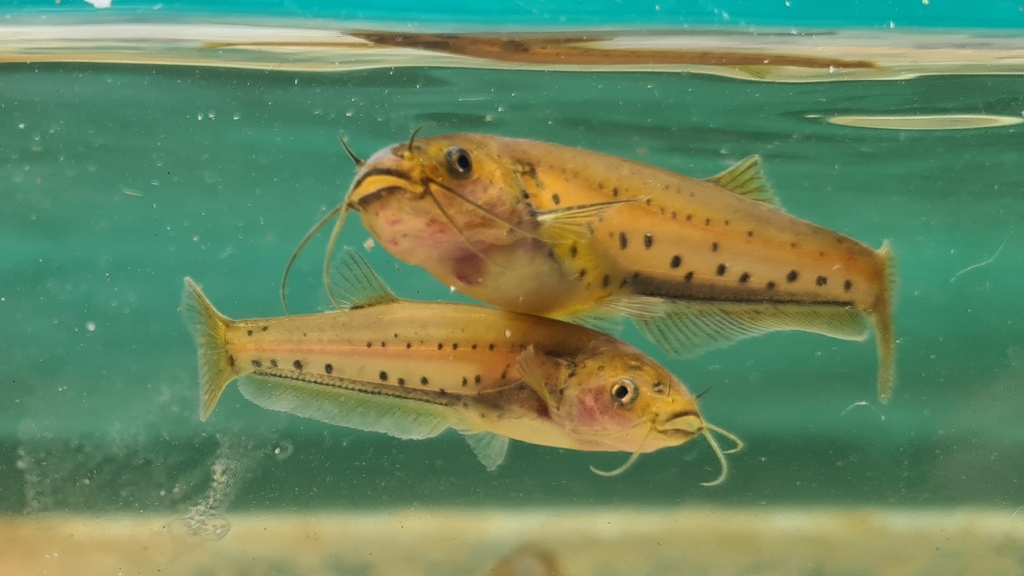
Trichogenes claviger
Trichogenes claviger, also known as the Caetés catfish (Portuguese: bagre-de-caetés), is a critically endangered species of ray-finned fish belonging to the family Trichomycteridae, the pencil catfishes. This species is endemic to streams in the Atlantic Forest of Brazil. It was discovered early in 2010 and scientifically described later that year. One of three species within the genus Trichogenes, it is restricted to an area of 16 km2 (6.2 sq mi) in the Caetés forest, a mountainous area in the Brazilian state of Espírito Santo. When discovered, the rainforest in which it occurs was unprotected and threatened by deforestation. A private nature reserve has since been established, allowing visitors to see the fish in its habitat.
A small fish, T. claviger is up to 51 mm (2.0 in) in length. A series of black dots runs along the side of the body, distinguishing it from related species. Males have a bony protrusion from the gill area (the opercular process) that is elongated and club-like, a feature that inspired the name of the species (claviger – 'club-bearing'). The opercular process in T. claviger is the only known secondary sex characteristic in pencil catfishes, and might have evolved for sexual signaling; it is also used by the fish to climb up net walls when caught. The mouth is terminal (faces forwards rather than being upturned or downturned); this feature is also found in the species' closest relative, T. beagle, but absent in all other members of their family. This fish is known to gulp air from the water surface; when carrying air, the body tilts downward.
From the article Trichogenes claviger on Wikipedia (CC BY-SA), quoted section by section
Description
T. claviger is a small fish; 18 collected specimens were between 16 and 51 mm (0.63 and 2.01 in) in standard length (measured from the snout to the end of the vertebral column). The body is deeper than it is wide, being deepest at the abdomen and tapering towards the tail. This results in convex upper and lower margins when viewed from the side, which differ from the more parallel upper and lower margins of T. longipinnis. The pectoral fin is relatively large and consists of 9 or 10 fin rays. The pelvic fin has 5 or 6 rays. The dorsal fin is comparatively small and situated closer to the caudal fin than to the snout. The anal fin is extensive with 32 to 35 unbranched rays – an extensive anal fin is also seen in T. longipinnis and T. beagle and distinguishes these species from other species in their family. The lower margin of the anal fin can be straight or convex. The upper half of the caudal fin has 9 or 10 rays, and the lower half has 6 or 7 rays. The top of the head and the fins are yellowish and the underside of the body is whitish. The body behind the head sports dark spots on its sides that are round to oval and of various sizes. The largest of the spots are arranged in a continuous line that starts at the gills and runs obliquely down to near the origin of the anal fin, and then continues parallel to the anal fin to the base of the caudal fin. …
Range & habitat
T. claviger is a local endemic of the Atlantic Forest, the second largest rainforest of the Americas, and one of the most biodiverse regions in the world. Originally, this forest covered 1.6 million hectares (4 million acres), mostly in Brazil but extending south into parts of Paraguay and Argentina. The species is only known from the Caetés forest, a remnant of the Atlantic Forest in the Brazilian state of Espírito Santo. Here, the fish lives in small streams that are part of the catchment area of the Itapemirim River, which is isolated from other catchment areas. The type locality (the locality where the specimen was collected on which the species is based on) is a small shaded stream named Picada Comprida at an altitude of around 1,150 m (3,770 ft). It is located within primary, mountainous rainforest interspersed with plantations of exotic trees. The occurrence of the species in the immediate surroundings of the site appeared to be patchy. A second locality at a different stream was discovered in 2019, 4 km (2.5 mi) away from the type locality, and a third locality was discovered by a local farmer in 2023. Together, these localities cover an area of over 16 km2 (6.2 sq mi). At the type locality, the stream containing the fish was about 30 cm (12 in) deep, slow flowing and had brown but clear water. …
Wikipedia: “Distribution and habitat”
What it does
The fish tend to dwell in the middle of the water column. The species does not solely rely on its gills for breathing but will also gulp air from the water surface and release air bubbles afterwards; such accessory air breathing is common in trichomycterids and loricarioids. Individuals carrying air will swim with their bodies tilted downward. As with T. longipinnis, the species is probably diurnal (active during the day). It is the only species of fish that occurs in its habitat, and it is unknown what prevents other species from entering these habitats. It mostly feeds on terrestrial arthropods that have fallen onto the water surface. An analysis of gut contents revealed that terrestrial insects such as hymenopterans and beetles are taken. Among the aquatic prey, black fly larvae, which attach themselves near the water margin and close to the water surface, are more commonly consumed than chironomid larvae. Juveniles differ from adults in having larger eyes, a much shorter snout, a narrower head with a strongly sloping upper surface, and a prognathous mouth (i.e., the lower jaw is larger than the upper jaw). Such marked differences probably indicate differences in ecology between juveniles and adults. In T. …
Wikipedia: “Ecology and biology”
Where it lives
Recorded sightings
—
geo-referenced records in GBIF, from museums, herbaria and field observers.
Drag the globe to turn it. Dots are where records exist, not a range map; darker means more records.
In the stacks
Searching the stacks…
Every page naming Trichogenes claviger in the Biodiversity Heritage Library →
This page is assembled live from iNaturalist, GBIF, Wikipedia, the Source Library and the Internet Archive. It is not yet part of the hand-edited codex. iNaturalist taxon 621741.