- Animals
- ›Chordates
- ›Vertebrates
- ›Mammals
- ›Therians
- ›Placental Mammals
- ›Ungulates, Carnivorans, and Allies
- ›Odd-toed Ungulates
- ›Equines
- ›Equus
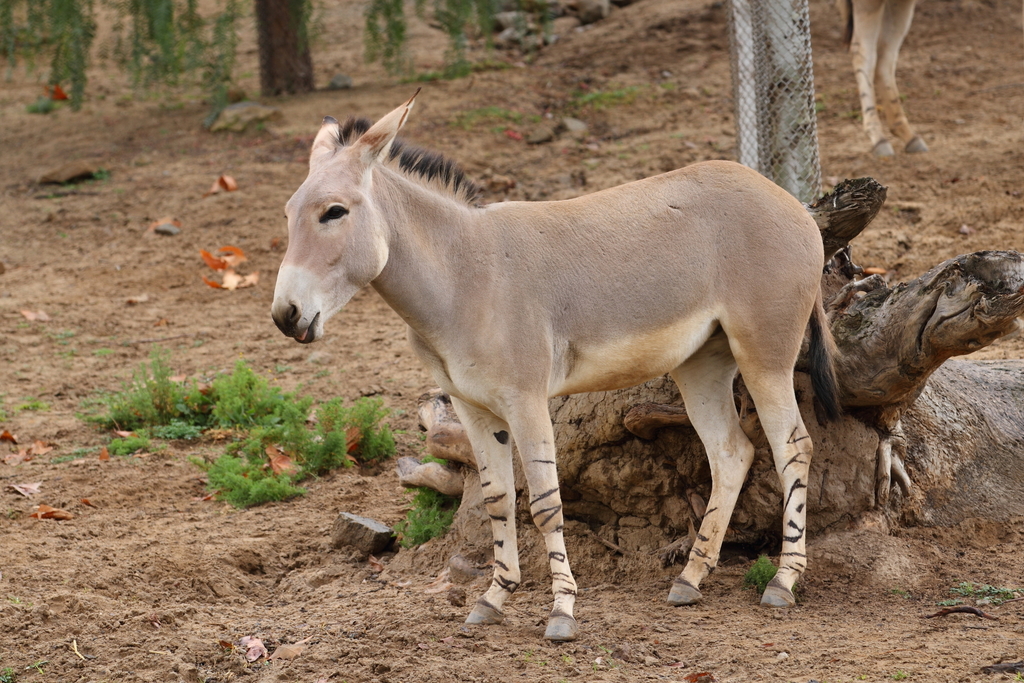
African Wild Ass
Equus africanus
The African wild ass (Equus africanus) or African wild donkey, is a wild member of the horse family, Equidae. This species is thought to be the ancestor of the domestic donkey (Equus asinus), which is sometimes placed within the same species. They live in the deserts and other arid areas of the Horn of Africa, in Eritrea, Ethiopia and Somalia. It formerly had a wider range north and west into Sudan, Egypt, and Libya. It is critically endangered, with about 570 existing in the wild.
From the article African wild ass on Wikipedia (CC BY-SA), quoted section by section
Description
The African wild ass is about 1.2 metres (4 ft) tall and weighs approximately 250 kilograms (600 lb). The short, smooth coat is a light grey to fawn colour, fading quickly to white on the undersides and legs. There is a slender, dark dorsal stripe in all subspecies, while in the Nubian wild ass (E. a. africanus), as well as the domestic donkey, there is a stripe across the shoulder. The legs of the Somali wild ass (E. a. somaliensis) are horizontally striped with black, resembling those of a zebra. On the nape of the neck, there is a stiff, upright mane, the hairs of which are tipped with black. The ears are large with black margins. The tail terminates with a black brush. The hooves are slender and approximately of the diameter as the legs.
Range & habitat
African wild asses are found in desert or semidesert environments. They have tough digestive systems, which can break down desert vegetation and extract moisture from food efficiently. They are adapted to live with little water for long stretches of time. Their large ears give them a sharp sense of hearing and help in cooling. Because of the sparse vegetation in their environment, wild asses often live separated from each other (except for mothers and young), unlike the tightly grouped herds of wild horses. They have voices which can be heard for over 3 km (1.9 mi), which helps them to keep in contact with other asses.
Wikipedia: “Habitat”
What it does
The African wild ass is primarily active in the cooler hours between late afternoon and early morning, seeking shade and shelter amongst the rocky hills during the day. The Somali wild ass is also very agile and nimble-footed, capable of moving quickly across boulder fields and in the mountains. On the flat, it has been recorded reaching speeds of 70 km/h (43 mph). In keeping with these feats, its soles are particularly hard and its hooves grow very quickly. Mature males defend large territories around 23 square kilometres in size, marking them with dung heaps – an essential marker in the flat, monotonous terrain. Due to the size of these ranges, the dominant male cannot exclude other males. Rather, intruders are tolerated – recognized and treated as subordinates, and kept as far away as possible from any of the resident females. In the presence of estrous females, the males bray loudly. These animals live in loose herds of up to fifty individuals.
In the wild, African wild ass breeding occurs during the wet season. The gestation period lasts for 11 to 12 months, and one foal is born during the period from October to February. The foal weans for 6 to 8 months after birth, reaching sexual maturity at the age of 2 years. Lifespan is up to 40 years in captivity. Wild asses can run swiftly, almost as fast as a horse. …
Wikipedia: “Behavior”
Listen
Looking for field recordings…
Where it lives
Recorded sightings
—
geo-referenced records in GBIF, from museums, herbaria and field observers.
Drag the globe to turn it. Dots are where records exist, not a range map; darker means more records.
In the stacks
Searching the stacks…
Every page naming Equus africanus in the Biodiversity Heritage Library →
This page is assembled live from iNaturalist, GBIF, Wikipedia, the Source Library and the Internet Archive. It is not yet part of the hand-edited codex. iNaturalist taxon 74315.