- Animals
- ›Chordates
- ›Vertebrates
- ›Mammals
- ›Therians
- ›Placental Mammals
- ›Primates, Rodents, and Allies
- ›Rodents
- ›Mice, Rats, and Hamsters
- ›Muroids
- ›Old World Mice and Rats
- ›Murines
- ›Australasian Mice and Rats
- ›Apomys
- ›Apomys
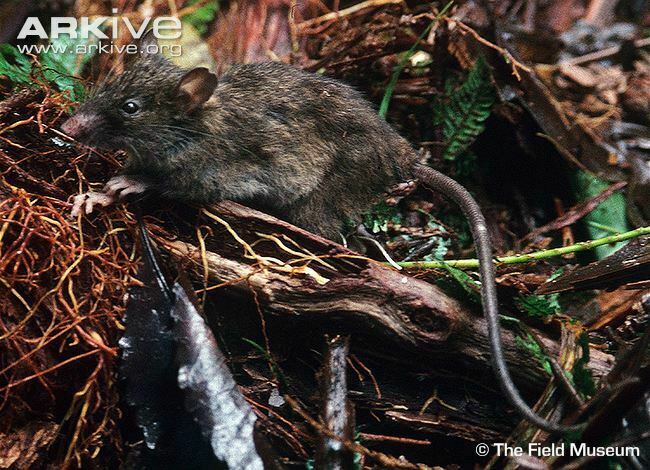
Camiguin Forest Mouse
Apomys camiguinensis
The Camiguin forest mouse (Apomys camiguinensis) is a forest mouse endemic to the island of Camiguin in the southern Philippines. It has large ears and eyes, a long tail and rusty-brown fur, and it feeds mostly on insects and seeds. This description is based on mice captured during a biological survey conducted in 1994 and 1995 high on the steep slopes of one of the island's volcanoes.
In April, 2006, the new mammal, a Philippine forest mouse, now identified as Apomys camiguinensis was captured on the steep slopes of a volcano of Camiguin during a biological survey by Heaney and Tabaranza. In 2002, Heaney, Tabaranza, and Eric Rickart (from the Utah Museum of Natural History), described a different species of forest-living rodent, Bullimus gamay, from Mt. Timpoong, the same mountain where the new mouse was collected. A frog (Oreophryne nana) named in 1967 had been thought to be the only vertebrate restricted to the island prior to the surveys by Heaney and Tabaranza. The scientists' research was described in the April 5 issue of Fieldiana: Zoology, a scientific journal about biodiversity research published by The Field Museum. It is endemically distributed to Dinagat (FMNH), Luzon (Benguet [USNM], Camarines Sur [FMNH], and Isabela [FMNH] provinces) and Mindoro (FMNH). It is abundant in primary montane forest (1125 – 1350 m), uncommon in mossy forest (1550 – 1750 m), and absent in disturbed lowland forest (475 – 900 m) on Mt. Isarog, southern Luzon, and also in montane forest at 925 m elevation in Balbalasang, Kalinga Province.
Listen
Looking for field recordings…
Where it lives
Recorded sightings
—
geo-referenced records in GBIF, from museums, herbaria and field observers.
Drag the globe to turn it. Dots are where records exist, not a range map; darker means more records.
In the stacks
Searching the stacks…
Every page naming Apomys camiguinensis in the Biodiversity Heritage Library →
This page is assembled live from iNaturalist, GBIF, Wikipedia, the Source Library and the Internet Archive. It is not yet part of the hand-edited codex. iNaturalist taxon 74073.