- Animals
- ›Chordates
- ›Vertebrates
- ›Mammals
- ›Therians
- ›Placental Mammals
- ›Ungulates, Carnivorans, and Allies
- ›Bats
- ›Yangochiroptera
- ›Noctilionoid Bats
- ›New World Leaf-nosed Bats
- ›Phyllostomine Bats
- ›Phyllostomini
- ›Lophostoma
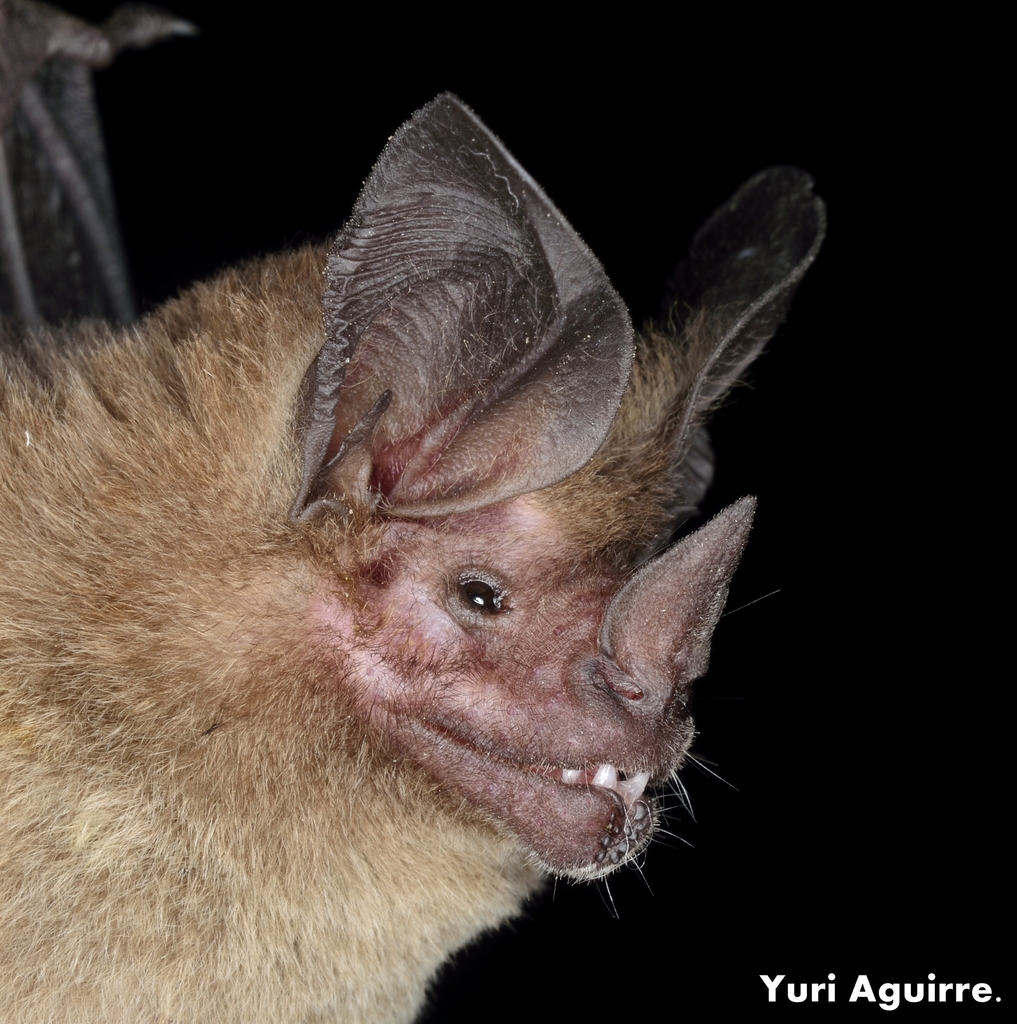
Pygmy Round-eared Bat
Lophostoma brasiliense
The pygmy round-eared bat (Lophostoma brasiliense) is a bat species from South and Central America.
From the article Pygmy round-eared bat on Wikipedia (CC BY-SA), quoted section by section
Description
Its ears are large with rounded tips. Its upper lip has several small warts. The fur is dark brown or black in color. Its forearm is 33–36 mm (1.3–1.4 in) long. Individuals weigh 9–11 g (0.32–0.39 oz). Its dental formula is 2.1.2.31.1.3.3 for a total of 32 teeth.
Range & habitat
The northernmost extent of its range is from eastern slopes of the Andes in Colombia, Ecuador, Peru, and Bolivia and extends through to Orinoquia and eastern Amazonia in Venezuela, Guyana, Suriname, French Guiana, and Brazil. The southern limit includes the states of Presidente Hayes in central Paraguay (lower (wet) Chaco), Mato Grosso do Sul (Cerrado), São Paulo, Rio de Janeiro and Espirito Santo (Atlantic Forest) in Brazil. It is also present in the Island of Trinidad. As of 2016, it was evaluated as a least-concern species by the IUCN.
== References ==
Wikipedia: “Range and habitat”
What it does
It is insectivorous, though it may also consume fruit. It is nocturnal, roosting in sheltered places during the day such as hollow trees or within termite mounds.
Wikipedia: “Biology and ecology”
Listen
Looking for field recordings…
Where it lives
Recorded sightings
—
geo-referenced records in GBIF, from museums, herbaria and field observers.
Drag the globe to turn it. Dots are where records exist, not a range map; darker means more records.
In the stacks
Searching the stacks…
Every page naming Lophostoma brasiliense in the Biodiversity Heritage Library →
This page is assembled live from iNaturalist, GBIF, Wikipedia, the Source Library and the Internet Archive. It is not yet part of the hand-edited codex. iNaturalist taxon 74514.