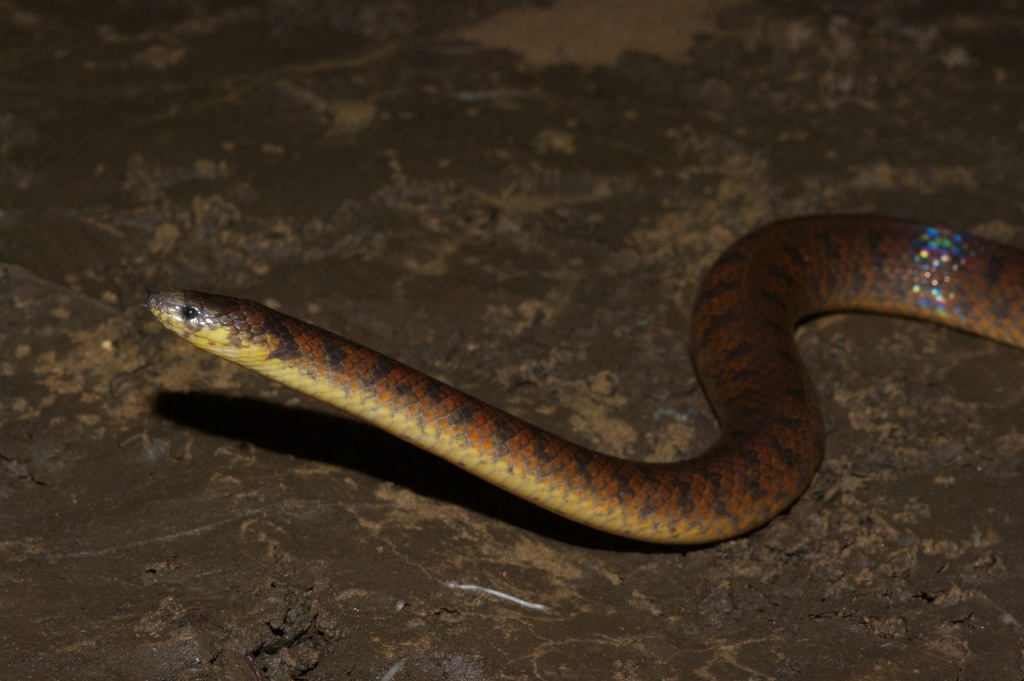
Atractus tamessari
Atractus tamessari Kok, 2006
First described in: Kok, P. J. R. A new snake of the genus Atractus Wagler, 1828 (Reptilia: Squamata: Colubridae) from Kaieteur National Park, Guyana, northeastern South America.
Descriptions from checklists and floras indexed by GBIF
description
Description of the holotype. An adult male, TTL 397 mm, SVL 346 mm, TL 51 mm (12.8 % of TTL); head slightly distinct from neck, length 1.4 times width (HW: 7.6 mm; HL: 10.8 mm); snout length (from eye to tip of snout) 4.0 mm, snout rounded in dorsal and lateral view; eye small (1.6 mm); pupil semi-elliptical; eye-nostril distance 29 % of HL; rostral small, visible in dorsal view, width about 1.8 times height; internasals small, as long as wide, laterally in contact with anterior and posterior nasals; prefrontals large, length 1.4 times width, much larger than the internasals, irregularly hexagonal, touching eye, their medial suture asymmetrical, noticeably dextral to the medial internasal suture; frontal pentagonal, slightly wider than long, 1.1 times length of medial prefrontal suture; parietals large, length 1.5 times width, medial suture of parietals 1.2 times length of frontal. Nasal divided, posterior nasal as long as anterior nasal; preocular absent; loreal long, length 2.8 times height; postoculars 2 / 2, small, upper slightly larger than lower; temporals 1 + 2, lower posterior temporal slightly longer than upper; supralabials 8 / 8, eighth largest, first contacting nasals,
A new snake of the genus Atractus Wagler, 1828 (Reptilia: Squamata: Colubridae) from Kaieteur National Park, Guyana, northeastern South America
diagnosis
Diagnosis. An Atractus species with 15 dorsal scale rows that can be distinguished from all other congeners by the following combination of characters: (1) medium size, adults reaching about 400 mm in TTL; (2) loreal much longer than high and touching the eye; (3) two postoculars; (4) eight supralabials, fourth and fifth touching the eye; (5) seven to eight infralabials, four in contact with chinshield; (6) six maxillary teeth; (7) 153 – 163 ventrals; (8) 28 – 31 subcaudals; (9) dorsal color pattern of irregular red or pale red markings, sometimes forming an incomplete broken dorsolateral stripe, on a medium brown to brownish black ground color; (10) venter yellowish cream, heavily mottled with brownish black. The new species can be referred to the genus Atractus because it possesses the following combination of characters: medium size; head small, slightly distinct from neck; eye small, with semi-elliptical pupil; scales smooth; dorsal scales in 15 rows without reduction; loreal present, touching the eye and separating prefrontals and supralabials; nostril between two scales; single pair of chinshields; anal single; subcaudals divided; maxillary teeth decreasing in size posteriorl
A new snake of the genus Atractus Wagler, 1828 (Reptilia: Squamata: Colubridae) from Kaieteur National Park, Guyana, northeastern South America
distribution
Distribution and ecology. Atractus tamessari is known only from the type locality (Fig. 5), which is located in the southeastern part of Kaieteur National Park, at the eastern edge of the Pakaraima Mountains (Fig. 6). The holotype and IRSNB 2641 were collected at night (ca. 22: 30 h), crawling on the ground a few meters from a stream, almost exactly at the same place and the same time, at a 24 h interval. IRSNB 2642 was collected by day, apparently sleeping, on a stump in the river. The habitat can be characterized as a submontane forest of the Pakaraima uplands on white sands dominated by clump wallaba (Dicymbe spp) (ter Steege 2001). Examination of stomachs revealed no identifiable remains of prey, although X-rays of the male body showed the presence of sand in the digestive tract, which may suggest the recent ingestion of an earthworm, a very common food of Atractus (Martins & Oliveira 1993, “ 1998 ” [1999]). No enlarged follicles were found in IRSNB 2641 ovaries; one egg was found in the abdominal cavity of IRSNB 2642, but as the specimen was cut in two by the collector, it is highly probable that other eggs were lost. All specimens have abdominal fat deposits. Other snake spec
A new snake of the genus Atractus Wagler, 1828 (Reptilia: Squamata: Colubridae) from Kaieteur National Park, Guyana, northeastern South America
etymology
Etymology. The specific name is a noun in the genitive case, honoring Michael Tamessar, retired Senior Scientific Officer of the Department of Biology at the University of Guyana (UG). Mike Tamessar spent most of his life encouraging Guyanese students to pursue studies in the fields of ichthyology and herpetology. Mike also collected many of the amphibians and reptiles in the collection of the Centre for Study of the Biological Diversity (CSBD) at UG.
A new snake of the genus Atractus Wagler, 1828 (Reptilia: Squamata: Colubridae) from Kaieteur National Park, Guyana, northeastern South America
In the stacks
Searching the stacks…
Every page naming Atractus tamessari in the Biodiversity Heritage Library →
From the GBIF Backbone Taxonomy and occurrence records (GBIF.org), with Wikipedia and the Source Library. GBIF species 5223951.