- Animals
- ›Chordates
- ›Vertebrates
- ›Reptiles
- ›Snakes and Lizards
- ›Lizards
- ›Wall lizards, amphisbaenians, and allies
- ›Amphisbaenians
- ›Two-legged Worm Lizards
- ›Bipes
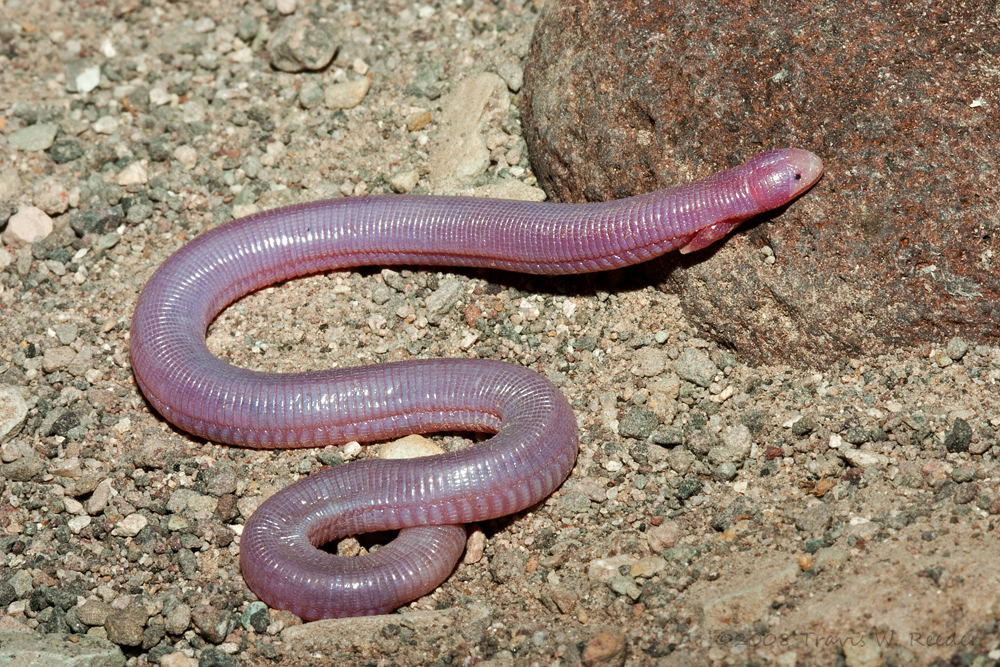
Five-toed Worm Lizard
Bipes biporus
The Mexican mole lizard (Bipes biporus), commonly known as the five-toed worm lizard, or simply as Bipes, is a species of amphisbaenian, which is endemic to the Baja California Peninsula. It is one of four species of amphisbaenians that have legs. It should not be confused with the axolotl, a salamander (Ambystoma mexicanum), which is usually called ajolote in Spanish. It is commonly found in Baja California.
From the article Mexican mole lizard on Wikipedia (CC BY-SA), quoted section by section
Description
B. biporus is pink and worm-like, 18–24 cm (7.1–9.4 in) in snout-to-vent length (SVL) and 6–7 mm (0.24–0.28 in) in width. It lives for one to two years. Its skin is closely segmented to give a corrugated appearance, and like earthworms, its underground movement is by peristalsis of the segments. Its blunt head allows it to burrow into sandy soils efficiently. The forelegs are short, strong and paddle-like, while the hind legs are absent, only having vestigial bones. The tail is autotomous without any regeneration. Due to sacrificing the development of its ear to permit it to dig more efficiently, the Mexican mole lizard has evolved to have its skin transmit vibrations to the cochlea.
Range & habitat
The Mexican mole lizard (B. biporus) is found in the states of Baja California, Baja California Sur, Guerrero and Chiapas, in Mexico. These species tend to be found on this peninsula near the sandy soils in desert with dry shrub land. They spend their time burrowed from 2.5 cm to 15 cm.
Wikipedia: “Geographic range”
What it does
B. biporus is oviparous, and the females lay one to four eggs in midsummer. The species only breeds underground. The eggs hatch after two months. The juveniles tend to be pink and then turn white as they grow. B. biporus does not exhibit sexual dimorphism, with their gender only being determined by looking at their gonads.
Wikipedia: “Reproduction”
Where it lives
Recorded sightings
—
geo-referenced records in GBIF, from museums, herbaria and field observers.
Drag the globe to turn it. Dots are where records exist, not a range map; darker means more records.
In the stacks
Searching the stacks…
Every page naming Bipes biporus in the Biodiversity Heritage Library →
This page is assembled live from iNaturalist, GBIF, Wikipedia, the Source Library and the Internet Archive. It is not yet part of the hand-edited codex. iNaturalist taxon 116513.