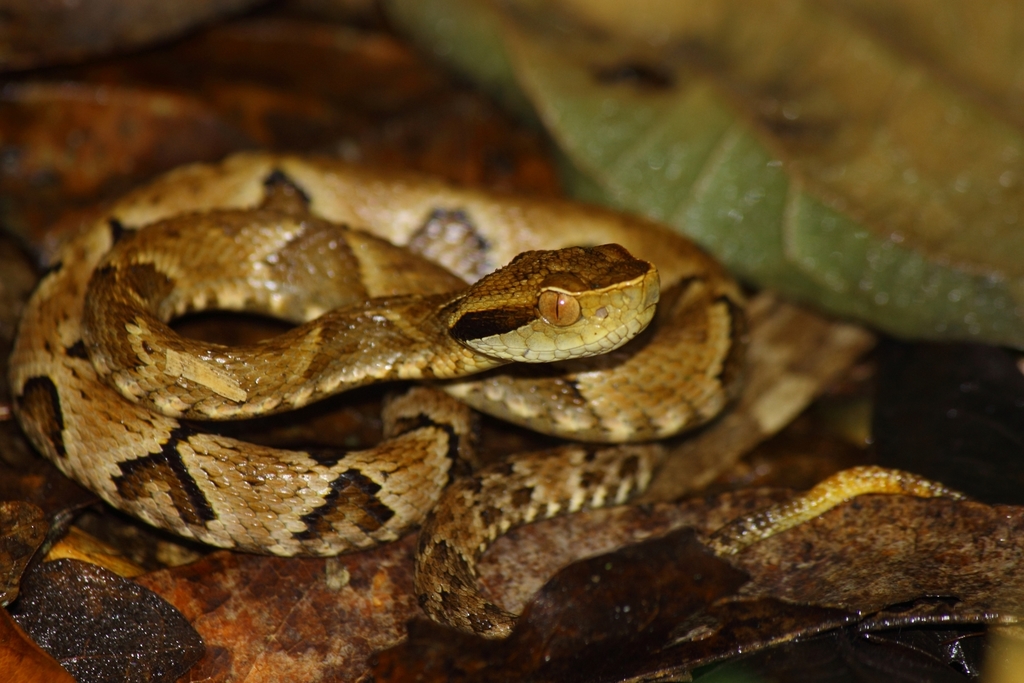
Yarará Lancehead
Bothrops jararaca
Bothrops jararaca—known as the jararaca or yarara—is a highly venomous pit viper species endemic to South America in southern Brazil, Paraguay, and northern Argentina. The specific name, jararaca, is derived from Old Tupi îararaka. Within its geographic range, it is often abundant and is an important cause of snakebite. No subspecies are currently recognized.
The drugs known as angiotensin converting enzyme (ACE) inhibitors, used for the treatment of hypertension and some types of congestive heart failure, were developed from a peptide found in the venom of this species.
From the article Bothrops jararaca on Wikipedia (CC BY-SA), quoted section by section
Description
This is a slender and terrestrial species that grows to a maximum total length of 160 cm (63 in), although the average total length is much less. The head scalation includes 5–12 intersupraoculars that are weakly keeled, 7–9 supralabials (usually 8) of which the second is fused with the prelacunal to form a lacunolabial, and 9–13 sublabials (usually 10–12). The midbody has 20–27 rows of dorsal scales (usually 23–25). The ventrals number 170–216 (rarely 218) and the 51–71 subcaudals are mostly paired. The color pattern is extremely variable, consisting of a dorsal ground color that may be tan, brown, gray, yellow, olive, or almost maroon. Midbody, this color is usually somewhat lighter than the head, anterior and posterior. The dorsal ground color is overlaid with a series of pale-edged, dark brown, subtriangular or trapezoidal markings on either side of the body, the apices of which reach the vertebral line. These marking may be situated opposite each other, or partially or completely juxtaposed; most specimens have a pattern with all three variations. In juveniles, the tip of the tail is white. The head has a prominent, dark brown stripe that runs from behind the eye, on either side of the head, back to the angle of the mouth, usually touching the last three supralabials. Dorsally, this stripe is bordered by a distinct pale area. …
Range & habitat
The snake's habitat is the Brazilian Atlantic Forest, today southern Brazil, eastern Paraguay (specifically the departments of Alto Paraná and Canindeyú) and the Argentine province of Misiones). Two closely related species, B. alcatraz and B. insularis, occur on Brazilian islands. The type locality is listed as "Lagoa d'Arara am Mucurí" (Brazil) by Wied-Neuwied in 1825. It occurs from near sea level to over 1,000 m (3,280 ft) altitude.
Wikipedia: “Geographic range”
What it does
This snake usually hunts at night and during the day takes shelter in foliage; in habitats at higher altitudes and those with colder months, a significant reduction in activities occurs, with greater activity observed during the warmer months. They are ambush predators and equipped with good camouflage; juveniles use caudal luring to attract and capture prey, making movements with the tip of the tail, which is white and appears very similar to an insect larva.
Wikipedia: “Behavior”
At the table
The drugs known as ACE inhibitors, which are used for the treatment of hypertension and some types of congestive heart failure, were developed from a peptide found in the venom of this species in 1965 by Brazilian scientist Sérgio Henrique Ferreira. Haemocoagulase enzyme derived from the venom is used as antihemorrhagic drug.
Wikipedia: “Medical uses”
Where it lives
Recorded sightings
—
geo-referenced records in GBIF, from museums, herbaria and field observers.
Drag the globe to turn it. Dots are where records exist, not a range map; darker means more records.
In the stacks
Searching the stacks…
Every page naming Bothrops jararaca in the Biodiversity Heritage Library →
This page is assembled live from iNaturalist, GBIF, Wikipedia, the Source Library and the Internet Archive. It is not yet part of the hand-edited codex. iNaturalist taxon 539050.