- Animals
- ›Chordates
- ›Vertebrates
- ›Mammals
- ›Therians
- ›Placental Mammals
- ›Primates, Rodents, and Allies
- ›Rodents
- ›Mice, Rats, and Hamsters
- ›Muroids
- ›Old World Mice and Rats
- ›Murines
- ›Australasian Mice and Rats
- ›Pseudomys
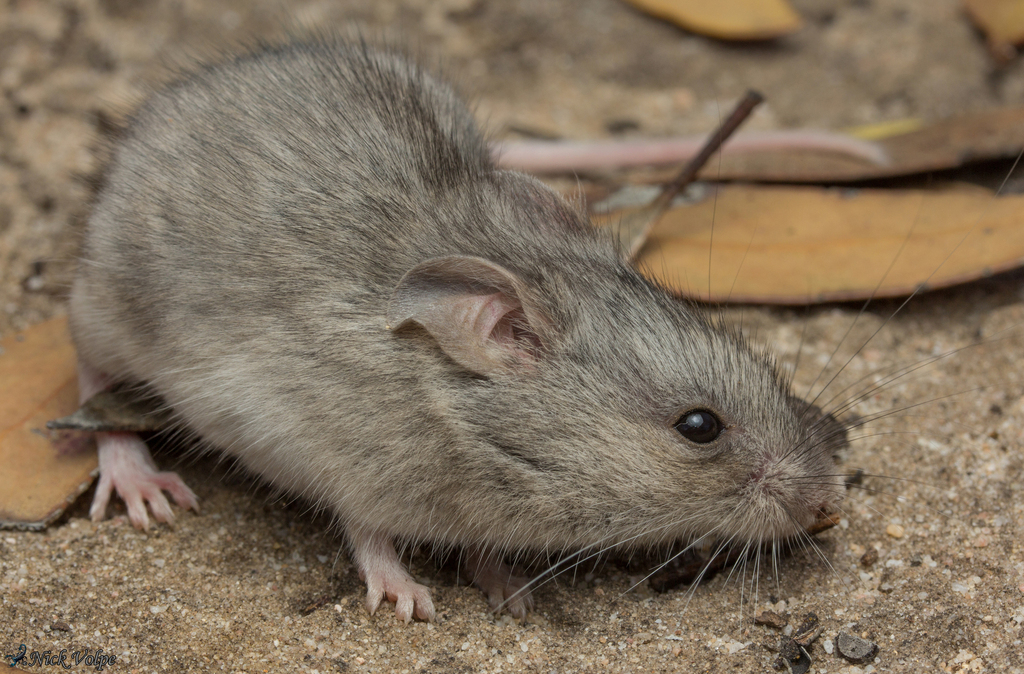
Silky Mouse
Pseudomys apodemoides
The silky mouse (Pseudomys apodemoides) is a small, nocturnal rodent native to the western and northwestern regions of Victoria, Australia. Weighing 16-22 grams, it has light blue-grey fur flecked with light brown and black guard hairs, and a white underside. Known for its complex burrows, the Silky Mouse favors floristically rich mallee-heath environments, especially areas near Banksia ornata, due to consistent soil moisture and food availability. The silky mouse primarily feeds on seeds, nectar, flowers, and insects. Though threatened by habitat destruction and fires, conservation efforts have led to population recovery.
From the article Silky mouse on Wikipedia (CC BY-SA), quoted section by section
Description
The silky mouse is a nocturnal burrowing rodent found only in Australia. Adults weigh between 16-22 grams, with a head and body length of 65-80 millimeters and a tail length of 90-110 millimeters. They have light blue-grey fur flecked with light brown on their backs, interspersed with black guard hairs, and white fur on their undersides. The tail has pink skin with white hairs and often features ten to fifteen grey-brown bands. P. apodemoides has prominent, bulging eyes and larger ears than the house mouse (Mus musculus). The silky mouse has very soft, fine fur and well-developed black or white whiskers. Other common names include silky-grey mouse, silky-grey southern mouse, Finlayson's mouse
Range & habitat
Pseudomys apodemoides prefers floristically rich mallee-heath environments, which provide cover from predators, moderate temperatures, and increased environmental moisture, creating microhabitats for insect species that are part of its diet. The silky mouse often builds burrows near Banksia ornata due to the soil moisture benefits it offers. Banksia ornata significantly impacts its habitat by intercepting a large portion of rainfall with its dense foliage, creating an irregular pattern of soil moisture. Despite some evaporation, much of the intercepted rain reaches the soil, resulting in a more consistent moisture level compared to other vegetation types. Marked stem-flow in B. ornata leads to rain-shadows and concentrated moisture under the bush, providing a stable moisture environment throughout much of the year. This preference for B. ornata not only ensures a more consistent moisture level but also supports the availability of food sources, making it an ideal burrow site for P. apodemoides. Silky mice are found throughout western and northwestern Victoria.
Wikipedia: “Habitat”
What it does
Pseudomys apodemoides is nocturnal, resting in their burrows during the day and foraging for seeds, nectar, flowers, and fruit at night. They also consume insects, particularly during breeding periods and pregnancy. Burrows are identified by excavation mounds of deeper soil, have clean, vertical pop-holes, and comprise several vertical shafts, a long tunnel system, and a large nesting chamber. Burrows are often near Banksia ornata due to soil moisture benefits and food availability.
Wikipedia: “Behavior and ecology”
Listen
Looking for field recordings…
Where it lives
Recorded sightings
—
geo-referenced records in GBIF, from museums, herbaria and field observers.
Drag the globe to turn it. Dots are where records exist, not a range map; darker means more records.
In the stacks
Searching the stacks…
Every page naming Pseudomys apodemoides in the Biodiversity Heritage Library →
This page is assembled live from iNaturalist, GBIF, Wikipedia, the Source Library and the Internet Archive. It is not yet part of the hand-edited codex. iNaturalist taxon 45212.