- Animals
- ›Chordates
- ›Vertebrates
- ›Mammals
- ›Therians
- ›Placental Mammals
- ›Primates, Rodents, and Allies
- ›Rodents
- ›Mice, Rats, and Hamsters
- ›Muroids
- ›Old World Mice and Rats
- ›Murines
- ›Old World Field Mice and Ryukyu Spiny Rats
- ›Apodemus
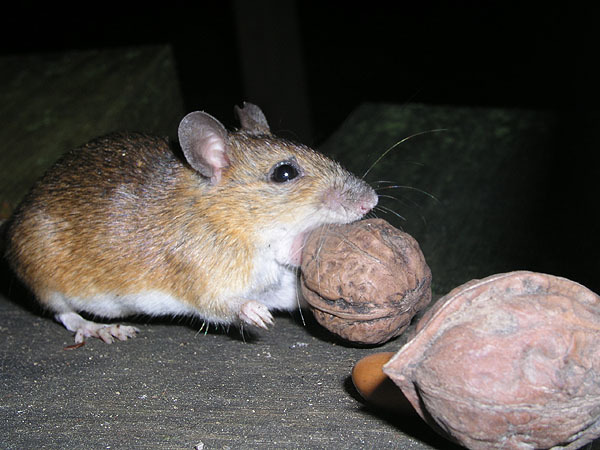
Large Japanese Field Mouse
Apodemus speciosus
The large Japanese field mouse (Apodemus speciosus) is a nocturnal species of rodent in the family Muridae.
It is endemic to Japan.
From the article Large Japanese field mouse on Wikipedia (CC BY-SA), quoted section by section
Range & habitat
The species appears to be present on all Japanese islands. It inhabits forests, grasslands, and cultivated fields, including rice paddies, at any altitude. Though occupying the same broad ecological niche as A. argenteus, the two species prefer different microhabitats: A. argenteus prefers dense canopy, while A. speciosus prefers open secondary forests.
Wikipedia: “Distribution and habitat”
What it does
Large Japanese field mice forage primarily at night, likely to avoid predation. They are omnivores but mostly known to be seed-eating mice, particularly around autumn and winter, as the mice hoard acorns and walnuts, which comprise 13-100% of their food. This makes them effective seed dispersers. Mast seeding can have serious effects on field mouse populations, including increases in overwinter survival, winter reproduction, and population density.
Effects of light. Large Japanese field mice have been observed changing their typical foraging behavior in response to varying light conditions. In response to higher light intensity, A. speciosus significantly decreases time outside of the nest, length of excursions, and food eaten compared to periods of dark. Additionally, the mice tend to carry food back to their nests during periods of light as opposed to eating away from the nest as they normally would in the dark. These behavioral changes are thought to be an adaptation to help the mice avoid potential predators, avoiding, for example, well-lit areas on the ground as they forage at night. Differences in such changes in behavior allow for the fulfillment of specific niches, as is observed between A. speciosus and A. argenteus, which react to light differently because of their differing body size.
Tannin selection. …
Wikipedia: “Foraging behavior”
Listen
Looking for field recordings…
Where it lives
Recorded sightings
—
geo-referenced records in GBIF, from museums, herbaria and field observers.
Drag the globe to turn it. Dots are where records exist, not a range map; darker means more records.
In the stacks
Searching the stacks…
Every page naming Apodemus speciosus in the Biodiversity Heritage Library →
This page is assembled live from iNaturalist, GBIF, Wikipedia, the Source Library and the Internet Archive. It is not yet part of the hand-edited codex. iNaturalist taxon 45563.