- Animals
- ›Chordates
- ›Vertebrates
- ›Mammals
- ›Therians
- ›Placental Mammals
- ›Primates, Rodents, and Allies
- ›Rodents
- ›Mice, Rats, and Hamsters
- ›Muroids
- ›Old World Mice and Rats
- ›Gerbils
- ›Gerbillini
- ›Meriones
- ›Pallasiomys
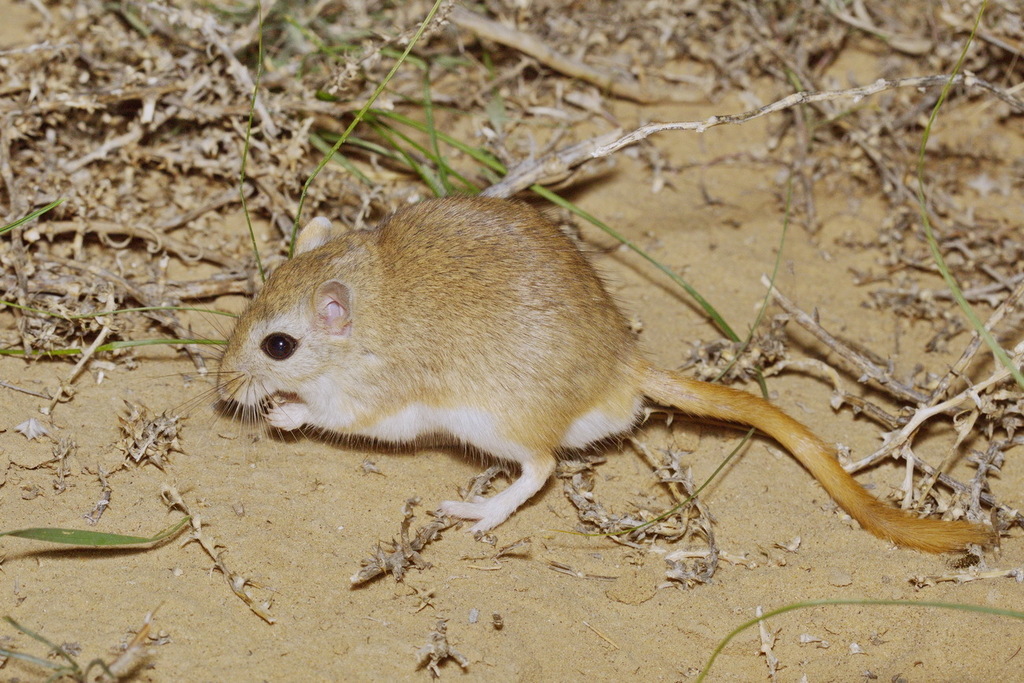
Mid-day Jird
Meriones meridianus
The midday jird, or midday gerbil (Meriones meridianus), is a species of rodent in the family Muridae and native to sandy deserts in Afghanistan, China, Iran, Azerbaijan, Kazakhstan, Kyrgyzstan, Mongolia, Russia, Tajikistan, Turkmenistan, and Uzbekistan. How this rodent received its common name is unclear as it is mainly nocturnal.
From the article Midday jird on Wikipedia (CC BY-SA), quoted section by section
Description
The midday jird is a medium-sized species with a head-and-body length of 95 to 134 mm (3.7 to 5.3 in), a tail of a similar length, and a weight of 30 to 60 g (1.1 to 2.1 oz). The upper parts are pale yellowish-grey, drab or darker brown, the hairs having blackish bases. The underparts are white with a light brown strip across the chest. The tail is brown or ochre above and slightly paler below. The claws are white, and the soles of the hind feet are densely hairy so that no bare skin is visible.
Range & habitat
The midday jird's range extends from Iran, Turkmenistan, Kazakhstan, Uzbekistan, Tajikistan, Kyrgyzstan, Russia to Afghanistan, Mongolia and western China. Its lives in sandy deserts, alluvial plains and especially arid sandy areas in hilly deserts with a scattering of scrub up to an elevation of 1,600 m (5,200 ft). It is a common rodent in the Aralkum area, where it has colonised the dried sea bottom.
Wikipedia: “Distribution and habitat”
What it does
The midday jird lives in large colonies with complex social structures. The entrance to the burrow is usually at the base of a plant and the tunnels may extend for up to 4 m (13 ft) horizontally and half of this vertically, being deeper in winter. It is mainly nocturnal, but may emerge in daylight in autumn and winter. Its diet consists mainly of seeds and fruits, but it also eats insects and some green vegetation. It stores small amounts of food in the burrow. Breeding takes place mainly in the spring and autumn with litters averaging about six young.
Wikipedia: “Behaviour and ecology”
Listen
Looking for field recordings…
Where it lives
Recorded sightings
—
geo-referenced records in GBIF, from museums, herbaria and field observers.
Drag the globe to turn it. Dots are where records exist, not a range map; darker means more records.
In the stacks
Searching the stacks…
Every page naming Meriones meridianus in the Biodiversity Heritage Library →
This page is assembled live from iNaturalist, GBIF, Wikipedia, the Source Library and the Internet Archive. It is not yet part of the hand-edited codex. iNaturalist taxon 44673.