- Animals
- ›Chordates
- ›Vertebrates
- ›Mammals
- ›Therians
- ›Placental Mammals
- ›Primates, Rodents, and Allies
- ›Rodents
- ›Squirrels, Dormice, and Mountain Beavers
- ›Squirrels
- ›Typical and Flying Squirrels
- ›Typical Squirrels
- ›Sciurus
- ›Hadrosciurus
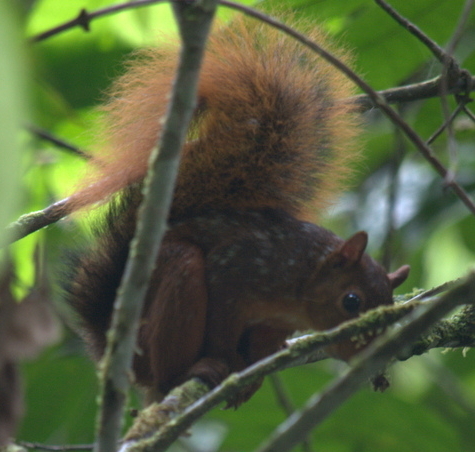
Junín Red Squirrel
Sciurus pyrrhinus
The Junín red squirrel (Sciurus pyrrhinus) is a species of squirrel from Peru and Ecuador.
From the article Junín red squirrel on Wikipedia (CC BY-SA), quoted section by section
Description
The Junín red squirrel is a relatively large tree squirrel, having a head-body length of about 25 cm (9.8 in). The majority of the body is covered in dark red fur, grizzled with black, fading to a chestnut brown on the tail, which is slightly shorter than the combined head and body. The underparts vary in colour between individuals, being white, red, or some shade in between. The whiskers and the edges of the ears are black.
Range & habitat
The squirrel is known to inhabit the eastern slopes of the Andes in central Peru, from Huánuco in the north to Ayacucho and Cusco in the south, although it may also live further east, perhaps as far as the Bolivian border, and further north, with one specimen collected in 1920 known from Zamora-Chinchipe Province of Ecuador. Within this region it inhabits both lowland rainforests and higher, montane, forests. Little is known about the biology and behavior of the squirrels. They are diurnal and arboreal, often seen in small groups, suggesting a lack of strong territoriality. Lactating females, presumably nursing young, have been observed in January. They are believed to be relatively numerous and more tolerant of human activities like logging and hunting compared to some other squirrel species. However, their limited range has led to their classification as “Vulnerable” by the Peruvian Ministry of the Environment.
== References ==
Wikipedia: “Distribution and biology”
Listen
Looking for field recordings…
Where it lives
Recorded sightings
—
geo-referenced records in GBIF, from museums, herbaria and field observers.
Drag the globe to turn it. Dots are where records exist, not a range map; darker means more records.
In the stacks
Searching the stacks…
Every page naming Sciurus pyrrhinus in the Biodiversity Heritage Library →
This page is assembled live from iNaturalist, GBIF, Wikipedia, the Source Library and the Internet Archive. It is not yet part of the hand-edited codex. iNaturalist taxon 46006.