- Animals
- ›Chordates
- ›Vertebrates
- ›Mammals
- ›Therians
- ›Placental Mammals
- ›Primates, Rodents, and Allies
- ›Rodents
- ›Squirrels, Dormice, and Mountain Beavers
- ›Squirrels
- ›Typical and Flying Squirrels
- ›Typical Squirrels
- ›Sciurus
- ›Sciurus
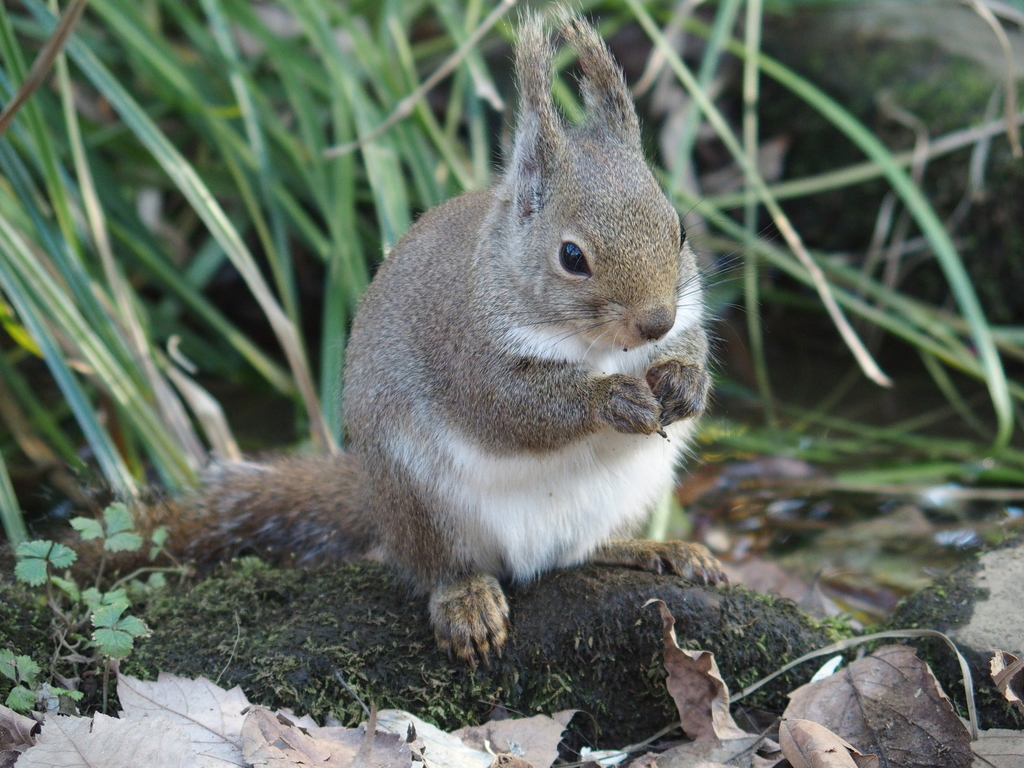
Japanese Squirrel
Sciurus lis
The Japanese squirrel (Sciurus lis) is a tree squirrel in the genus Sciurus endemic to Japan. The Japanese squirrel's range includes the islands of Honshū, Shikoku, and Kyūshū. Recently, populations on south-western Honshū and Shikoku decreased, and those on Kyūshū disappeared. One of the factors affecting the local extinction of this species seems to be forest fragmentation by humans.
From the article Japanese squirrel on Wikipedia (CC BY-SA), quoted section by section
Description
Japanese squirrels range from 16–22 centimetres (6.3–8.7 in) in body length from the head to the base of the tail, which makes up a further 13–17 centimetres (5.1–6.7 in). Their typical body weight is 250–310 grams (8.8–10.9 oz). Japanese squirrels have red-brown fur on their bodies and tails, with orange patches sometimes present on the sides and legs, that becomes grey over the winter. A white ring is typically present around the eye. The belly is white year-round.
Range & habitat
The Japanese squirrel's native range consists of the islands of Honshū, Shikoku, and Kyūshū. Several populations in southern Honshū have disappeared, chiefly due to habitat loss, and the species is believed to have become extirpated from Kyūshū.. The Japanese squirrel is absent from Hokkaido, where it is replaced by the Sciurus vulgaris orientis subspecies of the related red squirrel, which is conversely absent from the rest of the Japanese archipelago outside of Hokkaido. Japanese squirrels live primarily in mixed-species to pine lowland and subalpine forests.
Wikipedia: “Distribution and habitat”
What it does
Japanese squirrels are diurnal and active throughout the year. They are solitary as adults, with minimal overlap between home ranges. Males typically defend a territory of 4–30 hectares (9.9–74.1 acres), while females defend territories of 4–17 hectares (9.9–42.0 acres). Territories tend to be larger in heavily fragmented environments, as squirrels need to incorporate larger quantities of less-suitable marginal habitat. It has been found that fallen dead trees serve as landmarks for the movement, vigilance, and resting of Japanese squirrels. Deadwood also can serve as hoarding sites for Japanese squirrels, which is crucial for their survival. The increase of deadwood may provide benefits to small mammals, such as the Japanese squirrel, and the quality of habitat is improved significantly. The Japanese squirrel's predators include the Japanese marten, foxes, domestic cats, domestic dogs, and predatory birds including raptors and crows.
Diet. Japanese squirrels are herbivores and feed primarily on seeds, fruits, buds, and flowers gathered from trees; insects and fungi are also eaten more sporadically. Foraging occurs both on the ground and in tree canopies. Food hoarding focuses on thick-shelled fruit such as walnuts. Japanese walnut (Juglans ailantifolia) is a particularly important food in lowland mixed-species forests. …
Wikipedia: “Ecology and behavior”
Listen
Looking for field recordings…
Where it lives
Recorded sightings
—
geo-referenced records in GBIF, from museums, herbaria and field observers.
Drag the globe to turn it. Dots are where records exist, not a range map; darker means more records.
In the stacks
Searching the stacks…
Every page naming Sciurus lis in the Biodiversity Heritage Library →
This page is assembled live from iNaturalist, GBIF, Wikipedia, the Source Library and the Internet Archive. It is not yet part of the hand-edited codex. iNaturalist taxon 46000.