- Animals
- ›Chordates
- ›Vertebrates
- ›Mammals
- ›Therians
- ›Placental Mammals
- ›Ungulates, Carnivorans, and Allies
- ›Carnivorans
- ›Pinnipeds
- ›Earless Seals
- ›Phocinae
- ›Hooded Seals
- ›Cystophora
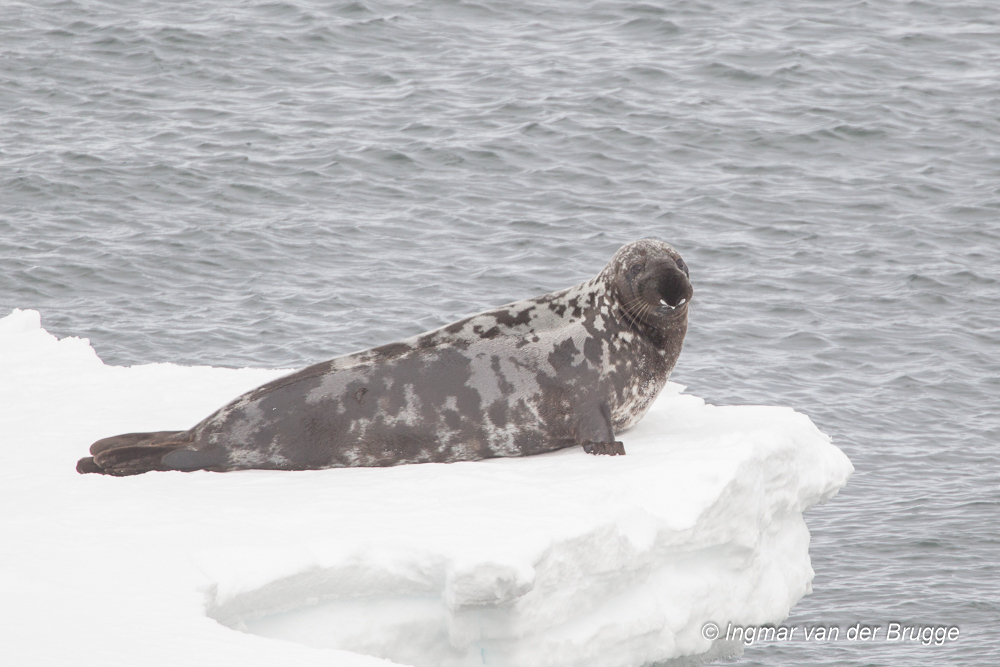
Hooded Seal
Cystophora cristata
The hooded seal or bladdernose seal (Cystophora cristata) is a large phocid found only in the central and western North Atlantic, ranging from Svalbard in the east to the Gulf of St. Lawrence in the west. The seals are typically silver-grey or white in color, with black spots that vary in size covering most of the body. Hooded seal pups are known as "blue-backs" because their coats are blue-grey on the back with whitish bellies. This coat is shed after 14 months of age when the pups molt. It is the only species in the genus Cystophora.
From the article Hooded seal on Wikipedia (CC BY-SA), quoted section by section
Range & habitat
Hooded seals live primarily on drifting pack ice and in deep water in the Arctic Ocean and North Atlantic. Although some drift away to warmer regions during the year, their best survival rate is in colder climates. They can be found on four distinct areas with pack ice: near Jan Mayen Island (northeast of Iceland); off Labrador and northeastern Newfoundland; the Gulf of St. Lawrence; and the Davis Strait (off midwestern Greenland). Males appear to be localized around areas of complex seabed, such as Baffin Bay, Davis Strait, and the Flemish cap, while females concentrate their habitat efforts primarily on shelf areas, such as the Labrador Shelf. Hooded seals are known to be a highly migratory species that often wander long distances, as far west as Alaska and as far south as the Canary Islands and Guadeloupe. Prior to the mid 1990s, hooded seal sightings in Maine and the east Atlantic were rare, but began increasing in the mid 1990s. From January 1997 to December 1999, a total of 84 recorded sightings of hooded seals occurred in the Gulf of Maine, one in France and one in Portugal. From 1996 to 2006, five strandings and sightings were noted near the Spanish coasts in the Mediterranean Sea. There is no scientific explanation for the increase in sightings and range of the hooded seal. …
Wikipedia: “Distribution and habitat”
What it does
The diet of the hooded seal is composed primarily of various amphipods (crustaceans), euphausiids (krill), and fish, including Atlantic argentine, capelin, Greenland halibut, flounder, polar cod, herring, and redfish. They also are known to eat octopus, squid, sea stars, shrimp, other crustaceans, and mussels. Relative to the other species, hooded seals consume 3 times the proportion of redfish; percentages of capelin were similar in relation to closely related species. Capelin is considered a more common choice of sustenance during the winter season. Their diet is considered to be rich in lipids and fatty acids.
Wikipedia: “Diet”
Listen
Looking for field recordings…
Where it lives
Recorded sightings
—
geo-referenced records in GBIF, from museums, herbaria and field observers.
Drag the globe to turn it. Dots are where records exist, not a range map; darker means more records.
In the stacks
Searching the stacks…
Every page naming Cystophora cristata in the Biodiversity Heritage Library →
This page is assembled live from iNaturalist, GBIF, Wikipedia, the Source Library and the Internet Archive. It is not yet part of the hand-edited codex. iNaturalist taxon 41706.