- Animals
- ›Chordates
- ›Vertebrates
- ›Mammals
- ›Therians
- ›Placental Mammals
- ›Ungulates, Carnivorans, and Allies
- ›Bats
- ›Yangochiroptera
- ›Vespertilionoid Bats
- ›Evening Bats
- ›Vesper Bats
- ›Hairy-tailed Bats
- ›Lasiurus
- ›Lasiurus
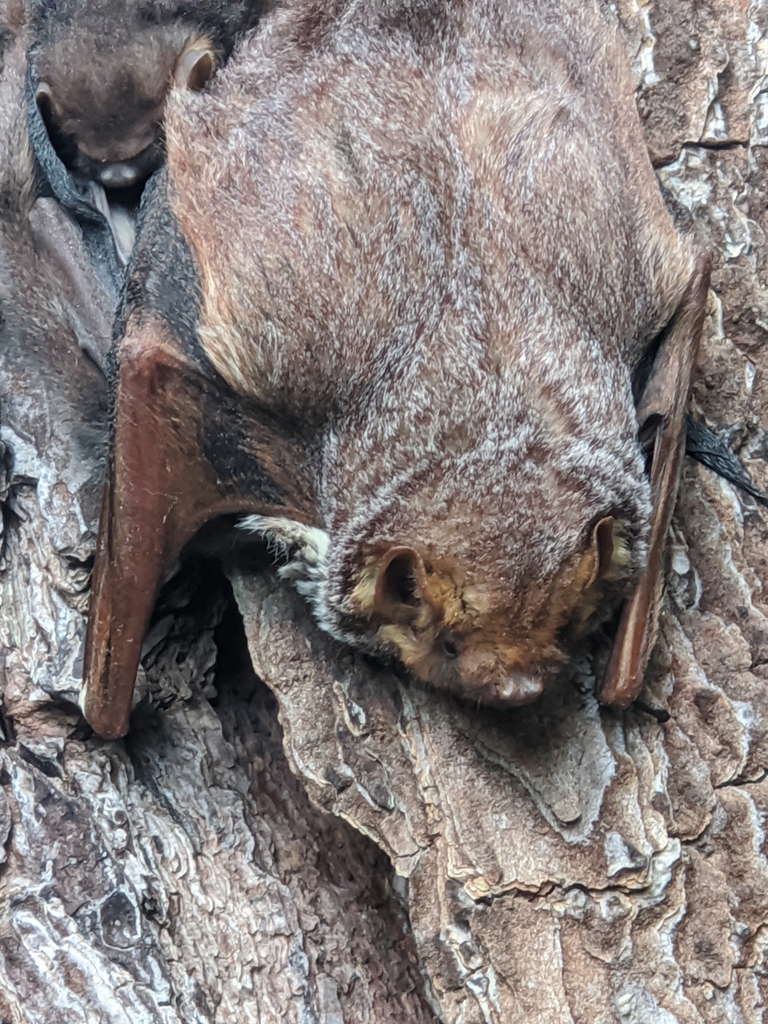
Seminole Bat
Lasiurus seminolus
The Seminole bat (Lasiurus seminolus) is a species of bat in the family Vespertilionidae. A common feature of the family Vespertilionidae is a tail that is located completely within the uropatagium (the membrane located between the hind limbs in bats). In Seminole bats, and other members of the Lasiurus genus, the upper surface of this membrane is covered in fur.
From the article Seminole bat on Wikipedia (CC BY-SA), quoted section by section
Description
The Seminole bat is often confused with the red bat. This is due to the coloring of the Seminole bat, which is a mahogany color with a frosted look due to white tipped dorsal hairs. Coloring is not sexually dimorphic, meaning that males and females are similar in color. Average weight is around 12 grams with females being larger than males.
Range & habitat
The Seminole bat is found in the Southeastern United States. This includes Louisiana, Georgia, Alabama, Mississippi, South Carolina and parts of Texas, Tennessee, Arkansas and North Carolina. There are also records of Seminole bats as far as Mexico. It is a migratory species, living along the Gulf Coast, in the Carolinas, and southern Arkansas during the winter. In the summer, they migrate as far north as Missouri and Kentucky. In 2015, it was documented for the first time in northwestern North Carolina. The bats prefer to live in forested areas. In winter months they are found to use leaf litter and Spanish moss as insulation in their roost sites. Spanish moss is also thought to be an important factor in Seminole bat environments year round and is believed to be a limiting factor in distribution of these bats.
== References ==
Wikipedia: “Distribution”
What it does
Seminole bats are insectivores. Insectivores are animals that feed primarily on insects. They have been found to eat relatively large amount of Hymenoptera (ants, bees and wasps), Coleoptera (beetles), Lepidoptera (moths). They have also been shown to eat smaller amounts of Homoptera (cicadas) and Diptera (flies).
Wikipedia: “Diet”
Listen
Looking for field recordings…
Where it lives
Recorded sightings
—
geo-referenced records in GBIF, from museums, herbaria and field observers.
Drag the globe to turn it. Dots are where records exist, not a range map; darker means more records.
In the stacks
Searching the stacks…
Every page naming Lasiurus seminolus in the Biodiversity Heritage Library →
This page is assembled live from iNaturalist, GBIF, Wikipedia, the Source Library and the Internet Archive. It is not yet part of the hand-edited codex. iNaturalist taxon 40521.