- Animals
- ›Chordates
- ›Vertebrates
- ›Mammals
- ›Therians
- ›Placental Mammals
- ›Primates, Rodents, and Allies
- ›Colugos
- ›Colugos
- ›Cynocephalus
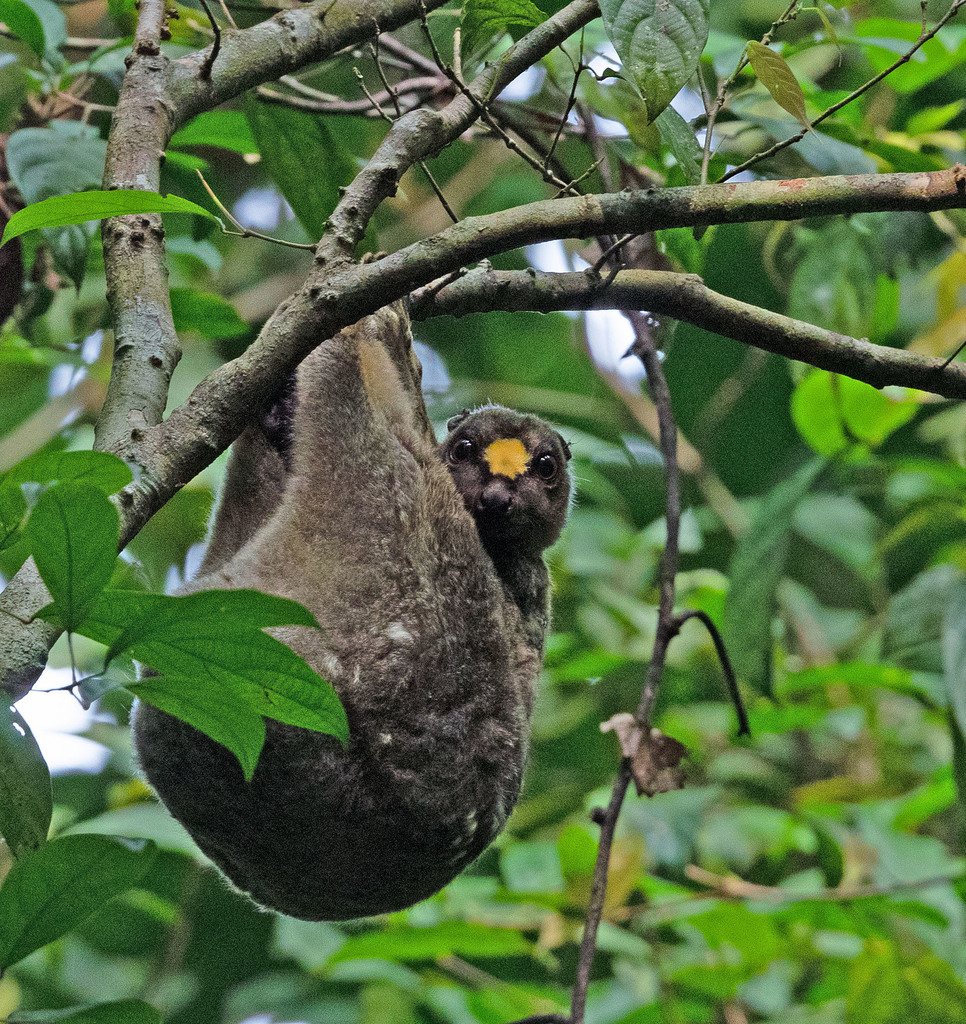
Philippine Colugo
Cynocephalus volans
The Philippine flying lemur or Philippine colugo (Cynocephalus volans), known locally as the kagwang, is one of two species of colugo. It is the only species in its genus. Despite their colloquial name, flying lemurs are not lemurs, nor are they capable of true powered flight, as they can only glide between trees.
The kagwang belongs to the order Dermoptera, which contains only one other species, the Sunda flying lemur, found in Indonesia, Thailand, Malaysia, and Singapore. Recent genetic analysis suggests two other species, the Bornean flying lemur and the Javan flying lemur, may be separate from the other species, but they have yet to be officially classified.
From the article Philippine flying lemur on Wikipedia (CC BY-SA), quoted section by section
Range & habitat
The Philippine flying lemur is endemic to the southern Philippines. Its population is concentrated in the Mindanao region and Bohol. It may also be found in Samar and Leyte. Colugos are found in heavily forested areas, living mainly high up in the trees in lowland and mountainous forests or sometimes in coconut and rubber plantations, rarely coming down to the ground. They spend most of their time at the top of the rainforest canopy or in the forest middle level. With their wide patagia and unopposable thumbs, Philippine flying lemurs are rather slow, clumsy climbers, ascending tree trunks in a series of slow lurches with their heads up and limbs spread to grasp the tree.
Wikipedia: “Habitat and ecology”
What it does
The Philippine flying lemur is a folivore, eating mainly young leaves and occasionally soft fruits, flowers, plant shoots, and insects. They also obtain a significant amount of their water from licking wet leaves and from the water in the plants and fruits themselves. Most of their nutrition is obtained by jumping and gliding between trees high in the canopy; rarely do they eat on the forest floor.
Wikipedia: “Diet”
Listen
Looking for field recordings…
Where it lives
Recorded sightings
—
geo-referenced records in GBIF, from museums, herbaria and field observers.
Drag the globe to turn it. Dots are where records exist, not a range map; darker means more records.
In the stacks
Searching the stacks…
Every page naming Cynocephalus volans in the Biodiversity Heritage Library →
This page is assembled live from iNaturalist, GBIF, Wikipedia, the Source Library and the Internet Archive. It is not yet part of the hand-edited codex. iNaturalist taxon 42538.