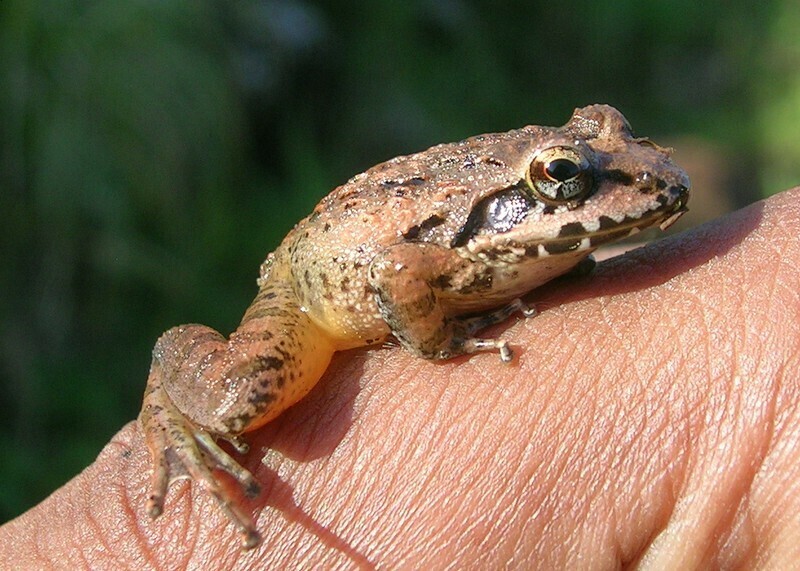
South Indian Frog
Indirana semipalmata
Indirana semipalmata is a species of frog endemic to the Western Ghats region of southern India. They are small frogs, reaching lengths of about 36 mm (1.4 in) from snout to vent. The species breeds during the monsoons, laying their eggs on moist rocks and tree bark. Their tadpoles are terrestrial - hatching, feeding, and undergoing metamorphosis without ever entering any standing bodies of water.
From the article Indirana semipalmata on Wikipedia (CC BY-SA), quoted section by section
Description
Indirana semipalmata is a small frog, with a snout-vent length (SVL) of 36 mm (1.4 in). The snout is blunt with moderate canthal ridges. The space between the eyes is about the same width as each of the upper eyelids. The tympanum and the eyes are of the same diameter. It possesses vomerine teeth with two slightly oblique oval groups just behind the level of the rear edge of the choanae. The males of the species lack vocal sacs. The first fingers of the forelimbs extend slightly beyond the second. At the ventral surface of each joint are well-developed tubercles and there is a single oval tubercle along the inner metatarsals. If the hind limbs are stretched forward the length of the body, the tibiotarsal ("ankle") articulation reaches the snout. The skin of Indirana semipalmata has short longitudinal glandular folds on the back; while on the bottom surface, it is smooth . It is predominantly brown in coloration with the throat and chest mottled and lighter in color. The temples and the sides of the eyes (the temporal and loreal regions) are black. A dark band is also present between the eyes at the top of the head. The limbs possess dark stripes across.
Range & habitat
Indirana semipalmata is endemic to an area less than 20,000 km2 (7,700 mi2) in the southern Western Ghats of India. It inhabits altitudes between 200 and 1,100 m (660 and 3,610 ft) above sea level. They have been recorded in at least ten localities – Malabar, Pulloorampara, Kodaikanal, Idukki, Parambikulam, Kalakkad, Siruvani, Shringeri, Agumbe, and Kudremukh.
Wikipedia: “Distribution”
What it does
The ecology and biology of Indirana semipalmata has not been extensively studied. It is a terrestrial species generally found on vegetation beside the banks of streams and rivers (riparian habitats). It can also be found in swamps and in the leaf litter in the floors of evergreen, semi-evergreen, and tropical rainforests. I. semipalmata breeds and lays clutches of eggs on wet rocks and the bark of fallen trees during the monsoon season. In a study in 2010 in the Agumbe Rainforest Research Station (ARRS), Karnataka, India, the eggs had an average diameter of 2.7 mm (0.11 in). Each clutch had an average of 343 eggs. Adult males were also observed near the egg clutches, presumably guarding them. Like most of the other members of the subfamily Ranixalinae, the tadpoles are non-aquatic. Upon hatching, the tadpoles remain on the moist surfaces, undergoing metamorphosis without ever entering any standing bodies of water. In the 2010 study, all of the egg clutches and the tadpoles were found at least 3 m (9.8 ft) from the nearest pool of water. The eggs and tadpoles are instead kept moist by dripping water from leaves and rainfall. The tadpoles have finless tails and strongly hooked beaks which enable them to skip along hard surfaces rather than swim. Partially metamorphosed tadpoles can leap with their hind limbs. …
Wikipedia: “Ecology and biology”
Listen
Looking for field recordings…
Where it lives
Recorded sightings
—
geo-referenced records in GBIF, from museums, herbaria and field observers.
Drag the globe to turn it. Dots are where records exist, not a range map; darker means more records.
In the stacks
Searching the stacks…
Every page naming Indirana semipalmata in the Biodiversity Heritage Library →
This page is assembled live from iNaturalist, GBIF, Wikipedia, the Source Library and the Internet Archive. It is not yet part of the hand-edited codex. iNaturalist taxon 26142.