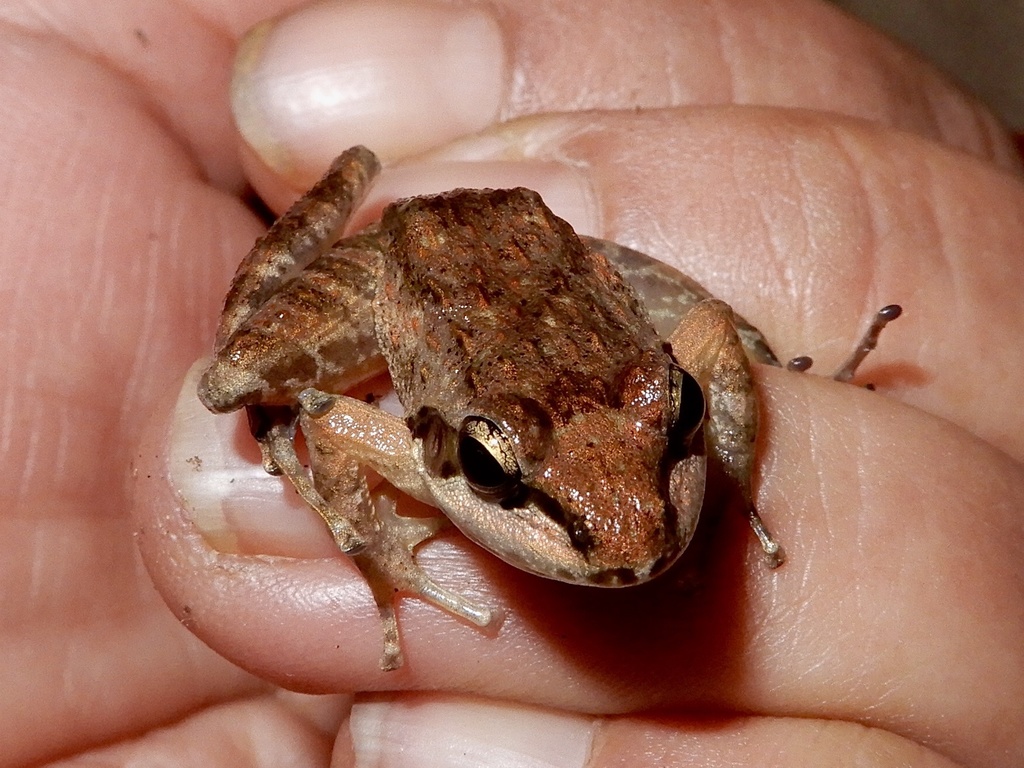
Beddomes Leaping Frog
Indirana beddomii
Indirana beddomii, Beddome's leaping frog, Beddome's Indian frog, or simply Beddome's frog, is a species of frog found in the Western Ghats. They are usually detected by their long leaps as they flush from the ground when disturbed. The species is named after the naturalist Richard Henry Beddome.
From the article Indirana beddomii on Wikipedia (CC BY-SA), quoted section by section
Description
Vomerine teeth in two oblique groups are found just behind the level of the choanae. A free, pointed papilla is on the middle of the tongue. The head is moderate, and the snout is obtuse, with an obtuse canthus rostralis and a concave loreal region. The nostril is a little nearer to the end of the snout than to the eye; the interorbital space is as broad as the upper eyelid, or a little narrower; the tympanum is distinct, two-thirds of the diameter of the eye. The front toes are moderate, with the first extending slightly beyond the second; the hind toes are two-thirds webbed, with the web reaching the disks of the third and fifth toes; the tips of the toes are dilated into well-developed disks; the subarticular tubercles are well developed. A single, small, oval inner metatarsal tubercle is present, with no tarsal fold. The tibiotarsal articulation reaches the tip of the snout or a little beyond. The skin of the back has short longitudinal glandular folds, with a strong fold from the eye to the shoulder. Their color is brown above, with rather indistinct darker spots; rarely, they are uniform pinkish, sometimes with a light vertebral band; a dark cross-band occurs between the eyes; a black band is found along the canthus rostralis, and a black temporal spot is seen. Its limbs are more or less distinctly cross-barred; the lower parts are uniformly whitish. …
Range & habitat
This species is found in the forests of the Western Ghats. This frog lives on the ground near or in riparian habitats in evergreen and mixed evergreen forests between 752 and 1200 meters above sea level. This frog can live in secondary forest but scientists consider it unlikely that it can survive in heavily disturbed habitats. This frog has not been observed on farms.
Wikipedia: “Distribution and habitat”
What it does
This frog lays eggs on wet cliffs in cracks in rocks. This frog's tadpoles live in these cracks rather than directly in the water.
Wikipedia: “Reproduction”
Listen
Looking for field recordings…
Where it lives
Recorded sightings
—
geo-referenced records in GBIF, from museums, herbaria and field observers.
Drag the globe to turn it. Dots are where records exist, not a range map; darker means more records.
In the stacks
Searching the stacks…
Every page naming Indirana beddomii in the Biodiversity Heritage Library →
This page is assembled live from iNaturalist, GBIF, Wikipedia, the Source Library and the Internet Archive. It is not yet part of the hand-edited codex. iNaturalist taxon 26149.