- Animals
- ›Chordates
- ›Vertebrates
- ›Amphibians
- ›Frogs and Toads
- ›African Reed Frogs
- ›Running Frogs and Wot-wots
- ›Kassina
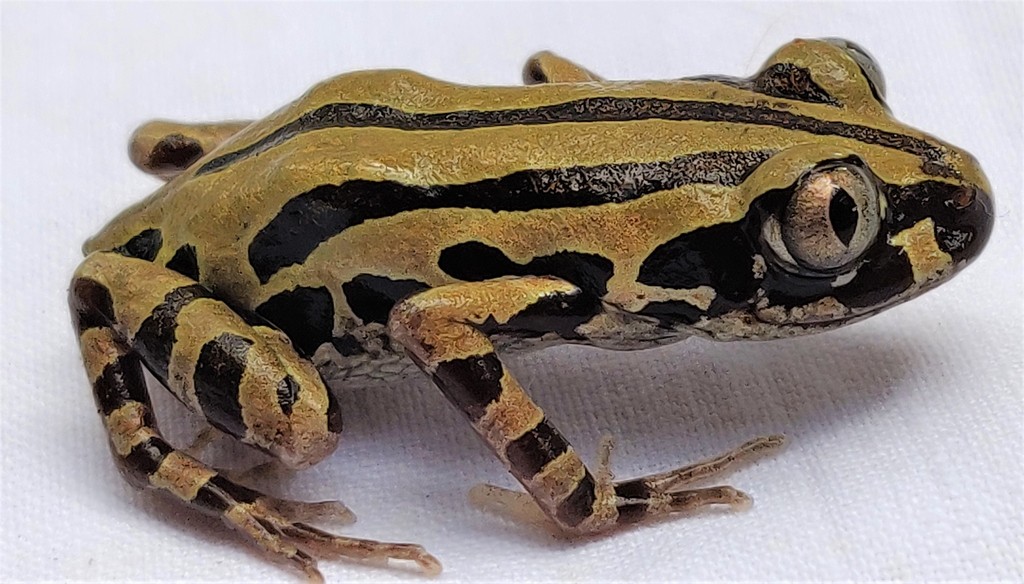
Senegal Running Frog
Kassina senegalensis
Kassina senegalensis, also known as the Senegal running frog, along with many other common names, is a species of frog native to much of Africa. It is a small and solidly-built species with large eyes. Most of the body is greyish-black, but there are brown bands and spots on certain parts. They can be found in many types of habitats, such as shrublands, grasslands, and wetlands, at elevations as high as 2,000 metres (1.2 mi). Their breeding occurs in water, where eggs are laid in various locations and fertilised one by one. They eat a variety of arthropods and secrete peptides from their skin to avoid becoming prey themselves. Their population is assumed to be very large and not in any immediate danger.
From the article Kassina senegalensis on Wikipedia (CC BY-SA), quoted section by section
Description
Senegal running frogs are relatively small and stocky. The vomer teeth of the upper mouth are arranged in two small groups. The tongue is heart-shaped. The Eustachian tube is quite small, and the eardrums are indistinct from the layer of skin covering them. Its four unwebbed fingers ordered from shortest to longest are its first, second, fourth, and third digits. The toes are also unwebbed. The eyes are large and somewhat protruding, while the head is shaped like an equilateral triangle, rounded at the tip. The entire body is smooth. In colour, Kassina senegalensis is greyish black, with brown longitudinal bands and spots of the same colour on various locations of the body, including the ears and eyes. They range in size from 35 to 40 millimetres (1.4 to 1.6 in). Males are a little smaller than females, and they have chocolate-coloured vocal sacs that can grow nearly twice their normal size during calls. Kassina senegalensis eggs are about 3 millimetres (0.12 in) in diameter; this includes the jellylike membrane that covers them. Identification of tadpoles can be difficult, as there is much variation among them, a trait shared with other species in the genus Kassina. They grow up to 75 millimetres (3.0 in) long, with wide fins and humped backs.
Range & habitat
Kassina senegalensis is found over a large portion of Africa, from Senegal in the west to Ethiopia and Somalia in the east, all the way south to South Africa. Its presence is uncertain in Burundi, the Democratic Republic of the Congo, Guinea-Bissau, Mauritania, and Togo. In the northern parts of its distribution, specifically Kenya and Tanzania, the relationship between its range and that of its relative Kassina somalica is not well understood. It is found in many different habitats, including savannas (both humid and dry), montane grasslands and shrublands, wetlands, and artificial environments (such as pastures and canals). They can be found at elevations as high as 2,000 metres (1.2 mi).
Wikipedia: “Distribution and habitat”
What it does
Kassina senegalensis can breed in both temporary and permanent sources of water, although due to their relatively long growth time, these are usually permanent or semi-permanent. Males call to attract females. The clasping male initiates the female's egg laying with their cloacae kept about 2 millimetres (0.079 in) apart. The male stays behind the female to fertilize eggs one at a time as the pair frequently moves to lay between one and fifteen eggs at each position. They are laid at a depth between 1 and 6 centimetres (0.39 and 2.36 in), quickly sinking to the bottom. A total of about 600 eggs are laid, which hatch after around six days. The presence of fish in breeding ponds shortens mating periods, whereas many other frog species avoid breeding in such conditions. All tested frog species, K. senegalensis included, immediately stopped breeding activity when the catfish species Clarias gariepinus is introduced. They take 50–60 days to complete metamorphosis.
Wikipedia: “Reproduction and life cycle”
Listen
Looking for field recordings…
Where it lives
Recorded sightings
—
geo-referenced records in GBIF, from museums, herbaria and field observers.
Drag the globe to turn it. Dots are where records exist, not a range map; darker means more records.
In the stacks
Searching the stacks…
Every page naming Kassina senegalensis in the Biodiversity Heritage Library →
This page is assembled live from iNaturalist, GBIF, Wikipedia, the Source Library and the Internet Archive. It is not yet part of the hand-edited codex. iNaturalist taxon 23512.