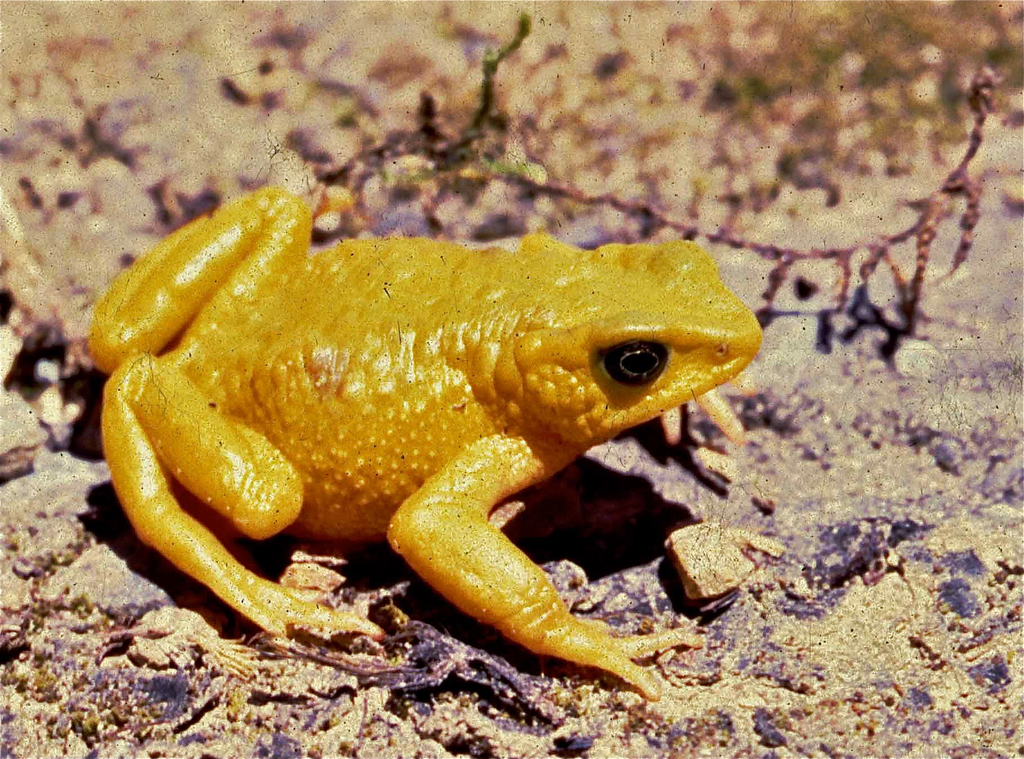
Azuay Stubfoot Toad
Atelopus bomolochos
Atelopus bomolochos, the Azuay stubfoot toad or Cuenca jambato frog, is a species of toad in the family Bufonidae. It is endemic to southern Ecuador and known from Cordillera Oriental in the Azuay, Cañar, and Loja Provinces.
From the article Atelopus bomolochos on Wikipedia (CC BY-SA), quoted section by section
Description
Males measure 38.4–40.8 mm (1.51–1.61 in) and females 43.9–51.0 mm (1.73–2.01 in) in snout–vent length. The dorsum is yellow, yellow with brown, or yellowish green, usually with black spots on the back. The belly is yellow or orange.
Range & habitat
Its natural habitats are humid montane forest, sub-páramo, and páramo at elevations of 2,500–2,800 m (8,200–9,200 ft) above sea level. It breeds in streams. This formerly abundant species has nearly disappeared from its range. The decline is attributed to chytridiomycosis and habitat loss. After one last individual was observed in 2002 in the Sangay National Park, and the species was feared extinct, the species was not seen before a small population was rediscovered in 2015 near Cuenca. A captive population is maintained in the Amaru Zoo, Cuenca.
== References ==
Wikipedia: “Habitat and conservation”
Listen
Looking for field recordings…
Where it lives
Recorded sightings
—
geo-referenced records in GBIF, from museums, herbaria and field observers.
Drag the globe to turn it. Dots are where records exist, not a range map; darker means more records.
In the stacks
Searching the stacks…
Every page naming Atelopus bomolochos in the Biodiversity Heritage Library →
This page is assembled live from iNaturalist, GBIF, Wikipedia, the Source Library and the Internet Archive. It is not yet part of the hand-edited codex. iNaturalist taxon 21703.