- Animals
- ›Chordates
- ›Vertebrates
- ›Cartilaginous Fishes
- ›Sharks and Rays
- ›Sharks
- ›Galean Sharks
- ›Mackerel Sharks
- ›Mackerel Sharks
- ›Isurus
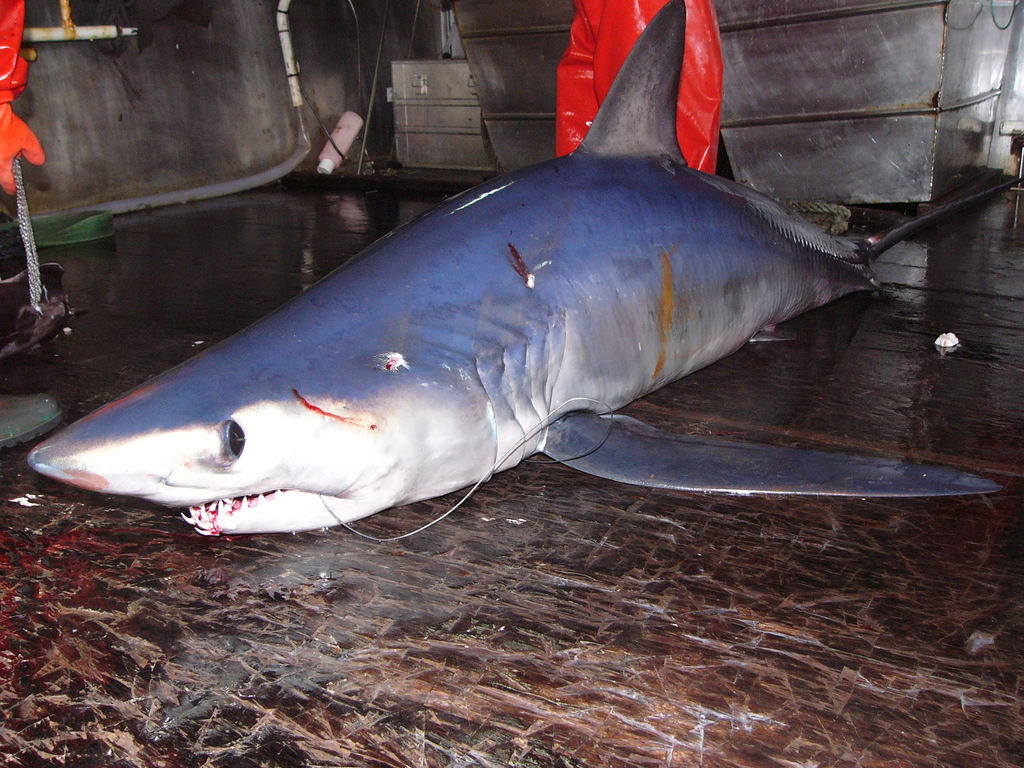
Longfin Mako
Isurus paucus
The longfin mako shark (Isurus paucus) is a species of mackerel shark in the family Lamnidae, with a probable worldwide distribution in temperate and tropical waters. An uncommon species, it is typically lumped together under the name "mako" with its better-known relative, the shortfin mako shark (I. oxyrinchus). The longfin mako is a pelagic species found in moderately deep water, having been reported to a depth of 220 m (720 ft). Growing to a maximum length of 4.3 m (14 ft), the slimmer build and long, broad pectoral fins of this shark suggest that it is a slower and less active swimmer than the shortfin mako.
Longfin mako sharks are predators that feed on small schooling bony fishes and cephalopods. Whether this shark is capable of elevating its body temperature above that of the surrounding water like the other members of its family is uncertain, though it possesses the requisite physiological adaptations. Reproduction in this species is aplacental viviparous, meaning the embryos hatch from eggs inside the uterus. In the later stages of development, the unborn young are fed nonviable eggs by the mother (oophagy). The litter size is typically two, but may be as many as eight. The longfin mako is of limited commercial value, as its meat and fins are of lower quality than those of other pelagic sharks; however, it is caught unintentionally in low numbers across its range. The International Union for Conservation of Nature has assessed this species as endangered due to its rarity, low reproductive rate, and continuing bycatch mortality.
From the article Longfin mako shark on Wikipedia (CC BY-SA), quoted section by section
Description
The longfin mako is the larger of the two mako and the second-largest species in its family (after the great white), reaching upwards of 2.5 m (8.2 ft) in length and weighing over 70 kg (150 lb); females grow larger than males. The largest reported longfin mako was a 4.3-metre-long (14 ft) female caught off Pompano Beach, Florida, in February 1984. Large specimens can scale over 200 kg (440 lb). This species has a slim, fusiform shape with a long, pointed snout and large eyes that lack nictitating membranes (protective third eyelids). Twelve to 13 tooth rows occur on either side of the upper jaw and 11–13 tooth rows are on either side of the lower jaw. The teeth are large and knife-shaped, without serrations or secondary cusps; the outermost teeth in the lower jaw protrude prominently from the mouth. The gill slits are long and extend onto the top of head. The pectoral fins are as long or longer than the head, with a nearly straight front margin and broad tips. The first dorsal fin is large with a rounded apex, and is placed behind the pectoral fins. The second dorsal and anal fins are tiny. The caudal peduncle is expanded laterally into strong keels. The caudal fin is crescent-shaped, with a small notch near the tip of the upper lobe. The dermal denticles are elliptical, longer than wide, with three to seven horizontal ridges leading to a toothed posterior margin. …
Range & habitat
Widely scattered records suggest that the longfin mako shark has a worldwide distribution in tropical and warm-temperate oceans; the extent of its range is difficult to determine due to confusion with the shortfin mako. In the Atlantic Ocean, it is known from the Gulf Stream off the East Coast of the United States, the Caribbean, and southern Brazil in the west, and from the Iberian Peninsula to Ghana in the east, possibly including the Mediterranean Sea and Cape Verde. In the Indian Ocean, it has been reported from the Mozambique Channel. In the Pacific Ocean, it occurs off Japan and Taiwan, northeastern Australia, a number of islands in the Central Pacific northeast of Micronesia, and southern California. An inhabitant of the open ocean, the longfin mako generally remains in the upper mesopelagic zone during the day and ascends into the epipelagic zone at night. Off Cuba, it is most frequently caught at a depth of 110–220 m (360–720 ft) and is rare at depths above 90 m (300 ft). Off New South Wales, most catches occur at a depth of 50–190 m (160–620 ft), in areas with a surface temperature around 20–24 °C (68–75 °F).
Wikipedia: “Distribution and habitat”
What it does
The biology of the longfin mako is little-known; it is somewhat common in the western Atlantic and possibly the central Pacific, while in the eastern Atlantic, it is rare and outnumbered over 1,000-fold by the shortfin mako in fishery landings. The longfin mako's slender body and long, broad pectoral fins evoke the oceanic whitetip shark (Carcharhinus longimanus) and the blue shark (Prionace glauca), both slow-cruising sharks of upper oceanic waters. This morphological similarity suggests that the longfin mako is less active than the shortfin mako, one of the fastest and most energetic sharks. Like the other members of its family, this species possesses blood vessel countercurrent exchange systems called the rete mirabilia (Latin for "wonderful net", singular rete mirabile) in its trunk musculature and around its eyes and brain. This system enables other mackerel sharks to conserve metabolic heat and maintain a higher body temperature than their environments, though whether the longfin mako is capable of the same is uncertain. The longfin mako has large eyes and is attracted to cyalume sticks (chemical lights), implying that it is a visual hunter. Its diet consists mainly of small, schooling bony fishes and squids. …
Wikipedia: “Biology and ecology”
Where it lives
Recorded sightings
—
geo-referenced records in GBIF, from museums, herbaria and field observers.
Drag the globe to turn it. Dots are where records exist, not a range map; darker means more records.
In the stacks
Searching the stacks…
Every page naming Isurus paucus in the Biodiversity Heritage Library →
This page is assembled live from iNaturalist, GBIF, Wikipedia, the Source Library and the Internet Archive. It is not yet part of the hand-edited codex. iNaturalist taxon 103571.