- Animals
- ›Chordates
- ›Vertebrates
- ›Ray-finned Fishes
- ›Herrings
- ›Clupeoidei
- ›River Sprats
- ›Asian freshwater herrings
- ›Clupeonella
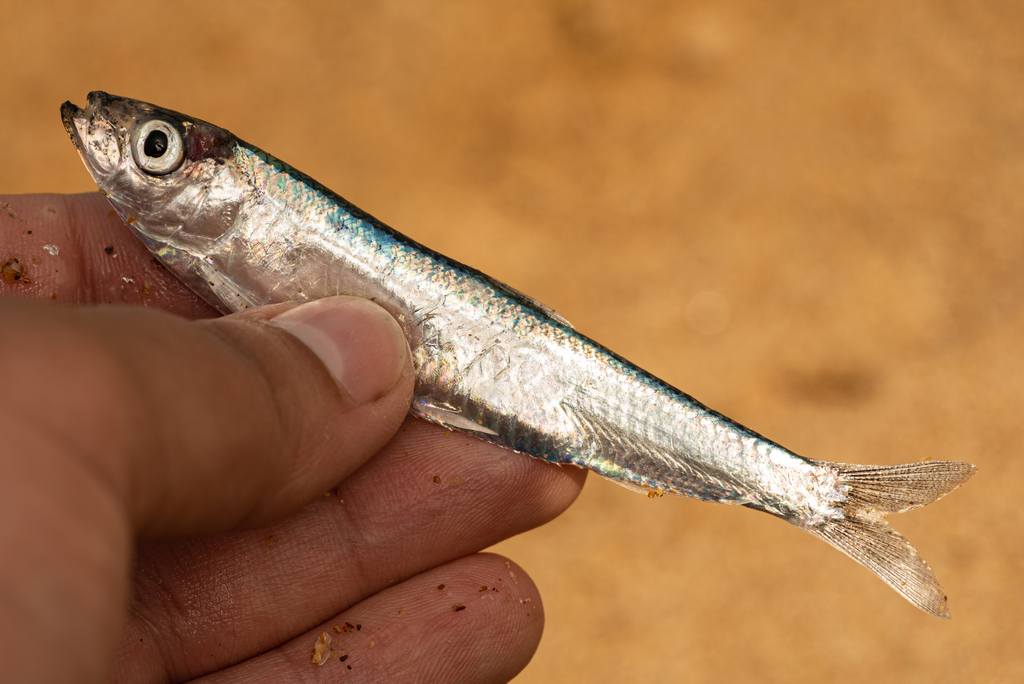
Anchovy Sprat
Clupeonella engrauliformis
Anchovy sprat, Clupeonella engrauliformis, is a species of fish in the family Clupeidae. It is one of several species of Clupeonella found in the Central and Southern Caspian Sea. It lives pelagically in the central and southern parts of this brackishwater lake. It is typically 12 cm (4.7 in) long, and up to 16.5 cm (6.5 in) maximum. It may be found down to a depth of 78 m (256 ft).
The achovy sprat was first described by ichthyologist N. A. Borodin in 1904 under the name Clupea engrauliformis. The holotype is 124 mm in length, was caught near Cape Buynak in the Caspian Sea and is stored in the Zoological Institute of the Russian Academy of Sciences.
From the article Anchovy sprat on Wikipedia (CC BY-SA), quoted section by section
Description
The maximum body length is 16.5 cm, with a mass up to 26 g. The body of the fish is elongated and low, with its height comprising 16-19% of the body length. The scales easily fall off. Its head is short and wide, with the interorbital distance being 16-18% of the body length and a small mouth. The abdomen of the achovy sprat is rounded with a keel, in which there are 23-31 keeled scales. There are 56-67 gill rakers. the dorsal fin has 13-21 soft rays with the first three being unbranched. the anal fin has 18-22 soft rays with the first three also unbranched. The tail fin is almost black and strongly notched. The edges of the pectoral fins are pointed. The back is dark with a greenish tint. Females are usually slightly larger than males.
What it does
The basis of its diet consists of copepods, and it feeds on zooplankton during the daytime, especially Eurytemora grimmi. To a lesser extent it consumes cladocerans, mysids and mollusk larvae. Its natural enemies are Brazhnikov's shad (Alosa braschnikowi), Caspian seal and sturgeons.
Wikipedia: “Diet”
Where it lives
Recorded sightings
—
geo-referenced records in GBIF, from museums, herbaria and field observers.
Drag the globe to turn it. Dots are where records exist, not a range map; darker means more records.
In the stacks
Searching the stacks…
Every page naming Clupeonella engrauliformis in the Biodiversity Heritage Library →
This page is assembled live from iNaturalist, GBIF, Wikipedia, the Source Library and the Internet Archive. It is not yet part of the hand-edited codex. iNaturalist taxon 611779.