- Animals
- ›Chordates
- ›Vertebrates
- ›Ray-finned Fishes
- ›Spiny-rayed fishes
- ›Jacks, Flounders, Barracudas, and Allies
- ›Flatfishes
- ›Righteye Flounders
- ›Microstominae
- ›Glyptocephalus
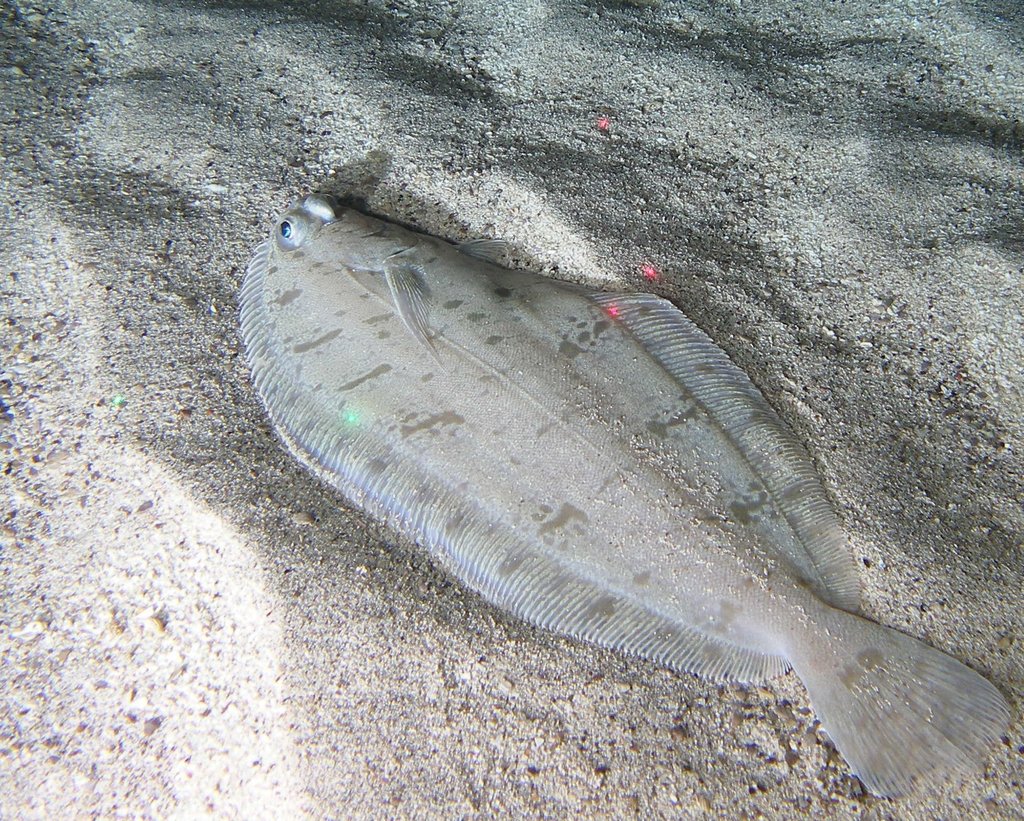
Rex Sole
Glyptocephalus zachirus
The rex sole (Glyptocephalus zachirus) is a flatfish of the family Pleuronectidae. Locally, it may also be known as a witch or threadfin sole (due to the filamentous pelvic fin on the eyed surface). It is a demersal fish that lives in temperate waters on sand or mud bottoms at depths of up to 900 metres (3,000 ft), though it is most commonly found between 61 and 500 metres (200 and 1,640 ft). Its native habitat is the northern Pacific, from Baja California in Mexico up the coasts of the United States, British Columbia and Alaska, across the Bering Sea to the coast of Russia and the Sea of Japan. It is slow-growing, reaching up to 60 centimetres (24 in) in length (though its average length is 36 centimetres (14 in)), and it can weigh up to 2.0 kilograms (4.4 lb). Maximum reported lifespan is 24 years.
From the article Rex sole on Wikipedia (CC BY-SA), quoted section by section
Description
The rex sole is a right-eyed flounder with an elongate, oval-shaped body and a small mouth. Its upper surface is uniform in colour, light brown to grey, with small scales; its underside is off-white. The dorsal and ventral fins on the upper side are dark, and the pectoral fin is long and mostly black. The caudal fin is rounded. The lateral line is nearly straight.
What it does
The rex sole's diet consists of benthos invertebrates such as crustaceans, worms, shrimps and crabs.
Wikipedia: “Diet”
Where it lives
Recorded sightings
—
geo-referenced records in GBIF, from museums, herbaria and field observers.
Drag the globe to turn it. Dots are where records exist, not a range map; darker means more records.
In the stacks
Searching the stacks…
Every page naming Glyptocephalus zachirus in the Biodiversity Heritage Library →
This page is assembled live from iNaturalist, GBIF, Wikipedia, the Source Library and the Internet Archive. It is not yet part of the hand-edited codex. iNaturalist taxon 180030.