- Animals
- ›Chordates
- ›Vertebrates
- ›Ray-finned Fishes
- ›Spiny-rayed fishes
- ›Blennies, Damselfishes and Allies
- ›Damselfishes
- ›Typical Damselfishes and Anemonefishes
- ›Amphiprion
- ›Amphiprion percula
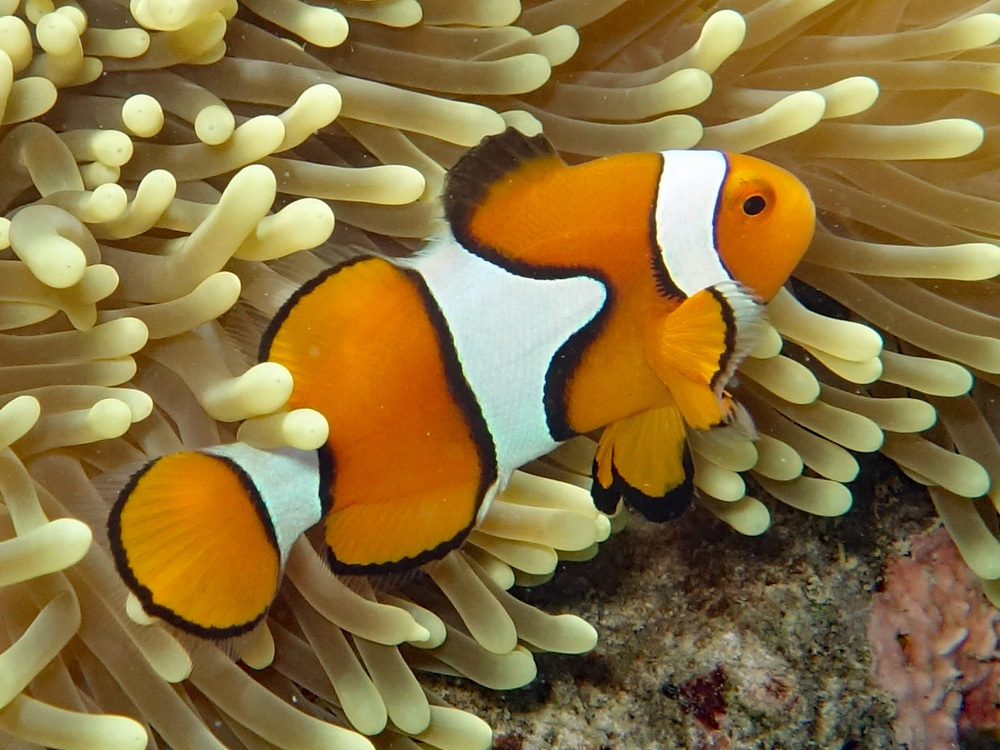
Percula Anemonefish
Amphiprion percula
The orange clownfish (Amphiprion percula) also known as percula clownfish and clown anemonefish, is widely known as a popular aquarium fish. Like other clownfishes (also known as anemonefishes), it often lives in association with sea anemones. A. percula is associated specifically with Heteractis magnifica and Stichodactyla gigantea, and as larvae use chemical cues released from the anemones to identify and locate the appropriate host species to use them for shelter and protection. This causes preferential selection when finding their anemone host species.
Although popular, maintaining this species in captivity is rather complex. The Great Barrier Reef Marine Park Authority regulates the number of collection permits issued to aquarium fish dealers who seek this, and other tropical fish within the Great Barrier Reef Marine Park.
From the article Orange clownfish on Wikipedia (CC BY-SA), quoted section by section
Description
Amphiprion percula can grow to be 11 cm (4.3 in) in length, but is on average 8 cm (3.1 in), and can be recognized by three white lines across their bright orange bodies, with no distinction in color between sexes. The anterior white bar is placed just behind the eye, the middle bar goes straight down the middle of the fish, and the posterior bar occurs near the caudal fin. An anterior projecting bulge also exists on the middle bar. In addition to the white coloring, black edging outlines each fin with varying thickness. This species can be mistaken for the similar species of clownfishes, A. ocellaris. This is known as the ocellaris clownfish and sometimes referred to as the "false percula clownfish" or "common clownfish" due to its similar color and pattern. The "easiest" way to distinguish the two species is the fact that A. percula has 10 spines in the first dorsal fin (rarely having 9) and A. ocellaris has 11 (rarely 10), which is a more reliable distinction than color patterns. A. ocellaris does not have thick black edging outlining the fins. Marine heatwaves are known for negatively effecting the growth patterns of species of vertebrates. To combat the heat stress, Orange clownfish are able to shrink their bodies. …
Range & habitat
Anemonefish are specialized coral reef fish that live within host anemones and are found in warmer waters in the Pacific and Indian Oceans, off northwest Australia, southeast Asia, and Japan. Both A. percula and the anemones reside in shallow waters and the depth usually does not exceed 12 m with water temperatures ranging between 25 and 28 °C. Host anemones, which are tube-like organisms that reside on coral reefs, are usually occupied by only one anemonefish species because one species outcompetes and exclude other species when they inhabit the same host anemone. Unless a significant size difference exists, two anemonefish species show aggression towards each other when trying to occupy the same host anemone. This is why the supply of nearby anemone hosts so strongly influences A. percula's ability to achieve recruitment and survival in general. A primary host anemone has an anemonefish at a high frequency and a secondary host anemone has one at a relatively low frequency. The distribution and availability of sea anemones is limited by the activity of photosynthesis of algae that occupy the anemones' tentacles. Secondary hosts are usually only used if a severe lack of available primary hosts exists. When many different species of anemonefishes occupy similar habitats, they tend to spread themselves out according to smaller microhabitats and available species of anemones. A. …
Wikipedia: “Habitat”
What it does
Since these fish live in a warm-water environment, they can reproduce all year long. Each group of fish consists of a breeding pair and none to four nonbreeders. Within each group there is a size-based hierarchy: the female is largest, the breeding male is second largest, and the male non-breeders get progressively smaller as the hierarchy descends. They exhibit protandry, meaning each fish is born male, but changes to female if the sole breeding female dies. If the female dies, the breeding male becomes the breeding female, and the largest nonbreeder becomes the breeding male. The spawning process is correlated with the lunar cycle. At night time the moon maintains a higher level of alertness in A. percula and this increases the interaction with the males and females. Before spawning, the male attracts the female via courting behaviour. These courting actions include extending their fins, biting the female and chasing her. The males also swim rapidly in an upward and downward motion to attract the females. The nest site is also important for the survival of the eggs. Depending on her size, the female spawns about 400–1500 eggs per cycle. The expected tenure of breeding females is roughly 12 years and is relatively long for a fish of its size, but is characteristic of other reef fish. Why the nonbreeders continue to associate with these groups has been unclear. …
Wikipedia: “Reproduction”
Where it lives
Recorded sightings
—
geo-referenced records in GBIF, from museums, herbaria and field observers.
Drag the globe to turn it. Dots are where records exist, not a range map; darker means more records.
In the stacks
Searching the stacks…
Every page naming Amphiprion percula in the Biodiversity Heritage Library →
This page is assembled live from iNaturalist, GBIF, Wikipedia, the Source Library and the Internet Archive. It is not yet part of the hand-edited codex. iNaturalist taxon 119391.