- Animals
- ›Chordates
- ›Vertebrates
- ›Ray-finned Fishes
- ›Spiny-rayed fishes
- ›Blennies, Damselfishes and Allies
- ›Damselfishes
- ›Typical Damselfishes and Anemonefishes
- ›Amphiprion
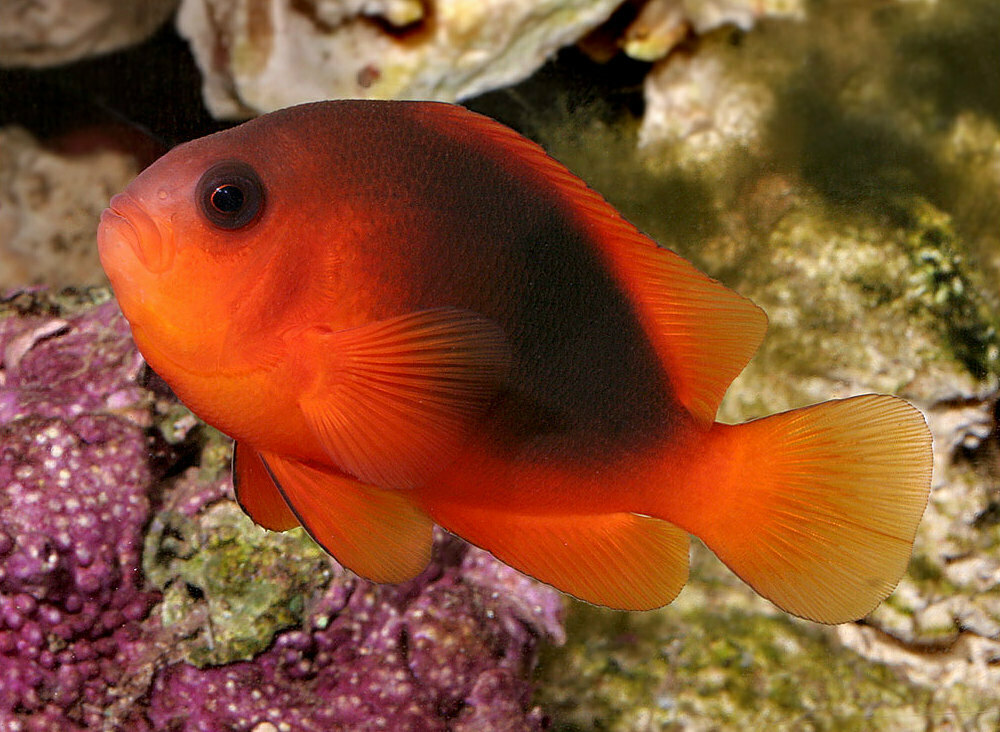
Red Saddleback Anemonefish
Amphiprion ephippium
The red saddleback anemonefish, Amphiprion ephippium, also known as the saddle anemonefish, is a marine fish belonging to the family Pomacentridae, the clownfishes and damselfishes.
From the article Red saddleback anemonefish on Wikipedia (CC BY-SA), quoted section by section
Description
Clownfish or anemonefish are fishes that, in the wild, form symbiotic mutualisms with sea anemones and are unaffected by the stinging tentacles of the host anemone, see Amphiprioninae § Mutualism. The sea anemone protects the clownfish from predators, as well as providing food through the scraps left from the anemone's meals and occasional dead anemone tentacles. In return, the clownfish defends the anemone from its predators, and parasites. Clownfish are small-sized, 10–18 centimetres (3.9–7.1 in), and depending on species, they are overall yellow, orange, or reddish or blackish color, and many show white bars or patches. Within species there may be color variations, most commonly according to distribution, but also based on sex, age and host anemone. Clownfish are found in warmer waters of the Indian and Pacific oceans and the Red Sea in sheltered reefs or in shallow lagoons. In a group of clownfish, there is a strict dominance hierarchy. The largest and most aggressive fish is female and is found at the top. Only two clownfish, a male and a female, in a group reproduce through external fertilization. Clownfish are sequential hermaphrodites, meaning that they develop into males first, and when they mature, they become females.
Wikipedia: “Characteristics of Anemonefish”
Range & habitat
A. ephippium is found in the Andaman and Nicobar Islands, Thailand, Malaysia, Sumatra, and Java. The original collection locality, Tranquebar is believed to be erroneous as it is outside the known range.
Host anemones. A. ephippium is associated with the following species of anemones:
Entacmaea quadricolor Bubble-tip anemone Heteractis crispa Sebae anemone
Wikipedia: “Distribution and habitat”
Where it lives
Recorded sightings
—
geo-referenced records in GBIF, from museums, herbaria and field observers.
Drag the globe to turn it. Dots are where records exist, not a range map; darker means more records.
In the stacks
Searching the stacks…
Every page naming Amphiprion ephippium in the Biodiversity Heritage Library →
This page is assembled live from iNaturalist, GBIF, Wikipedia, the Source Library and the Internet Archive. It is not yet part of the hand-edited codex. iNaturalist taxon 57754.