- Animals
- ›Chordates
- ›Vertebrates
- ›Ray-finned Fishes
- ›Spiny-rayed fishes
- ›Blennies, Damselfishes and Allies
- ›Damselfishes
- ›Chromis and Humbugs
- ›Dascyllus
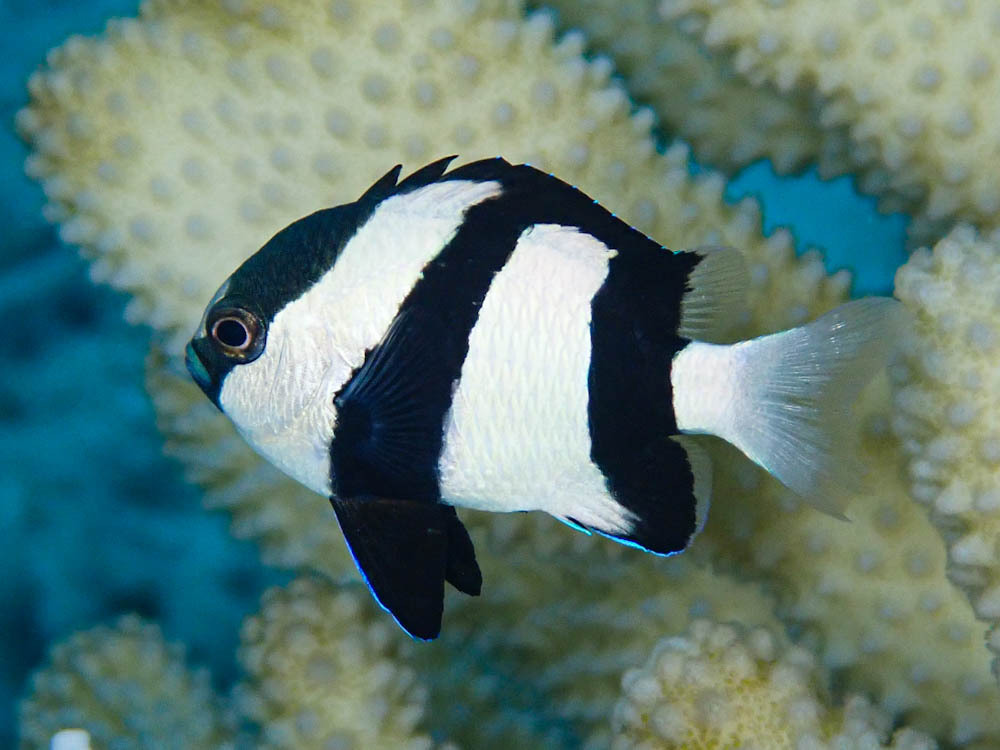
Humbug Dascyllus
Dascyllus aruanus
Dascyllus aruanus, known commonly as the whitetail dascyllus or humbug damselfish among other vernacular names, is a species of marine fish in the family Pomacentridae.
From the article Whitetail dascyllus on Wikipedia (CC BY-SA), quoted section by section
Description
Whitetail dascyllus is up to 10 centimetres (3.9 in) in length but its common size is 6 centimetres (2.4 in) and is white with three black vertical bars. It is morphologically identical to D. emamo, differing only in the sounds they make and their geographic distribution. It also appears very similar to the closely related D. abudafur. It may also be mistaken for D. melanurus, which has four black stripes instead of three. They have a small mouth, a flat spine, a black and white body with a large white spot between the eyes. In the first year of life, the damselfish grows to be about 6 centimeters. However, it is fully grown by the end of its second year and remains at around 10 centimeters for another three to four years until it dies. The colors remain the same throughout their lives and serve multiple purposes. It has been hypothesized that the bold contrast of black and white attract fish of the same species, yet display as a sign of their host coral's toxicity to potential predators.
Range & habitat
Associated with coral reefs, most usually in groups above Acropora coral heads. The black and white damselfish maintains a symbiotic relationship with its coral reef through exchange of nutrients for shelter. As planktivores, the humbug acts as a "gardener" by grazing on unwanted algae and excreting its waste in the form of phosphate and ammonium. In return, they can use the coral reef for protection and shelter, leaving only when necessary. To remain in the safety of the reef, the humbug will feed on waste and small prey nearby.
Wikipedia: “Habitat”
What it does
As a group that will stay at the same coral reef for their entire life, Dascyllus aruanus is very aggressive when it comes to their territory. All resources are heavily guarded and any unfamiliar species is seen as a threat. Living in a coral reef in shallow waters can make protection a full time job for some of these fish, making them extremely observant and wary. Some individuals are more aggressive than others, making an attack first response rather than observing for warning signs. As a species residing in shallow waters, there are multiple species of fish that come across the damselfish habitat. The humbug recognizes individuals of its own species by the dominant color pattern of the black stripes rather than movement. The social behaviors of the damselfish begin at a very young age. Juveniles stay in their schools and heavily rely on each other at all times. Communication in these groups is used for warning signals when threats come across or when food is available around the shelter. Similar to adults, juveniles remain close to their home at all times and will retreat at any sign of danger. Hierarchies are also used in these schools with an early establishment of dominance based on size. Larger fish (males and females) lead the foraging groups and get first priority of food, which usually corresponds to larger size prey. …
Wikipedia: “Behavior”
In human culture
They are called aquarium 'Starter fish' as they are quite tolerant of variable conditions and aid in conditioning the tank environment for less hardy fish. These fish have been reared in captivity. They can be territorial with other fish. The adult is quite aggressive.
Wikipedia: “In aquaculture”
Where it lives
Recorded sightings
—
geo-referenced records in GBIF, from museums, herbaria and field observers.
Drag the globe to turn it. Dots are where records exist, not a range map; darker means more records.
In the stacks
Searching the stacks…
Every page naming Dascyllus aruanus in the Biodiversity Heritage Library →
This page is assembled live from iNaturalist, GBIF, Wikipedia, the Source Library and the Internet Archive. It is not yet part of the hand-edited codex. iNaturalist taxon 952775.