- Animals
- ›Chordates
- ›Vertebrates
- ›Ray-finned Fishes
- ›Spiny-rayed fishes
- ›Butterflyfishes, Angelfishes, and Allies
- ›Seabreams and Porgies
- ›Pterogymnus
Panga
Pterogymnus laniarius
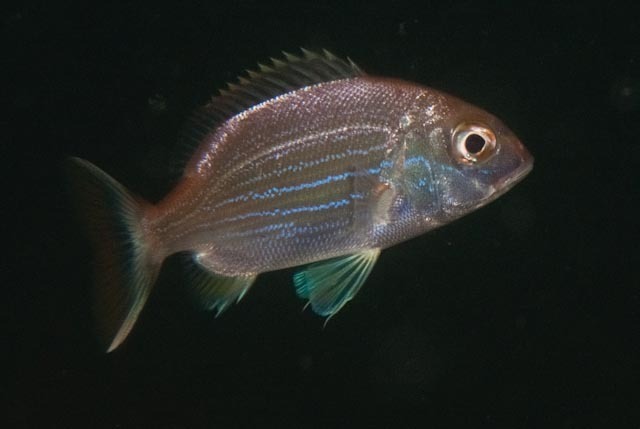
Panga is the common South African name for Pterogymnus laniarius, a small, ocean-dwelling fish, native to the southeast Atlantic Ocean and southwest Indian Ocean. Alternatively called "torpedo scads", they are cold-blooded with white flesh. Their scales are generally pink in color with whitish underbelly and blue-green stripes running laterally along their sides.
From the article Panga on Wikipedia (CC BY-SA), quoted section by section
Description
The panga has the area between the eyes and the flange on the preoperculum scaled. The lower jaw has 2 rows of molar-like teeth. The dorsal fin has 12 spines and 10 soft rays while the anal fin has 3 spines and 8 soft rays. There is a scaly sheath at the base of the soft rayed parts of both the dorsal and anal fin but no scales on the soft rayed part of these fins. The compressed body is ovoid in shape with a depth that fits into its standard length 2.3 to 2.5 times. The dorsal profile of the head is smoothly convex and the eye is large with the rear edge of the preorbital bone having a wave-like shape and is not covered by the scales of the cheek. The overall colour of the body is red or pink, lighter in colour on the lower body, with 5 or 6 indistinct bluish, horizontal lines underneath the lateral line. This species has a maximum total length of 45 cm (18 in), although 27 cm (11 in) is more typical.
Range & habitat
The panga is endemic to South Africa where it occurs in the southeastern Atlantic Ocean in False Bay in the Western Cape to Beira, Mozambique in the southwestern Indian Ocean. This species is found mostly on deep, low. topographically complex reefs and sometimes over areas of mud and sand as deep as 120 m (390 ft).
Wikipedia: “Distribution and habitat”
In human culture
The panga has the genus name Pterogymnus which combines ptero, meaning "fin", and gymnus, meaning "naked", a reference to the lack of scales on the soft rayed parts of the dorsal and anal fins, when compared to Cymatoceps. The specific name, laniarius, means "butcher" or "pertaining to butchers", an allusion Valenciennes did not explain.
Wikipedia: “Etymology”
Where it lives
Recorded sightings
—
geo-referenced records in GBIF, from museums, herbaria and field observers.
Drag the globe to turn it. Dots are where records exist, not a range map; darker means more records.
In the old herbals & bestiaries


In the stacks
Searching the stacks…
Every page naming Pterogymnus laniarius in the Biodiversity Heritage Library →
This page is assembled live from iNaturalist, GBIF, Wikipedia, the Source Library and the Internet Archive. It is not yet part of the hand-edited codex. iNaturalist taxon 446437.