- Animals
- ›Chordates
- ›Vertebrates
- ›Ray-finned Fishes
- ›Spiny-rayed fishes
- ›Perches, Scorpionfishes, Sticklebacks, and Allies
- ›Eelpouts and allies
- ›Gunnels
- ›Pigmented Gunnels
- ›Pholis
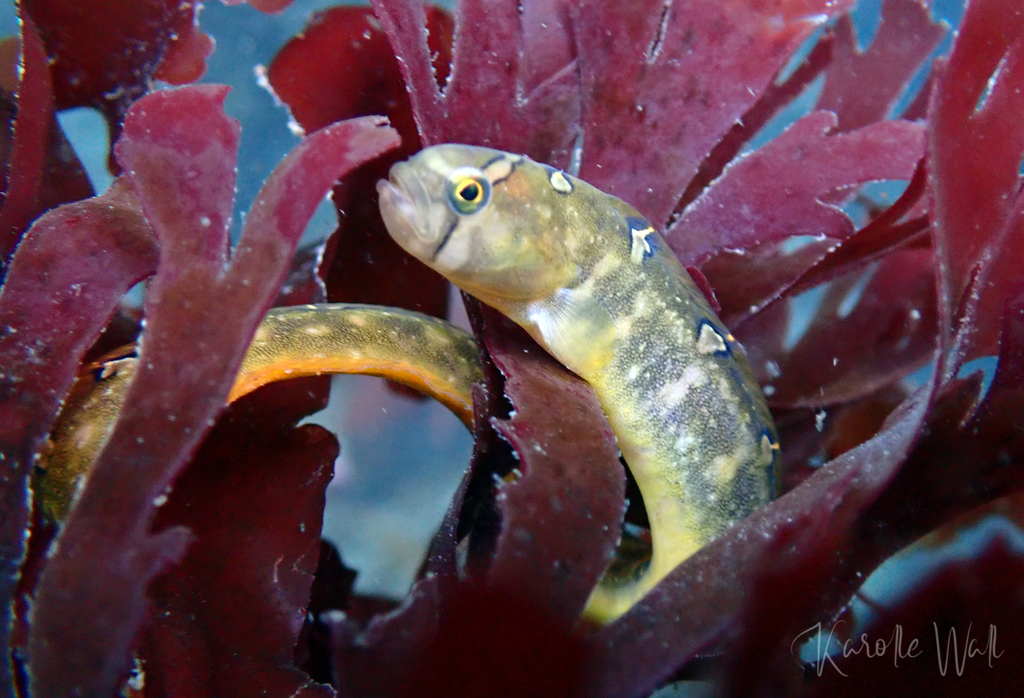
Crescent Gunnel
Pholis laeta
The crescent gunnel (Pholis laeta), also known as the bracketed blenny, is a species of marine ray-finned fish belonging to the family Pholidae, the gunnels. This fish occurs in the shallow coastal waters of the eastern North Pacific Ocean.
From the article Crescent gunnel on Wikipedia (CC BY-SA), quoted section by section
Description
Pholis laeta, like other gunnels, is somewhat eel-like. It grows to a maximum total length of 25 cm (9.8 in). The dorsal fin contains between 74 and 80 spines and the anal fin contains 35 to 37. soft rays. The caudal fin is rounded and the pelvic fins are tiny. There are two rows of blackish crescent-shaped markings each with a yellow spot in their centers along the back, and these identify this species from other gunnels. The overall color of the body may vary from orange-brown to olive-green, the color being camouflage and color phases vary with habitat.
Range & habitat
The crescent gunnel is found in the eastern Pacific along the western coast of North America from the Bering Sea coast of Alaska through the Aleutian Islands south as far as Crescent City in northern California. Pholis laeta lives in shallow, marine areas. It may also be found out of water under seaweed or rocks. It is known to live in the demersal zone at depths of up to 73 metres. This fish is common in such habitats as tide pools and in intertidal environments and may be found under rocks that are protected by seaweed.
Wikipedia: “Distribution and habitat”
Where it lives
Recorded sightings
—
geo-referenced records in GBIF, from museums, herbaria and field observers.
Drag the globe to turn it. Dots are where records exist, not a range map; darker means more records.
In the stacks
Searching the stacks…
Every page naming Pholis laeta in the Biodiversity Heritage Library →
This page is assembled live from iNaturalist, GBIF, Wikipedia, the Source Library and the Internet Archive. It is not yet part of the hand-edited codex. iNaturalist taxon 67362.