- Animals
- ›Chordates
- ›Vertebrates
- ›Ray-finned Fishes
- ›Spiny-rayed fishes
- ›Perches, Scorpionfishes, Sticklebacks, and Allies
- ›Eelpouts and allies
- ›Gunnels
- ›Pigmented Gunnels
- ›Pholis
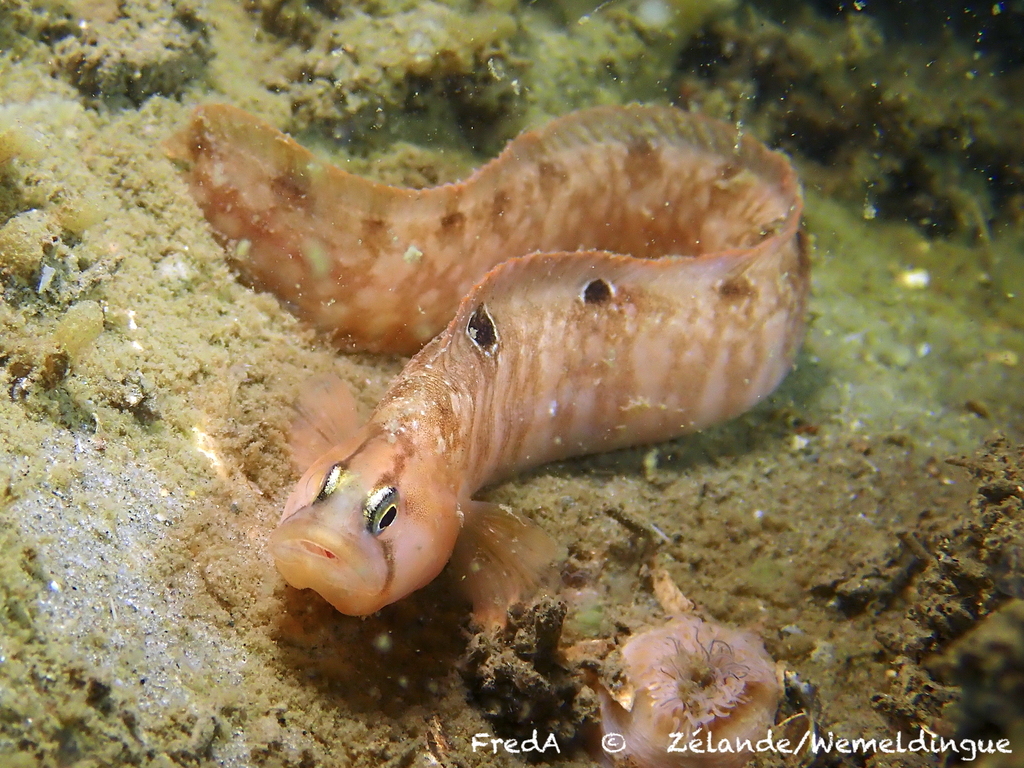
Rock Gunnel
Pholis gunnellus
The rock gunnel or Butterfish(Pholis gunnellus) is an eel-like fish found in the intertidal and subtidal zones of the North Atlantic. It is one of two species of gunnel native to the Atlantic Ocean, the other being the banded gunnel. The rock gunnel is capable of remaining above the waterline at low tide and breathing air.
From the article Rock gunnel on Wikipedia (CC BY-SA), quoted section by section
Description
The rock gunnel is often mistaken for an eel due to its flattened, elongated body. Fully grown adults can reach 30 cm in length. A long dorsal fin spans the body from just behind the head, supported by soft spiny rays. Its anal fin begins roughly midway along the body. The head is rather small with its lower jaw protruding and mouth turned upwards. Coloration is highly variable, ranging from hues of yellow-green to brown to crimson. A row of 9–13 dark spots, each surrounded by a pale ring, lines the dorsal fin. The butterfish has a maximum published standard length of 25 cm (9.8 in).
Range & habitat
The rock gunnel is found in the coastal waters of North America and Europe. It ranges from Labrador and Greenland to Delaware Bay in the West Atlantic, and from the Kanin Peninsula to the Bay of Biscay in the East Atlantic. Within its range it is found from the intertidal zone to depths of over 100 m. The rock gunnel uses habitat sheltered by rocks and algae both above and below the waterline, likely to protect it from its natural predators, which include seabirds, fish, and marine mammals.
Wikipedia: “Distribution and habitat”
What it does
The rock gunnel may remain above the waterline at low tide, sheltered beneath rocks and algae, and can breathe air if necessary. They are frequently encountered on rocky shorelines, and splash around noticeably when uncovered. Within its North American range, the rock gunnel disappears from the intertidal during winter, likely to avoid freezing air temperatures. Their diet is made up of small crustaceans, polychaetes, mollusks and the eggs of fish. The female lays the eggs in a large mass on the seabed and this is closely guarded until the larvae hatch. The butterfish spawns from November to January, the female laying between 80 and 200 eggs in a ball-like mass placed beneath a stone or in the empty shell of a bivalve.
Wikipedia: “Behavior”
Where it lives
Recorded sightings
—
geo-referenced records in GBIF, from museums, herbaria and field observers.
Drag the globe to turn it. Dots are where records exist, not a range map; darker means more records.
In the stacks
Searching the stacks…
Every page naming Pholis gunnellus in the Biodiversity Heritage Library →
This page is assembled live from iNaturalist, GBIF, Wikipedia, the Source Library and the Internet Archive. It is not yet part of the hand-edited codex. iNaturalist taxon 152974.