- Animals
- ›Chordates
- ›Vertebrates
- ›Ray-finned Fishes
- ›Spiny-rayed fishes
- ›Wrasses and allies
- ›False scorpionfishes, wrasses, and parrotfishes
- ›Wrasses and Parrotfishes
- ›Hogfishes, Cales and Tuskfishes
- ›Cales and Weed Whitings
- ›Siphonognathus
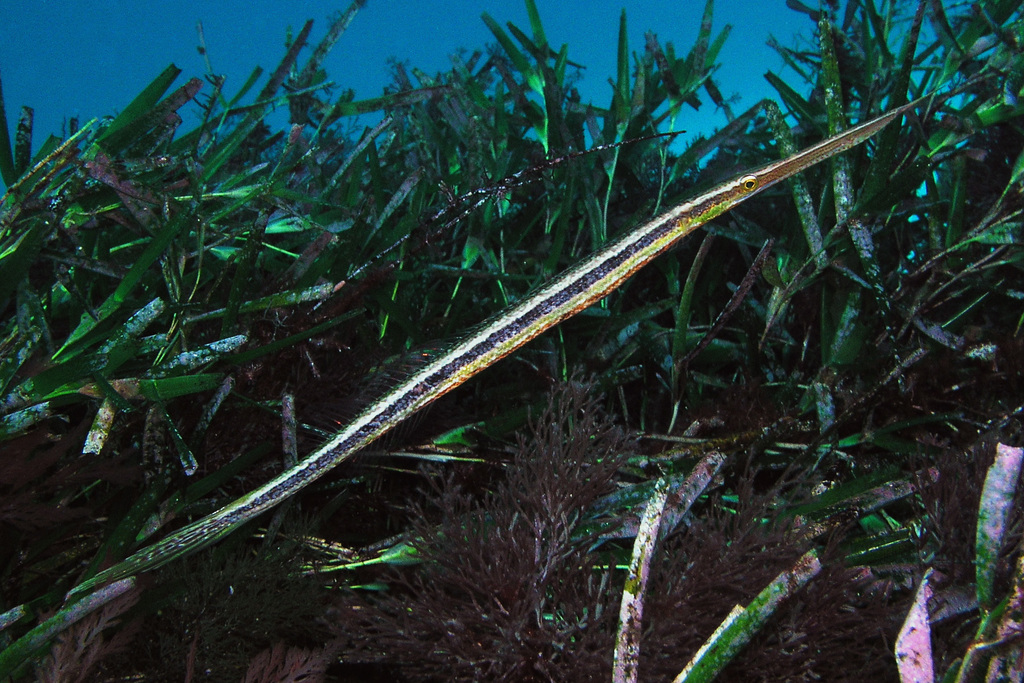
Tubemouth
Siphonognathus argyrophanes
The tubemouth (Siphonognathus argyrophanes) is a species of ray-finned fish, a weed whiting from the family Odacidae. It is endemic to the southern coatsts of Australia where it is camouflaged to live among beds of seagrass.
From the article Tubemouth on Wikipedia (CC BY-SA), quoted section by section
Description
The tubemouth has a highly elongated head and body and has a fleshy barbel which protrudes from the end of the upper lip. It has many teeth fused into a beak-like structure. The long-based dorsal fin is low and the shorter anal fin sits below the posterior third of the dorsal fin. It has a long and pointed caudal fin but lacks pelvic fins. It is green on the back, whitish to red-brown ventrally and has a dark stripe along the flanks. It can attain a standard length of 40 centimetres (16 in).
Range & habitat
The tubemouth is endemic to southern Australia where it can be found from Geraldton in Western Australia southwards and then along the southern coast of Australia to the Gippsland Lakes in Victoria and Tasmania.
Wikipedia: “Distribution”
Where it lives
Recorded sightings
—
geo-referenced records in GBIF, from museums, herbaria and field observers.
Drag the globe to turn it. Dots are where records exist, not a range map; darker means more records.
In the stacks
Searching the stacks…
Every page naming Siphonognathus argyrophanes in the Biodiversity Heritage Library →
This page is assembled live from iNaturalist, GBIF, Wikipedia, the Source Library and the Internet Archive. It is not yet part of the hand-edited codex. iNaturalist taxon 112704.