- Animals
- ›Chordates
- ›Vertebrates
- ›Ray-finned Fishes
- ›Carps, Characins, Catfishes and Allies
- ›Minnows, Suckers, Carps, and Loaches
- ›Carps and Minnows
- ›True Minnows
- ›Western Minnows
- ›Ptychocheilus
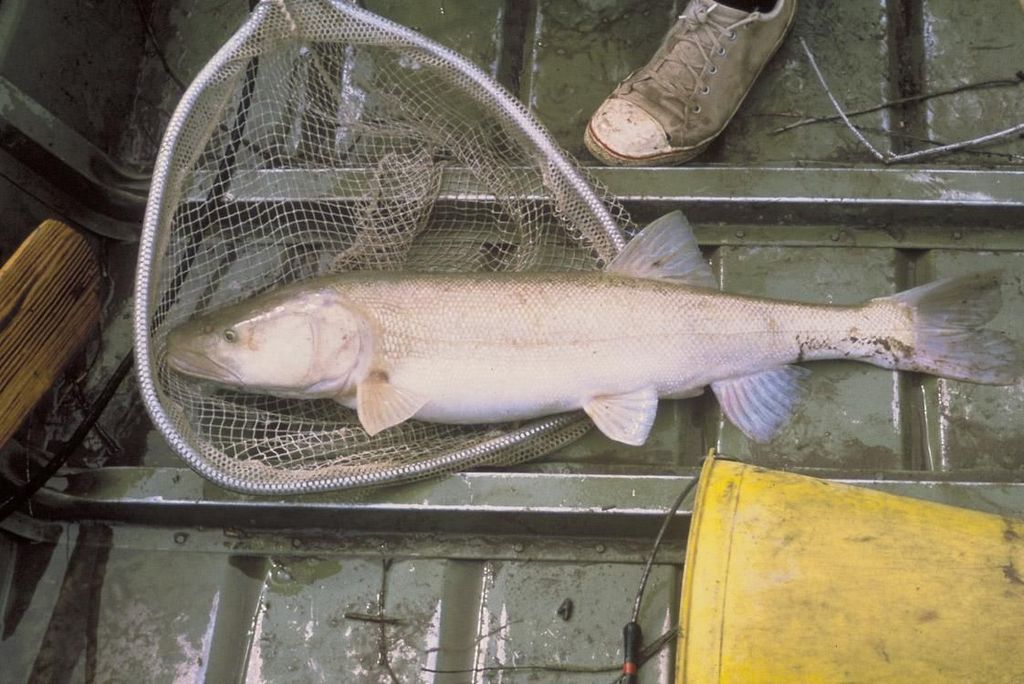
Colorado Pikeminnow
Ptychocheilus lucius
The Colorado pikeminnow (Ptychocheilus lucius), formerly known as the squawfish, is a species of freshwater ray-finned fish belonging to the family Leuciscidae, the daces, chubs, Eurasian minnows, and related species. This is one of the largest leuciscids of North America and one of the largest in the world, with reports of individuals up to 6 ft (1.8 m) long and weighing over 100 pounds (45 kg). Native to the Colorado River Basin of the Southwestern United States and adjacent Mexico, it was formerly an important food fish for both Native Americans and European settlers. Once abundant and widespread in the basin, its numbers have declined to where it has been extirpated from the Mexican part of its range and was listed as endangered in the US part in 1967, a fate shared by the three other large Colorado Basin endemic fish species - bonytail chub, humpback chub, and razorback sucker. The Colorado pikeminnow is currently listed as vulnerable by the IUCN, while its NatureServe conservation status is "critically imperiled".
From the article Colorado pikeminnow on Wikipedia (CC BY-SA), quoted section by section
Description
Like the other three species of pikeminnows, it has an elongated body reminiscent of the pike. The cone-shaped and somewhat flattened head is elongated, forming nearly a quarter of the body length. Color grades from bright olive green on the back to a paler yellowish shade on the flanks, to white underneath. Young fish also have a dark spot on the caudal fin. Both the dorsal and anal fins typically have 9 rays. The pharyngeal teeth are long and hooked. No teeth are in the jaw, however, and the lip folds back to create a fleshy mouth. The reports of 6 ft (2 m) individuals are estimates from skeletal remains, but a number of community elders, interviewed by the Salt Lake Tribune in 1994, reported that such individuals were once common. Catches in the 1960s ranged up to 60 cm (24 in) for 11-year-old fish, but by the early 1990s, maximum sizes reached no more than 34 cm (13 in). Biologists now consider the typical size of an adult pikeminnow to be between 4 and 9 pounds (1.8 and 4.1 kg), and reports of the fish lately exceeding 3 feet (0.91 m) in length are now in question.
Range & habitat
The species was once found throughout the Colorado Basin, so occurred in Arizona, California, Colorado, Nevada, New Mexico, Utah, and Wyoming, as well as in Mexico. Damming and habitat alterations have confined the species to the upper Colorado drainage; currently, remnant populations are known from the Green, Gunnison, White, San Juan, and Yampa Rivers. They have been transplanted to the Salt and Verde Rivers, both within their native range.
Wikipedia: “Range”
What it does
Young pikeminnows, up to 5 cm (2 in) long, eat cladocerans, copepods, and chironomid larvae, then shift to insects around 10 cm (4 in) long, gradually eating more fish as they mature. Once they achieve a length around 30 cm (12 in), they feed almost entirely upon fish. This fish has an ontogenetic separation of life history stage. The altricial young emerge from whitewater canyons, enter the drift as sac fry, and are transported downstream. Habitat for the young fish is predominately alongshore backwaters and associated shorelines of more alluvial reaches of the turbulent and turbid rivers of the Colorado system. In contrast, adults reside in more well-defined channels, where they seek eddy habitats and prey on suckers and minnows. Colorado pikeminnows are potamodromous, making freshwater spawning migrations to home in on their natal areas. These migrations can begin as upstream or downstream movements, depending on the location of home range of individuals, and may involve 100 kilometres (62 mi) or more. Spawning occurs around the summer solstice, with declining flows and increasing temperatures. Breeding males are bronze-colored and heavily covered with tubercles, while females are generally larger, lighter in color, and with fewer tubercles. …
Wikipedia: “Biology and reproduction”
Where it lives
Recorded sightings
—
geo-referenced records in GBIF, from museums, herbaria and field observers.
Drag the globe to turn it. Dots are where records exist, not a range map; darker means more records.
In the stacks
Searching the stacks…
Every page naming Ptychocheilus lucius in the Biodiversity Heritage Library →
This page is assembled live from iNaturalist, GBIF, Wikipedia, the Source Library and the Internet Archive. It is not yet part of the hand-edited codex. iNaturalist taxon 111223.