- Animals
- ›Chordates
- ›Vertebrates
- ›Ray-finned Fishes
- ›Spiny-rayed fishes
- ›Perches, Scorpionfishes, Sticklebacks, and Allies
- ›Scorpionfishes and Allies
- ›Typical Flatheads
- ›Platycephalus
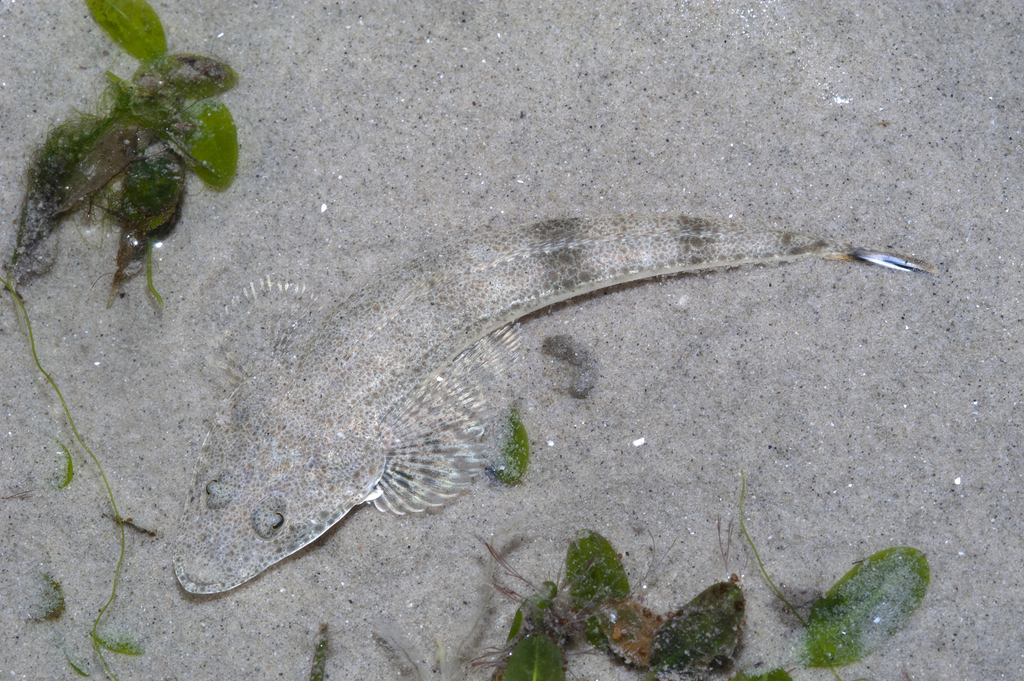
Bartail Flathead
Platycephalus indicus
The bartail flathead (Platycephalus indicus), also called bar-tailed flathead, bartail blenny, gobi, Indian flathead, or Indo-Pacific flathead, is the type species for the Platycephalus genus of fish. It is found in the Indian Ocean and western Pacific Ocean. The species has been recorded in the Mediterranean, having invaded as a Lessepsian migrant through the Suez Canal. However, although a number of specimens were caught in trawls in the late 1970s then none were caught until 2011,...
From the article Bartail flathead on Wikipedia (CC BY-SA), quoted section by section
Description
The bartail flathead has a depressed head that is smooth, apart from low parieto-occipital, scapular and preopercular ridges, which are neither spined nor serrated. There is a short, blunt spine in front of the eye. The preoperculum terminates in 2 strong, slightly upturned spines. There are canine like vomerine teeth, with a single obvious row of canine-like teeth on the palatine while the jaws have wide bands of villiform teeth. The first dorsal fin has a short separate first spine and a further 7-9 spines, the second dorsal fin has 13 soft rays, as does the anal fin. The rear margins of the second dorsal fin and anal fin have deep incisions in the membrane between the rays. The overall colour is brownish, there are 8 or 9 indistinct dusky bands across the back. The top of the head is finely mottled with more or less roundish spots each enclosed in a pale ring. the lower body is yellowish. the fins, other than the caudal fin, have rows of dusky spots on the fin rays while the caudal fin has a longitudinal black band in its middle, with 2 diagonal black bands above and below this. This species has a maximum published total length of 100 cm (39 in), although 60 cm (24 in) is more typical, and a maximum published weight of 3.5 kg (7.7 lb).
Range & habitat
The bartail flathead has a wide Indo-Pacific distribution from the Red Sea and the eastern coast of Africa east to the Philippines, north to Japan and south to Papua New Guinea. It was previously thought to occur in northern Australia but this population has now been recognised as a separate species P. australis. It is recorded on occasions in the Levantine waters of the Mediterranean Sea since 1953, a likely entry from the Suez Canal. The bartail flathead is found at depths between 20 and 200 m (66 and 656 ft) over sand and mud substrates, often close to reefs or seagrass beds, and the juveniles have been known to enter the freshwater reaches of rivers.
Wikipedia: “Distribution and habitat”
Where it lives
Recorded sightings
—
geo-referenced records in GBIF, from museums, herbaria and field observers.
Drag the globe to turn it. Dots are where records exist, not a range map; darker means more records.
In the stacks
Searching the stacks…
Every page naming Platycephalus indicus in the Biodiversity Heritage Library →
This page is assembled live from iNaturalist, GBIF, Wikipedia, the Source Library and the Internet Archive. It is not yet part of the hand-edited codex. iNaturalist taxon 109634.