- Animals
- ›Chordates
- ›Vertebrates
- ›Ray-finned Fishes
- ›Spiny-rayed fishes
- ›Perches, Scorpionfishes, Sticklebacks, and Allies
- ›Scorpionfishes and Allies
- ›Typical Flatheads
- ›Platycephalus
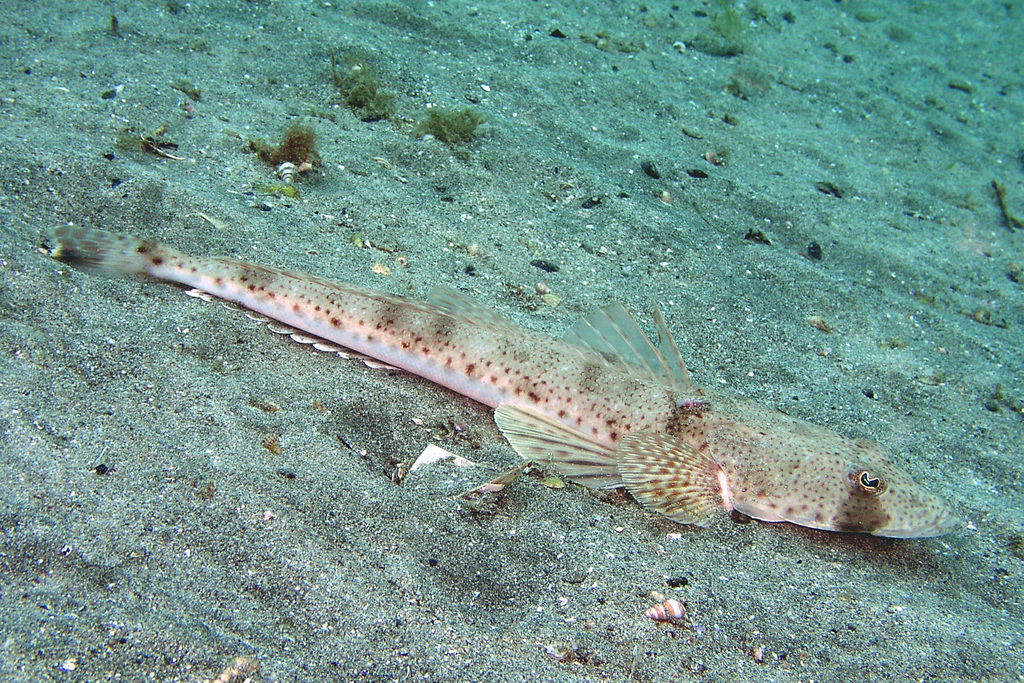
Southern Sand Flathead
Platycephalus bassensis
Platycephalus bassensis the Southern sand flathead, Bass flathead, bay flathead, common flathead, sand flathead, sandy, sandy flathead, slimy flathead or yanks, is a species of marine ray-finned fish belonging to the family Platycephalidae, the flatheads. It is endemic to Australia.
They are bottom dwellers and are popular for their use in fish and chips. They are the most commonly caught recreational species in Tasmania.
From the article Platycephalus bassensis on Wikipedia (CC BY-SA), quoted section by section
Description
Platycephalus bassensis has and elongated and slightly flattened body with a large, flattened head which is just under one-third of the standard length and which has two clear bony ridges to the rear of the eye. The eyes are large and have a small lappet on the iris. It has a large mouth with small canine like teeth in the jaws and a broad patch of vomerine teeth with a thin band of palatine teeth. There are two robust spines on the angle of the preoperculum with lower spine being around two times longer than the upper spine. The first dorsal fin is short based, has 8 or 9 spines with the first spine being very short and is separate. The second dorsal fin has a moderately long base with 13 or 14, typically 14, soft rays with the first rays being the longest. The anal fin has a similar shape and is opposite the second dorsal fin, has a slightly longer base and contains 14 soft rays. The caudal fin is truncate. This species has a maximum published total length of 55 cm (22 in) and a maximum published weight of at least 3.1 kg (6.8 lb). The overall colour is sandy to pale brownish with a scattering of small pale to dark spots. There are 2 or 3 vague bands posteriorly along the back and a whitish belly. There is an irregular blotch on the lower lobe of the caudal fin which is frequently interrupted by the pale fin rays, the upper lobe is marked with large brown spots or blotches.
Range & habitat
Platycephalus bassensis is endemic to southern Australia where it occurs from northern New South Wales to southwestern Western Australia, including around Tasmania. However, some authorities state that records west of the Great Australian Bight are misidentifications of P. westraliae. This species occurs on sandy, muddy or shelly substrates in shallow coastal bays down to depths of around 100 m (330 ft).
Wikipedia: “Distribution and habitat”
What it does
Platycephalus bassensis is an ambush predator which buries itself in the sediment feeding on fishes and large benthic crustaceans.
Wikipedia: “Diet”
Where it lives
Recorded sightings
—
geo-referenced records in GBIF, from museums, herbaria and field observers.
Drag the globe to turn it. Dots are where records exist, not a range map; darker means more records.
In the stacks
Searching the stacks…
Every page naming Platycephalus bassensis in the Biodiversity Heritage Library →
This page is assembled live from iNaturalist, GBIF, Wikipedia, the Source Library and the Internet Archive. It is not yet part of the hand-edited codex. iNaturalist taxon 516146.