- Animals
- ›Chordates
- ›Vertebrates
- ›Mammals
- ›Therians
- ›Placental Mammals
- ›Primates, Rodents, and Allies
- ›Rodents
- ›Mice, Rats, and Hamsters
- ›Muroids
- ›Nesomyids
- ›Pouched Mice and Rats
- ›Cricetomys
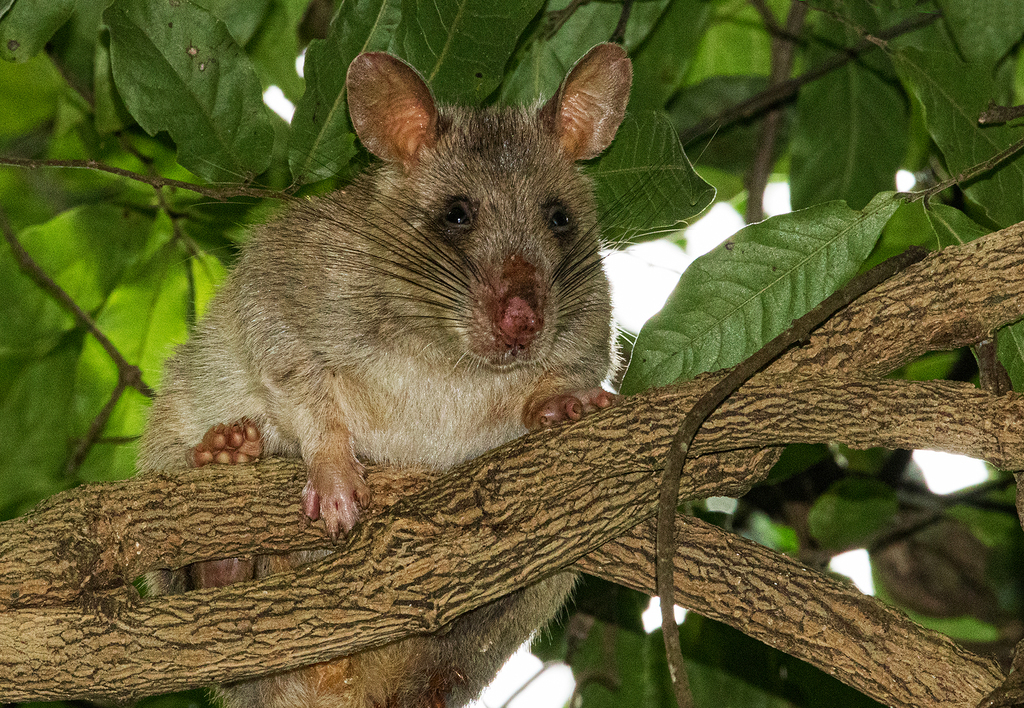
Southern Giant Pouched Rat
Cricetomys ansorgei
The southern giant pouched rat (Cricetomys ansorgei) is a species of rodent in the family Nesomyidae. It is distributed in the savannah of East and Southern Africa.
From the article Southern giant pouched rat on Wikipedia (CC BY-SA), quoted section by section
Description
The southern giant pouched rat is a large rodent, with males larger than females. Adult males typically weigh 1.5 to 2.0 kg (3.3 to 4.4 lb), while females weigh 1.2 to 1.6 kg (2.6 to 3.5 lb). The pouches for which these rats are named consist of oversized cheek-pouches, which they often use to transport large food-finds back to their burrows for storage. From their nose to the tip of their tail, these animals are approximately 70 to 80 cm (28 to 31 in) long. They have dark brown to reddish fur on their backs and a pale belly. The tail is bi-colored, brown with white at the distal third of the tail. Females have small litters, usually between 1–3 young at a time. Males scent mark using cheek and anogenital rubbing, as well as urine, and appear to preferentially mark unfamiliar locations.
Range & habitat
The southern giant pouched rat is widely distributed in mainly tropical regions of southern Africa, notably Zimbabwe, Kenya, Tanzania, Zambia, and the Democratic Republic of Congo.
Wikipedia: “Distribution”
Listen
Looking for field recordings…
Where it lives
Recorded sightings
—
geo-referenced records in GBIF, from museums, herbaria and field observers.
Drag the globe to turn it. Dots are where records exist, not a range map; darker means more records.
In the stacks
Searching the stacks…
Every page naming Cricetomys ansorgei in the Biodiversity Heritage Library →
This page is assembled live from iNaturalist, GBIF, Wikipedia, the Source Library and the Internet Archive. It is not yet part of the hand-edited codex. iNaturalist taxon 1453959.