On eBird ↗
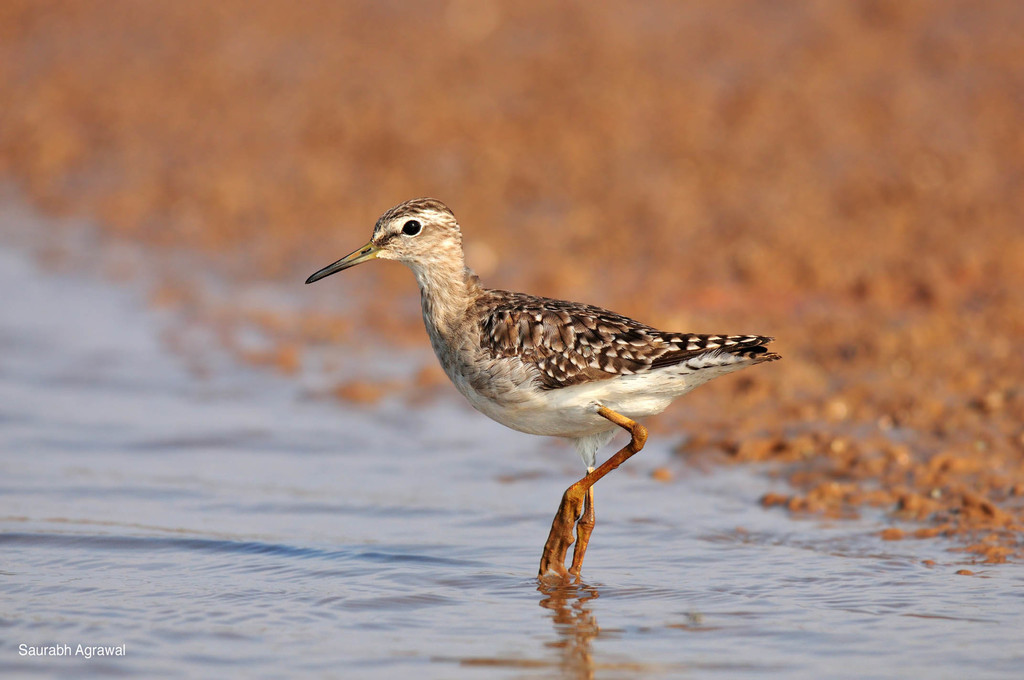
Wood Sandpiper
Live sightings near you, the range map, bar charts of when it is seen, and Macaulay Library photos and recordings.
Wood Sandpiper
Tringa glareola
The wood sandpiper (Tringa glareola) is a small wader. This Eurasian species is the smallest of the shanks, which are mid-sized long-legged waders of the family Scolopacidae. The genus name Tringa is the New Latin name given to the green sandpiper by Aldrovandus in 1599 based on Ancient Greek trungas, a thrush-sized, white-rumped, tail-bobbing wading bird mentioned by Aristotle. The specific glareola is from Latin glarea, " gravel".
From the article Wood sandpiper on Wikipedia (CC BY-SA), quoted section by section
Description
The wood sandpiper resembles a longer-legged, more delicate form of the aforementioned green sandpiper (T. ochropus), or a solitary sandpiper (T. solitaria), albeit with a shorter, finer bill, brown back and longer yellowish legs. The wood sandpiper differs from the green by having a smaller, less contrasting white rump-patch, while the solitary sandpiper has no rump-patch, at all. However, the wood sandpiper is not closely related to these two species; its closest relative is the common redshank (T. totanus), with which it shares a sister relationship with the marsh sandpiper (T. stagnatilis). These three species are a group of smallish shanks with red or yellowish legs, displaying a breeding plumage of subdued, light-brown above (with some darker mottling), and a pattern of somewhat smaller, diffuse, brownish spots on the breast and neck.
Range & habitat
The wood sandpiper breeds in subarctic wetlands, from the Scottish Highlands in the west, east across Eurasia and the Palearctic. They will migrate to Africa, South Asia (particularly India) and Australia. Vagrant birds have been seen as far into the Pacific as the Hawaiian Islands. In Micronesia, it is a regular visitor to Palau and the Mariana Islands, where flocks of up to 32 birds have been reported; it is observed and recorded on Kwajalein, Marshall Islands, approximately once each decade. The wood sandpiper is also encountered in the Western Pacific region of East Asia and some Western Pacific islands between mid-October and mid-May. A slight westward-expansion saw the establishment of a small resident breeding population in Scotland, beginning in the 1950s. This species is usually found in and around freshwater habitats during migration and wintering.
Wikipedia: “Distribution and habitat”
What it does
Mature wood sandpipers moult all of their primary feathers between August and December, whilst juvenile birds shed a varying number of outer primaries between December and April, much closer to their departure from Africa. Immature birds are also much more flexible than older birds regarding the timing (and rate) of their moult and refueling. Adults and immatures which accumulate fuel loads of c.50% of their lean body mass can potentially cross distances of 2397–4490 km in one non-stop flight.
Breeding. The wood sandpiper nests primarily on the ground, or will re-use an abandoned tree nest of another bird species, such as the fieldfare (Turdus pilaris). Four pale-green eggs are laid between March and May. These are incubated by both sexes beginning with the last egg. They hatch after 22 to 23 days. They are initially cared for by both parents but the female normally departs after a few days. The young can feed themselves. The young fledge when aged around 30 days.
Food and feeding. They forage for invertebrates by probing their bills in shallow water or into wet mud, such as lakeshores or riverbanks, and mainly eat aquatic insects, crustaceans, arthropods, various worms, and other small prey.
Wikipedia: “Behaviour and ecology”
Listen
Looking for field recordings…
Where it lives
Recorded sightings
—
geo-referenced records in GBIF, from museums, herbaria and field observers.
Drag the globe to turn it. Dots are where records exist, not a range map; darker means more records.
In the stacks
Searching the stacks…
Every page naming Tringa glareola in the Biodiversity Heritage Library →
This page is assembled live from iNaturalist, GBIF, Wikipedia, the Source Library and the Internet Archive. It is not yet part of the hand-edited codex. iNaturalist taxon 3888.