 NL·0297
Herbarium of the Nature Library
- Name
- Buceros rhinoceros
- Family
- Bucerotidae
- Native to
- Southern Thailand, Peninsular Malaysia, Sumatra, Java and Borneo; long extinct as a breeder in Singapore, with occasional wild wanderers recorded since 2025
- Habitat
- Tropical rainforest
On eBird ↗
Rhinoceros Hornbill
Live sightings near you, the range map, bar charts of when it is seen, and Macaulay Library photos and recordings.
Rhinoceros hornbill
Buceros rhinoceros
Also calledKenyalang (Iban) · Enggang (Malay)
A huge black-and-white hornbill crowned with an extravagant upturned orange-red casque, like a rhinoceros horn. It is the state bird of Sarawak, 'Land of the Hornbills', and a major disperser of rainforest seeds.
The rhinoceros hornbill is a large species of forest hornbill. In captivity, it can live for up to 35 years. It is found in lowland and montane, tropical and subtropical climates and in mountain rain forests up to 1,400 metres in the Malay Peninsula from southern Thailand; and the islands of Singapore, Borneo, Sumatra and Java. Wikipedia
What it can do
- iDisperses the large seeds of figs and other rainforest trees over wide areas
- iiFemale seals herself into a tree cavity nest, fed by the male
- iiiWingbeats are so loud they can be heard from a distance as a whooshing roar
In the field
Field marks
- aVery large black hornbill with white belly and white tail with a black band
- bMassive ivory-yellow bill topped by an orange-red casque curving upward like a horn
- cRed eye in males, white eye in females
- dLoud wing noise in flight
- Voice
- Deep, resonant 'gronk' calls; pairs duet with the male's lower notes and the female's higher ones
- Not to be confused with
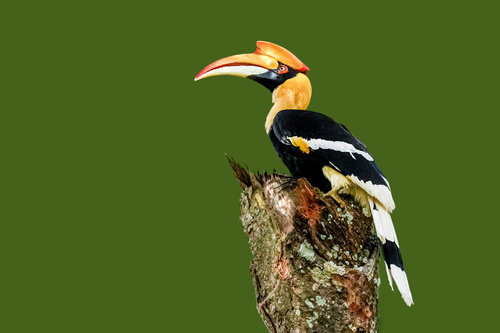
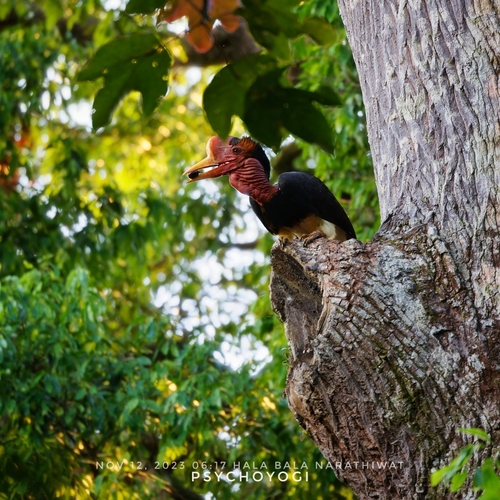
- Great hornbill has a flatter, yellow, two-pointed casque and a white neck; Helmeted hornbill has a short red casque and long central tail feathers.
- Where to see it
- Taman Negara (Malaysia), Kinabatangan River and Danum Valley (Sabah), Lambir Hills (Sarawak), Khao Sok (Thailand)
- When
- Resident year-round
Listen
Looking for field recordings…
Life & habits
- Diet
- Mainly figs and other fruit; also insects, lizards and small vertebrates
- Habitat
- Lowland and hill rainforest with large old trees
- Size
- About 80–120 cm long
Pairs fly between fruiting trees with loud, whooshing wingbeats; the sealed-in female relies on the male for months.
Where it lives
Recorded sightings
—
geo-referenced records in GBIF, from museums, herbaria and field observers.
Native range
Southern Thailand, Peninsular Malaysia, Sumatra, Java and Borneo; long extinct as a breeder in Singapore, with occasional wild wanderers recorded since 2025
Drag the globe to turn it. Dots are where records exist, not a range map; darker means more records.
In the old herbals & bestiaries
Woodcuts and engravings matched from the Source Library’s scanned books by name. Plates marked “relative” show a close kin rather than this exact species. Click a plate to read the page it came from, with translation.


In the stacks
Searching the stacks…
Every page naming Buceros rhinoceros in the Biodiversity Heritage Library →
Marginalia
Among the Iban of Sarawak, the kenyalang is the messenger of the upper world, and carved hornbill effigies were raised in the Gawai Kenyalang festival. The bird appears on Sarawak's coat of arms.
Curiosity
Its casque is mostly hollow and light, unlike the solid casque of the Helmeted hornbill.
Kinship

Fact-checked: 2 corrections made to this sheet. Photographs: iNaturalist contributors under the licences shown. Records: GBIF.org. Historical plates: Source Library (CC BY-SA 4.0; originals public domain). Summary text: Nature Library editors and Wikipedia (CC BY-SA). Medicinal and edibility notes are historical and educational, not advice. iNaturalist taxon 5532.