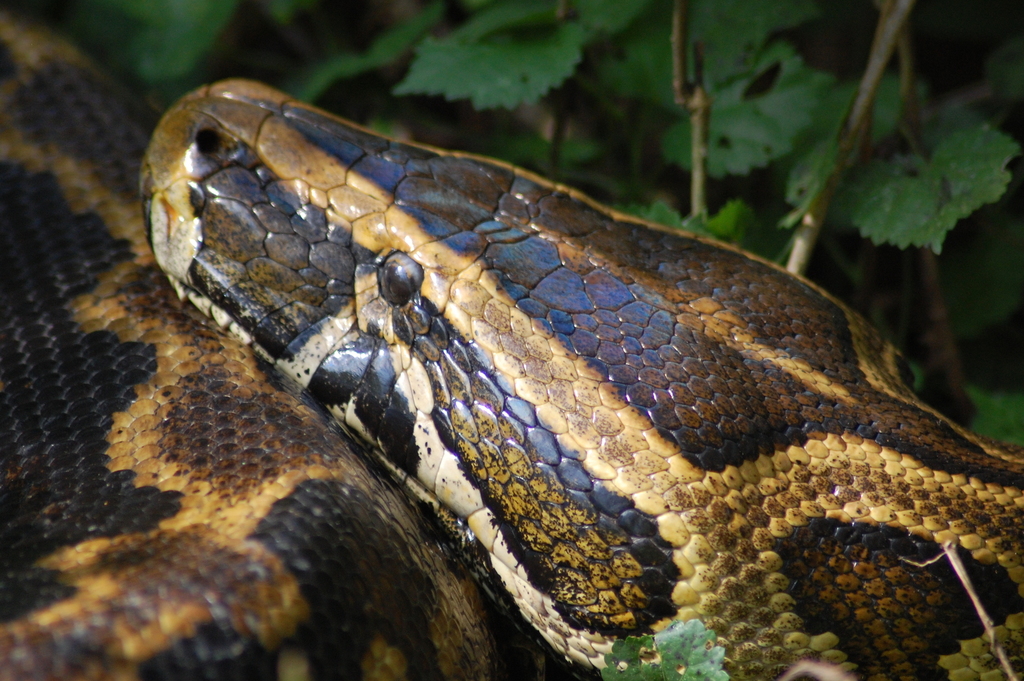
African Rock Python
Python sebae
The Central African rock python (Python sebae) is a species of large constrictor snake in the family Pythonidae. The species is native to sub-Saharan Africa. It is one of ten living species in the genus Python.
It is Africa's largest snake, and one of the eight largest snake species in the world, along with the green anaconda, reticulated python, Burmese python, Southern African rock python, Indian python, yellow anaconda and Australian scrub python. Specimens may approach or exceed 6 m (20 ft). The Southern African rock python is generally smaller than its northern relative and in general, the Central African rock python is regarded as one of the longest species of snake in the world. The snake is found in a variety of habitats, from forests to near deserts, although usually near sources of water. The snake becomes dormant during the dry season. The Central African rock python kills its prey by constriction and often eats animals up to the size of antelope, occasionally even crocodiles. The snake reproduces by egg-laying. Unlike most snakes, the female protects her nest and sometimes even her hatchlings.
From the article Central African rock python on Wikipedia (CC BY-SA), quoted section by section
Description
The Central African rock python is Africa's largest snake species and one of the world's largest. Adults measure 3 to 3.53 m (9 ft 10 in to 11 ft 7 in) in total length, with only unusually large specimens likely to exceed 4.8 m (15 ft 9 in). Reports of specimens over 6 m (19 ft 8 in) are considered reliable, although larger specimens have never been confirmed. Weights are reportedly in the range of 55 to 65 kg (121 to 143 lb) or more. Exceptionally large specimens weigh 91 kg (201 lb) or more. On average, large adults of Central African rock pythons are quite heavily built, perhaps more so than most specimens of the somewhat longer reticulated as well as Indian and Burmese pythons and far more so than the amethystine python, although the species is on average less heavily built than the green anaconda. The species may be the second heaviest living snake with some authors agreeing that it can exceptionally exceed 90 kg (200 lb). A large specimen considered authentic was shot in the Gambia and measured 7.5 m (24 ft 7 in).
The snake varies considerably in body size between different areas. In general, it is smaller in highly populated regions, such as in southern Nigeria, only reaching its maximum length in areas such as Sierra Leone, where the human population density is lower. …
Range & habitat
The Central African rock python occurs throughout much of tropical sub-Saharan Africa. It ranges across central and western Africa, from Senegal east to Ethiopia and Somalia and south to northern Angola and northern Tanzania. The Central African rock python inhabits a wide range of habitats, including forest, savanna, grassland, semidesert, and rocky areas. It is particularly associated with areas of permanent water, on the edges of swamps, lakes, and rivers. It also adapts to disturbed habitats around settlements, especially cane fields. In 2009, a Central African rock python was found in the Everglades. It is feared to be establishing itself as an invasive species alongside the already-established Burmese python. Feral rock pythons were also noted in the 1990s in the Everglades.
Wikipedia: “Distribution and habitat”
What it does
Like all pythons, the Central African rock python is non-venomous and kills by constriction. After gripping the prey, it coils around it, tightening its coils every time the victim breathes out. Death is thought to be caused by cardiac arrest rather than by asphyxiation or crushing. The Central African rock python mainly feeds on small antelopes, hyraxes, monkeys and occasionally waterbirds, monitor lizards and crocodiles. Poultry, dogs, goats and other livestock are eaten in suburban areas. Central African rock pythons may also prey on the cubs of lions, leopards and hyenas. In March 2017, a 3.9-m (12-ft 10-in) African rock python was filmed eating a large adult male spotted hyena weighing 70 kg (150 lb). This encounter suggests that the snake might very well be capable of hunting and killing larger and more dangerous animals than previously thought. The largest ever recorded meal of any snake was when a 4.9 m African Rock Python consumed a 59 kg impala.
Wikipedia: “Feeding”
In human culture
The Central African rock python was first described by Johann Friedrich Gmelin, a German naturalist, in 1789. It is one of ten species in the genus Python, large constricting snakes found in the moist tropics of Asia and Africa. The generic name Python is a Greek word referring to the enormous serpent at Delphi slain by Apollo in Greek mythology. The specific name sebae is a latinization of the surname of Dutch zoologist, Albertus Seba. Common name usage varies with the species referred to as the African rock python or simply the rock python.
Wikipedia: “Taxonomy and etymology”
Where it lives
Recorded sightings
—
geo-referenced records in GBIF, from museums, herbaria and field observers.
Drag the globe to turn it. Dots are where records exist, not a range map; darker means more records.
In the stacks
Searching the stacks…
Every page naming Python sebae in the Biodiversity Heritage Library →
This page is assembled live from iNaturalist, GBIF, Wikipedia, the Source Library and the Internet Archive. It is not yet part of the hand-edited codex. iNaturalist taxon 32152.