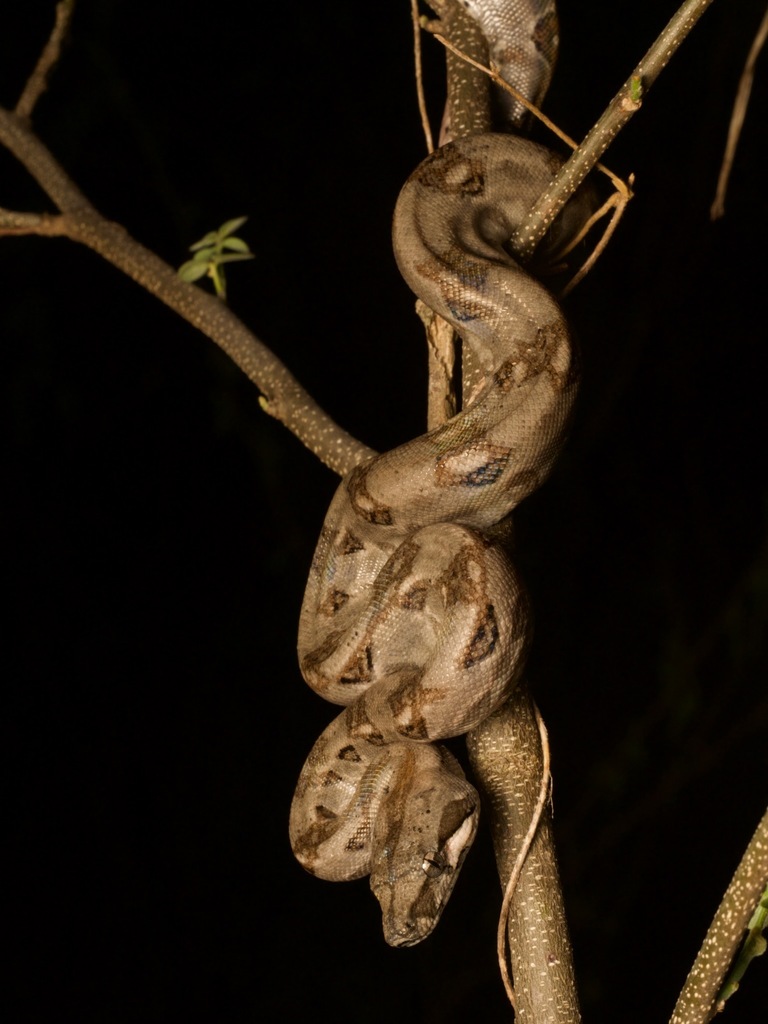
Central American Boa
Boa imperator
Boa imperator (or Boa constrictor imperator in common usage) is a large and heavy-bodied arboreal species of nonvenomous, constrictor-type snake in the family Boidae. One of the most popular pet snakes (often bred in captivity) in the world, B. imperator's native range is from Mexico through Central and South America (west of the Andes Mountains, mainly in Colombia), with local populations on several small Caribbean islands. It is commonly called the Central American boa, northern boa, Colombian boa (or Colombian red-tailed boa), common boa and common northern boa.
From the article Boa imperator on Wikipedia (CC BY-SA), quoted section by section
Description
Boa imperator is a wide-ranging species, living in both Central America and the northern parts of South America. As a result, the appearance of this snake varies greatly depending on the specific locality. As one of the smaller Boa species, they average between 1.3 m (4.2 ft.) and 2.5 m (8.2 ft.) in length when fully grown, but have been known to reach 3.7 m (12 ft.). They usually weigh around 6 kg (13 lb), although females are significantly larger than males. Lifespan in the wild is around 20–30 years, but 40 can be exceeded in captivity. Although Boa imperator exhibits almost identical patterns to Boa constrictor, this species often has a darker tail, usually dark brown or very dark red. They are, however, usually just as colorful as their counterparts and, like the larger boas, can be bred into a variety of different colors, given the right conditions to breed. Notably, the species is one of only two in snakes to have a confirmed XY sex chromosome system. One population, found on the Cayos Cochinos (Hog Islands) off the northern coast of Honduras, have evolved naturally hypomelanistic skin (containing reduced melanin), resulting in lighter-colored snakes; nonetheless, they retain the "signature" darkened tail-tip seen in the species, though the color of the tail may vary from salmon-pink to orange.
Another well-known locality of Boa imperator is the population from Nicarag …
Range & habitat
Boa imperator can be found in some regions of Mexico, Central America and northwestern Colombia, as well as several islands along the coasts of these areas. The type locality given is "l'Amerique meridionale, principalement au Mexique" (Central America, principally Mexico). Boa imperator prefers to live in rainforests due to humidity, temperature, cover from potential predators and ample prey.
Wikipedia: “Geographic range”
What it does
Boa imperator generally live on their own, and do not interact with any other snakes unless they want to mate. They are crepuscular, but they may bask during the day when night-time temperatures are too low. As semi-arboreal snakes, young Boa imperator may climb into trees and shrubs to forage; however, they become mostly terrestrial as they become older and heavier. Boa imperators strike when they perceive a threat. Their bite can be painful, especially from large snakes, but is rarely dangerous to humans. Specimens from Central America are more irascible, hissing loudly and striking repeatedly when disturbed, while those from South America tame down more readily. Like all snakes, Boa imperators in a shed cycle are more unpredictable, because the substance that lubricates between the old skin and the new makes their eyes appear milky, blue or opaque, so that the snake cannot see very well, causing it to be more defensive than it might be otherwise.
Wikipedia: “Behavior”
Where it lives
Recorded sightings
—
geo-referenced records in GBIF, from museums, herbaria and field observers.
Drag the globe to turn it. Dots are where records exist, not a range map; darker means more records.
In the stacks
Searching the stacks…
Every page naming Boa imperator in the Biodiversity Heritage Library →
This page is assembled live from iNaturalist, GBIF, Wikipedia, the Source Library and the Internet Archive. It is not yet part of the hand-edited codex. iNaturalist taxon 539399.