- Animals
- ›Chordates
- ›Vertebrates
- ›Reptiles
- ›Snakes and Lizards
- ›Snakes
- ›Colubrid Snakes
- ›Colubrine Snakes
- ›Pituophis
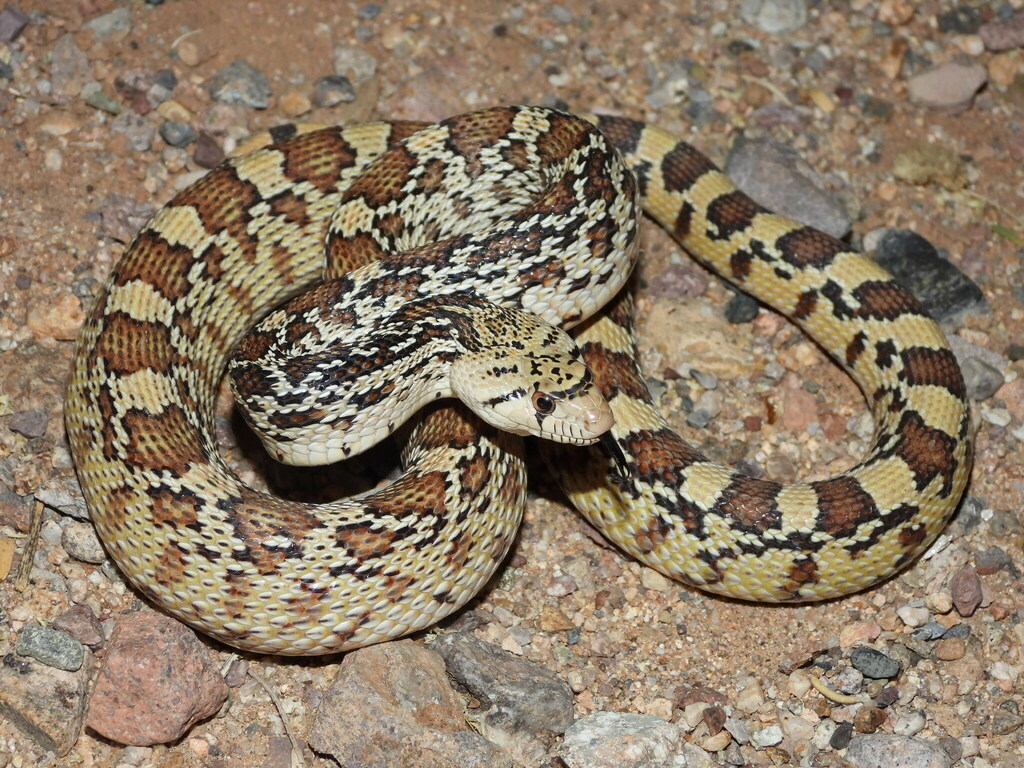
Gopher Snake
Pituophis catenifer
Pituophis catenifer is a species of nonvenomous colubrid snake endemic to North America. Nine subspecies are currently recognized, including the nominotypical subspecies, Pituophis catenifer catenifer, described here. This snake is often mistaken for the prairie rattlesnake, but can be easily distinguished from a rattlesnake by the lack of black and white banding on its tail and by the shape of its head, which is narrower than a rattlesnake's.
From the article Pituophis catenifer on Wikipedia (CC BY-SA), quoted section by section
Description
Adult gopher snakes are typically 36-84 in (91–213 cm) in length, when fully mature. Dorsally, gopher snakes are yellowish or a light, sandy brown, with a series of large, dark brown or black markings and smaller, darker spots along the sides. Ventrally, they are a lighter yellowish, either uniformly or with brown markings. They also come in several morphs, depending on the subspecies. This snake is often mistaken for the prairie rattlesnake (Crotalus viridus), but can be easily distinguished from a rattlesnake by the lack of a tail rattle, no black-and-white banding on its tail, and the shape of its head, which is narrower than a rattlesnake's. Additionally, rattlesnakes (and indeed most vipers) possess a large venom gland located behind each eye, giving their heads a much rounder, more angular shape, as opposed to the more cylindrical, slender head shape of a gopher snake or other colubrid.
What it does
The gopher snake has a unique defensive mechanism, in which it puffs up its body and curls itself into the classic strike pose of a rattlesnake, but rather than delivering an open-mouthed strike, the gopher snake often strikes with a closed mouth, using its blunt nose to warn off possible predators. Additionally, gopher snakes vibrate their tails in a manner similar to rattlesnakes. One paper found that gopher snakes on islands lacking rattlesnakes vibrate their tails for shorter times than gopher snakes in mainland California, which is home to numerous rattlesnake species. This suggests that gopher snake-tail vibration may in fact be rattlesnake mimicry, since the behavior appears to be breaking down in areas without rattlesnakes, perhaps because predators on these islands have no reason to evolve to avoid tail-vibrating snakes (rattlesnakes are venomous, gopher snakes are not).
Wikipedia: “Behavior”
In human culture
The specific name, catenifer, is Latin for "chain-bearing", referring to the dorsal color pattern.
Wikipedia: “Etymology”
Where it lives
Recorded sightings
—
geo-referenced records in GBIF, from museums, herbaria and field observers.
Drag the globe to turn it. Dots are where records exist, not a range map; darker means more records.
In the stacks
Searching the stacks…
Every page naming Pituophis catenifer in the Biodiversity Heritage Library →
This page is assembled live from iNaturalist, GBIF, Wikipedia, the Source Library and the Internet Archive. It is not yet part of the hand-edited codex. iNaturalist taxon 29044.