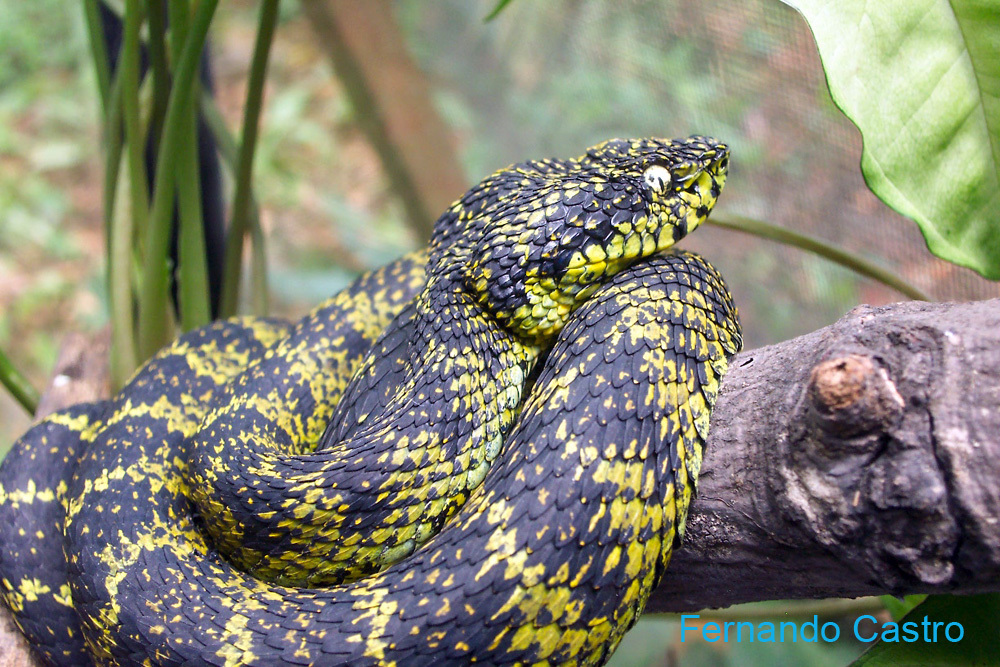
Highland Eyelash-Pitviper
Bothriechis schlegelii
Bothriechis schlegelii, known commonly as the highland eyelash-pitviper, Schlegel's eyelash-pitviper, eyelash viper or eyelash palm viper, is a species of pit viper in the family Viperidae, native to Colombia.
Somewhat small, arboreal snakes, B. schlegelii is perhaps best known for the namesake superciliary ("eyelash") scales above its eyes, and for having distinctly keeled or "raised" scales covering the bulk of its body. The species is also known for producing a veritable rainbow of color forms (morphs).
From the article Bothriechis schlegelii on Wikipedia (CC BY-SA), quoted section by section
Description
The eyelash viper is a relatively small species of pitviper, with adults ranging from 55–82 cm (22–32 in) long, and females being longer and more variable in size than males, which can grow to 69 cm (27 in) long. It has a wide, triangular-shaped head, and eyes with vertical pupils. Like all pit vipers, it is solenoglyphous, having large, hypodermic needle-like fangs in the front of the upper jaw that fold back when not in use, and has heat sensitive organs, or pits, located on either side of the head between the eye and nostril.
Its most distinguishing feature, and origin of its common name, is the set of modified scales above the eyes that look much like eyelashes. The eyelashes are thought to aid in camouflage, breaking up the snake's outline among the foliage where it hides. The eyelash viper occurs in a wide range of colors. No external features distinguish the two sexes.
Range & habitat
Previously thought to range from southern Mexico to northwestern South America, a systematic revision of the species in 2024 caused many of the populations in its purported range to become their own separate species. Although these species are very closely related, this restricts the range of B. schlegelii sensu stricto to Colombia, in primarily highland regions.
Wikipedia: “Distribution”
What it does
Like other Bothriechis species, B. schlegelii is adapted to a nearly completely arboreal lifestyle, possessing a strong, prehensile tail with which it secures itself around tree limbs, often coiled into a tight bundle during the day, as the species is primarily nocturnal. After dark, the eyelash viper awakens and awaits the presence of small, tree-dwelling animals that may cross its path, including mammals (rodents, bats, mouse opossums), amphibians (cloud forest landfrogs, fleshbelly frogs, tree frogs), birds (hummingbirds) or lizards (anoles, geckos, juvenile iguanas, whiptails), as well as occasionally fish. In typical ambush-predator fashion, B. schlegelii waits patiently for potential, unsuspecting prey to wander by. In some cases, individuals have been known to select specific ambush sites, returning each year in-time for the spring bird migration. Studies have indicated that individuals of B. schlegeli perfect their own strike accuracy with practice, over time.[1] Sometimes, B. schlegelii (especially juveniles) will employ what is known as "caudal luring", wriggling their tail in a "worm"-like fashion to entice potential prey, such as hungry frogs or lizards, to move within striking-range. …
Wikipedia: “Behavior”
In human culture
The specific name schlegelii honors Hermann Schlegel, who was a German ornithologist and herpetologist. Common names of B. schlegelii include the eyelash viper, eyelash pit viper, eyelash palm viper, eyelash palm-pitviper, Schlegel's viper, Schlegel's pit viper, Schlegel's palm viper, eyelash snake, eyelash lancehead, eyelash mountain viper, and horned palm viper. In Spanish, the primary language of countries comprising its distribution, common names include bocaracá, oropel (golden morph), víbora bocaracá, toboba pestañas, víbora de pestañas (eyelash viper), and serpiente loro (parrot snake).
Wikipedia: “Etymology”
Where it lives
Recorded sightings
—
geo-referenced records in GBIF, from museums, herbaria and field observers.
Drag the globe to turn it. Dots are where records exist, not a range map; darker means more records.
In the stacks
Searching the stacks…
Every page naming Bothriechis schlegelii in the Biodiversity Heritage Library →
This page is assembled live from iNaturalist, GBIF, Wikipedia, the Source Library and the Internet Archive. It is not yet part of the hand-edited codex. iNaturalist taxon 30844.