- Animals
- ›Chordates
- ›Vertebrates
- ›Reptiles
- ›Turtles and Tortoises
- ›Pond and Box Turtles
- ›Emydine Turtles
- ›Glyptemys
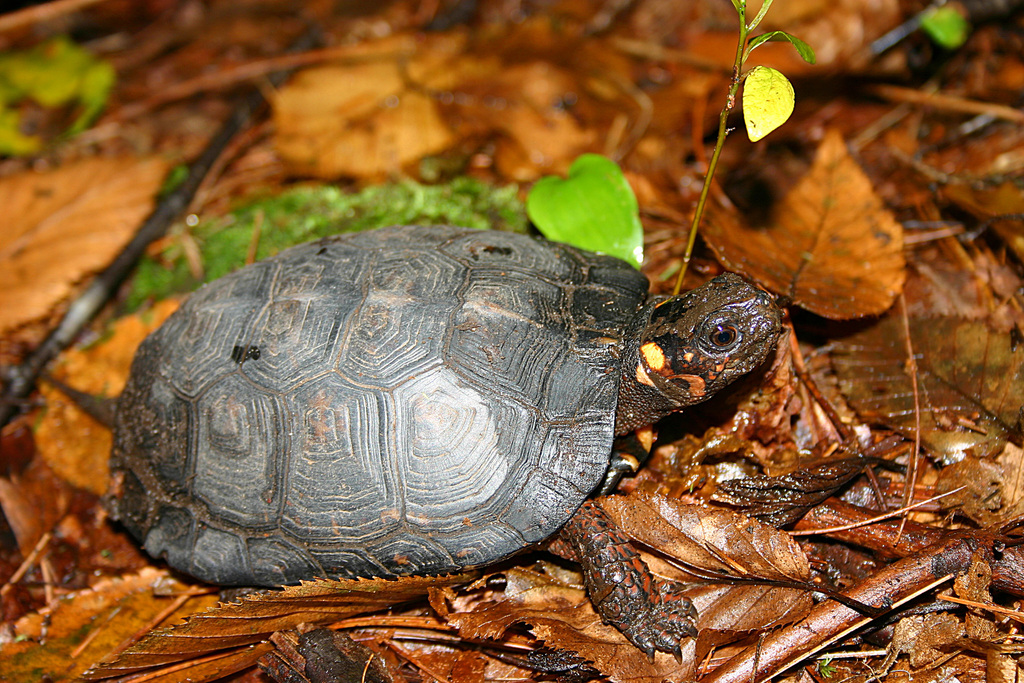
Bog Turtle
Glyptemys muhlenbergii
The bog turtle (Glyptemys muhlenbergii), also known commonly as Muhlenberg's turtle, is a critically endangered species of semiaquatic turtle in the family Emydidae. The species is native to the eastern United States. It was first scientifically described in 1801 after an 18th-century survey of Pennsylvania. The smallest North American turtle, it measures about 10 centimeters (4 in) in straight carapace length when fully grown. Although the bog turtle is similar in appearance to the painted turtle (Chrysemys picta) and the spotted turtle (Clemmys guttata), its closest relative is actually the somewhat larger wood turtle (Glyptemys insculpta). The bog turtle can be found from Vermont in the north, south to Georgia, and west to Pennsylvania. Diurnal and secretive, it spends most of its time buried in mud and – during the winter months – in hibernation. The bog turtle is omnivorous, feeding mainly on small invertebrates. The bog turtle is the state reptile of New Jersey.
An adult bog turtle weighs 110 grams (3.9 oz) on average. Its skin and shell are typically dark brown, with a distinctive orange spot on each side of the neck. Considered threatened at the federal level, the bog turtle is protected under the United States' Endangered Species Act. Invasive plants and urban development have eradicated much of the bog turtle's habitat, substantially reducing its numbers. Demand for the bog turtle is high in the black market pet trade, partly because of its small size and unique characteristics.
From the article Bog turtle on Wikipedia (CC BY-SA), quoted section by section
Description
The bog turtle is the smallest species of turtle in North America. The adults weigh approximately 110 grams (3.9 oz) when fully grown. It does not have a prominent snout. Its head is dark brown to black, and it has a bright yellow, orange, or red spot on each side of its neck. The spot is often forked, facing posteriorly. The bog turtle has a dark skin color with an orange-red wash on the inside of the legs of some individuals. The carapace is domed and rectangular in shape, and it tends to be narrower toward the head and wider toward the tail. The carapace often has easily identifiable rings on the rough scales or scutes. The scutes may also have a radiating arrangement of lines. In some older individuals, and those that burrow frequently in coarse substrates, the shell may be smooth. Although generally black, a chestnut sunburst pattern in each scute is sometimes present on the carapace. The belly of the shell, the plastron, is also a dark brown to black color with light marks present. The spotted turtle and painted turtle are similar in appearance to the bog turtle. The bog turtle is distinguishable from any other species of turtle in its geographic range by the distinctively colored blotch on its neck. …
Range & habitat
The bog turtle is native only to the eastern United States, congregating in colonies that often consist of fewer than 20 individuals. It prefers calcareous wetlands (areas containing lime), including meadows, bogs, marshes, and spring seeps, that have both wet and dry regions. Its habitat is often on the edge of woods. The bog turtle has sometimes been seen in cow pastures and near beaver dams. With habitats often time containing both overlapping wet and dry pockets The bog turtle's preferred habitat, sometimes called a fen, is slightly acidic with a high water table year-round. The constant saturation leads to the depletion of oxygen, subsequently resulting in anaerobic conditions. Soft mud, sand, or stone characterize the bottom substrate. The bog turtle uses soft, deep mud to shelter from predators and the weather. Spring seeps and groundwater springs provide optimum locations for hibernation during winter. Home range size is sex dependent, averaging about 0.17 to 1.33 hectares (0.42 to 3.29 acres) for males and 0.065 to 1.26 hectares (0.16 to 3.11 acres) for females. However, research has shown that densities can range from 5 to 125 individuals per 0.81 hectares (2.0 acres). …
Wikipedia: “Geographic distribution and habitat”
What it does
The bog turtle is primarily diurnal, active during the day and sleeping at night. It wakes in the early morning, basks until fully warm, then begins its search for food. It is a seclusive species, making it challenging to observe in its natural habitat. During colder days, the bog turtle will spend much of its time in dense underbrush, underwater, or buried in mud. Such behavior is indicative of the bog turtle's ability to survive without oxygen. On warmer days, the bog turtle's activities include scavenging, mating (during early spring), and basking in sunlight, the last of which it spends a great deal of the day doing. However, the bog turtle usually takes shelter from the sun during the hottest part of the day. Occasionally, during times of extreme heat, the turtle will either estivate, or become subterranean, sometimes occupying networks of tunnels filled with water. At night, the bog turtle buries itself in soft tunnels. Late September to March or April is usually spent in hibernation, either alone or in small groups in spring seeps. These groups can contain up to 12 individuals, and sometimes can include other species of turtles. Bog turtles try to find an area of dense soil, such as a strong root system, for protection during the dormant period. However, they may hibernate in other places such as the bottom of a tree, animal burrows, or empty spaces in mud. …
Wikipedia: “Behavior”
Where it lives
Recorded sightings
—
geo-referenced records in GBIF, from museums, herbaria and field observers.
Drag the globe to turn it. Dots are where records exist, not a range map; darker means more records.
In the stacks
Searching the stacks…
Every page naming Glyptemys muhlenbergii in the Biodiversity Heritage Library →
This page is assembled live from iNaturalist, GBIF, Wikipedia, the Source Library and the Internet Archive. It is not yet part of the hand-edited codex. iNaturalist taxon 39864.