- Animals
- ›Chordates
- ›Vertebrates
- ›Reptiles
- ›Turtles and Tortoises
- ›Pond and Box Turtles
- ›Emydine Turtles
- ›Actinemys
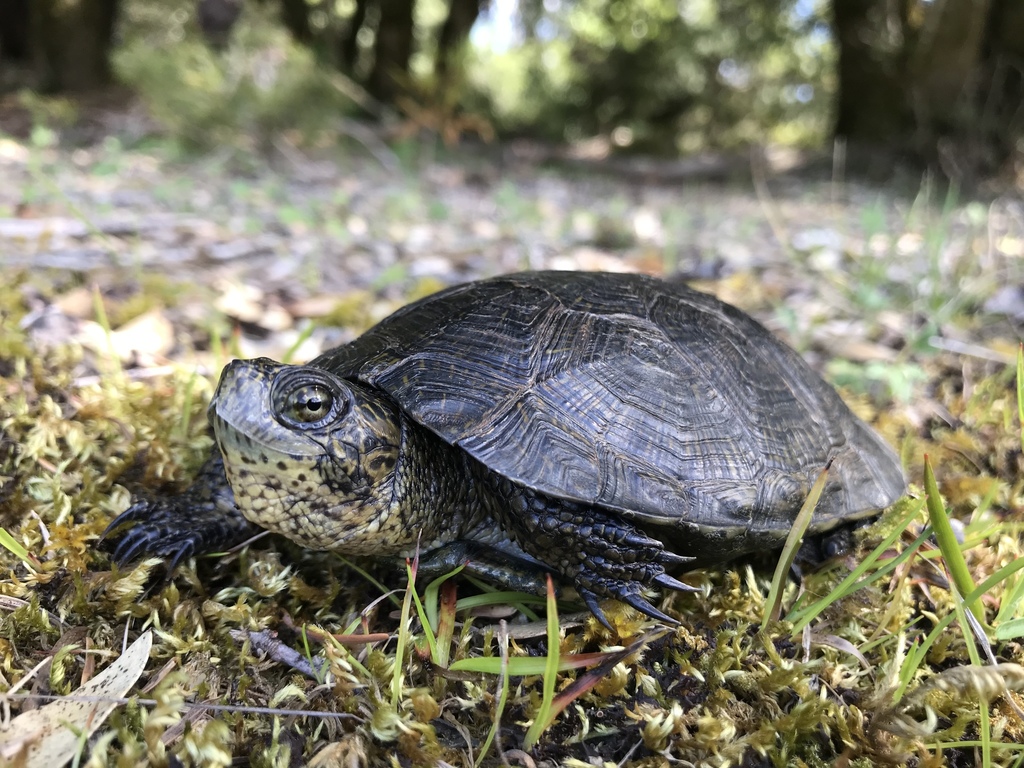
Northwestern Pond Turtle
Actinemys marmorata
The western pond turtle (Actinemys marmorata), also known commonly as the Pacific pond turtle is a species of small to medium-sized turtle in the family Emydidae. The species is endemic to the western coast of the United States and Mexico, ranging from western Washington state to northern Baja California. It was formerly found in Canada (in British Columbia), but in May 2002, the Canadian Species at Risk Act listed the Pacific pond turtle as being extirpated.
From the article Western pond turtle on Wikipedia (CC BY-SA), quoted section by section
Description
The dorsal color of A. marmorata is usually dark brown or dull olive, with or without darker reticulations or streaking. The plastron is yellowish, sometimes with dark blotches in the centers of the scutes. The straight carapace length is 11–21 cm (4.5–8.5 in). The carapace is low and broad, usually widest behind the middle, and in adults is smooth, lacking a keel or serrations. Adult western pond turtles are sexually dimorphic, with males having a light or pale yellow throat.
Range & habitat
The western pond turtle originally ranged from northern Baja California, Mexico, north to the southern regions of British Columbia, Canada. It was once a large part of a major fishery on Tulare Lake, California, supplying San Francisco with a local favorite, turtle soup, as well as feed for hogs that learned to dive for it in the shallows of Hog Island, also on Tulare Lake. As of 2007, it has become rare or absent in the Puget Sound region of Washington. It has a disjunct distribution in most of the Northwest, and some isolated populations exist in southern Washington. The western pond turtle is now rare in the Willamette Valley north of Eugene, Oregon, but abundance increases south of that city where temperatures are higher. It may be locally common in some streams, rivers and ponds in southern Oregon. A few records are reported east of the Cascade Mountains, but these may have been based on introduced individuals. It ranges up to 305 m (1,001 ft) in Washington, and to about 915 m (3,002 ft) in Oregon. It also occurs in Uvas Canyon area, Santa Cruz Mountains, California, and in the North Bay, and lakes such as Fountaingrove Lake. Many taxonomic authorities now split what had been considered one species of turtle into two species. The southern species is named Actinemys pallida, or the southwestern pond turtle. Its range is southern California and Mexico. …
Wikipedia: “Distribution”
What it does
The western pond turtle occurs in both permanent and intermittent waters, including marshes, streams, rivers, ponds, and lakes. It favors habitats with large numbers of emergent logs or boulders, where individuals aggregate to bask. They also bask on top of aquatic vegetation. Consequently, this species is often overlooked in the wild. However, it is possible to observe resident turtles by moving slowly and hiding behind shrubs and trees. A. marmorata can be encouraged to use artificial basking substrate, or rafts, which allows for easy detection of the species in complex habitats. In addition to its aquatic habitat, terrestrial habitat is also extremely important for the western pond turtle. Since many intermittent ponds can dry up during summer and fall months along the west coast, especially during times of drought, the western pond turtle can spend upwards of 200 days out of water. Many turtles overwinter outside of the water, during which time they often create their nests for the year. Overwintering sites can sometimes be 500 meters from a main body of water
Wikipedia: “Ecology and behavior”
Where it lives
Recorded sightings
—
geo-referenced records in GBIF, from museums, herbaria and field observers.
Drag the globe to turn it. Dots are where records exist, not a range map; darker means more records.
In the stacks
Searching the stacks…
Every page naming Actinemys marmorata in the Biodiversity Heritage Library →
This page is assembled live from iNaturalist, GBIF, Wikipedia, the Source Library and the Internet Archive. It is not yet part of the hand-edited codex. iNaturalist taxon 73592.