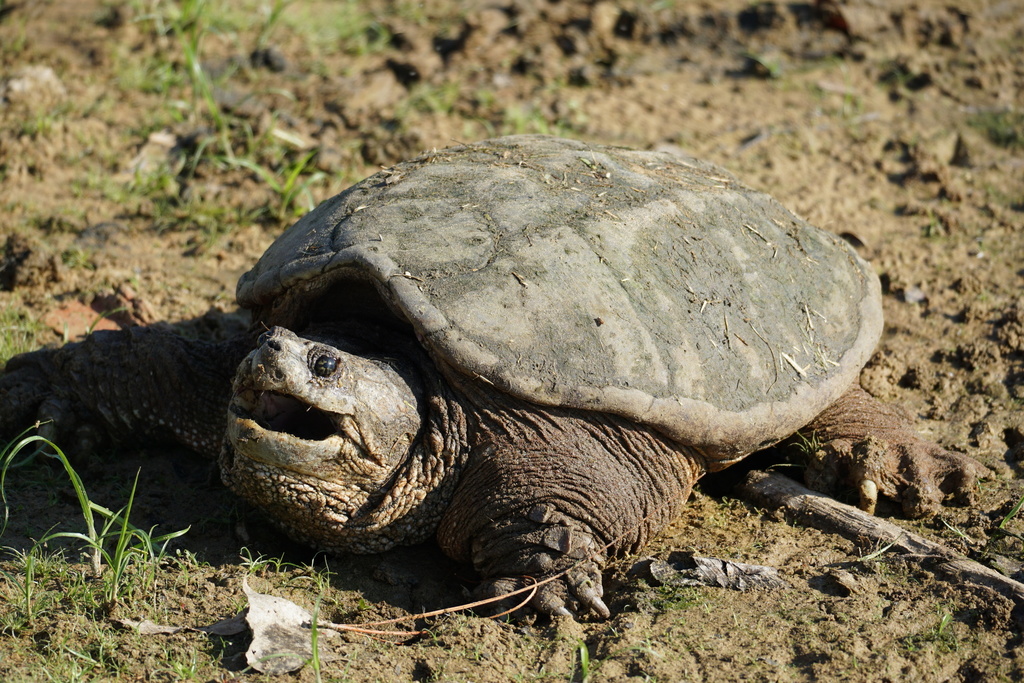
Common Snapping Turtle
Chelydra serpentina
The common snapping turtle (Chelydra serpentina) is a species of large, freshwater turtles in the family Chelydridae. Its natural range extends from southeastern Canada, southwest to the edge of the Rocky Mountains, as far east as Nova Scotia, and Florida. The present-day C. serpentina population in the Middle Rio Grande suggests that the common snapping turtle has been present in this drainage since at least the 17th century and is likely native. The three species of Chelydra and the larger alligator snapping turtles (genus Macrochelys) are the only extant chelydrids, a family now restricted to the Americas. The common snapping turtle, as its name implies, is the most widespread.
The common snapping turtle is noted for its combative disposition when out of the water, with its powerful, beak-like jaws, and highly mobile head and neck (hence the specific epithet serpentina, meaning "snake-like"). In water, it is likely to flee and hide underwater in sediment. The common snapping turtle has a life-history strategy characterized by high and variable mortality of embryos and hatchlings, delayed sexual maturity, extended adult longevity, and iteroparity (repeated reproductive events) with low reproductive success per reproductive event.
From the article Common snapping turtle on Wikipedia (CC BY-SA), quoted section by section
Description
C. serpentina has a rugged, muscular build with a ridged carapace (upper shell) that varies in color from tan to brown and black, although ridges tend to be more pronounced in younger individuals. The straight-line carapace length in adulthood may be nearly 50 cm (20 in), though lengths of 25–47 cm (9.8–18.5 in) are more common. C. serpentina usually weighs 4.5–16 kg (9.9–35.3 lb). Per one study, breeding common snapping turtles were found to average 28.5 cm (11.2 in) in carapace length and 22.5 cm (8.9 in) in plastron length and weigh about 6 kg (13 lb). Males are larger than females, with almost all weighing in excess of 10 kg (22 lb) being male and quite old, as the species continues to grow throughout life. Any specimen above the aforementioned weights is exceptional, but the heaviest wild specimen caught reportedly weighed 34 kg (75 lb). Common snapping turtles kept in captivity can be quite overweight due to overfeeding and have weighed as much as 39 kg (86 lb). In the northern part of its range, the common snapping turtle is often the heaviest native freshwater turtle. Common snapping turtles have well-developed olfactory organs, nerves, and bulbs that suggest that this species has a great sense of smell.
What it does
Common habitats for these turtles are shallow ponds or streams. Some may inhabit brackish environments, such as estuaries. These sources of water tend to have an abundance of aquatic vegetation due to the shallow pools. Some describe them as habitat generalists as they can occupy most permanent bodies of water. Common snapping turtles sometimes bask—though rarely observed—by floating on the surface with only their carapaces exposed, though in the northern parts of their range, they also readily bask on fallen logs in early spring. In shallow waters, common snapping turtles may lie beneath a muddy bottom with only their heads exposed, stretching their long necks to the surface for an occasional breath. Their nostrils are positioned on the very tip of the snout, effectively functioning as snorkels.
Diet. Common snapping turtles are omnivorous. Important aquatic scavengers, they are also active hunters that use ambush tactics to prey on anything they can swallow, including many invertebrates, fish, frogs, other amphibians, reptiles (including snakes and smaller turtles), unwary birds, and small mammals. There has been no documented difference between the diets of males and females. …
Wikipedia: “Ecology and life history”
At the table
The common snapping turtle is a traditional ingredient in turtle soup; consumption in large quantities, however, can become a health concern due to potential concentration of toxic environmental pollutants in the turtle's flesh.
Wikipedia: “As food”
Where it lives
Recorded sightings
—
geo-referenced records in GBIF, from museums, herbaria and field observers.
Drag the globe to turn it. Dots are where records exist, not a range map; darker means more records.
In the stacks
Searching the stacks…
Every page naming Chelydra serpentina in the Biodiversity Heritage Library →
This page is assembled live from iNaturalist, GBIF, Wikipedia, the Source Library and the Internet Archive. It is not yet part of the hand-edited codex. iNaturalist taxon 39682.