 NL·0513
Herbarium of the Nature Library
- Name
- Latimeria chalumnae
- Family
- Latimeriidae
- Native to
- Western Indian Ocean: Comoros, Mozambique, South Africa, Tanzania, Kenya and Madagascar
- Habitat
- Deep reef slope, Submarine caves
West Indian Ocean coelacanth
Latimeria chalumnae
Also calledGombessa (Comorian) · Qiāngjíyú 腔棘鱼 (Chinese) · Celacanto (Spanish/Portuguese)
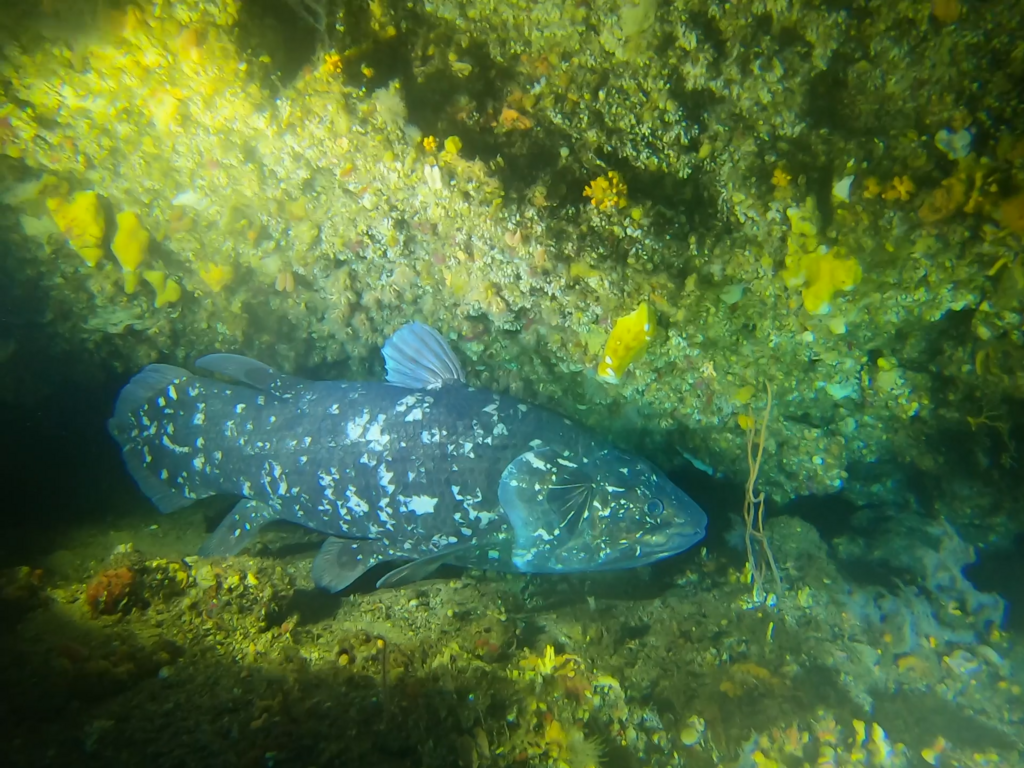
A lobe-finned 'living fossil' known only from fossils and believed extinct for 66 million years until a fisherman's catch in South Africa in 1938. Its fleshy fins and ancient lineage make it a cousin of the fish that first walked onto land.
The West Indian Ocean coelacanth, sometimes known as the gombessa, African coelacanth, and simply coelacanth, is a crossopterygian, one of two extant species of coelacanth, a rare order of vertebrates more closely related to lungfish and tetrapods than to the common ray-finned fishes. The other extant species is the Indonesian coelacanth. Wikipedia
What it can do
- iMoves its paired lobed fins in an alternating pattern like the legs of a walking tetrapod
- iiSenses prey's electric fields with a jelly-filled rostral organ in its snout
- iiiDrifts head-down in 'headstands' while hunting
- ivOpens its mouth unusually wide thanks to a hinged joint in its skull
- vLives about a century and carries its young for around five years
In the field
Field marks
- aLarge, deep blue fish with white blotches
- bFleshy, limb-like lobed fins
- cThree-lobed tail
- dSluggish, drifting swimmer
- When
- Resident; hides in caves by day
Life & habits
- Diet
- Carnivore: fish, squid and cuttlefish
- Habitat
- Steep volcanic slopes at 150–700 m; shelters in caves by day
- Size
- Up to ~2 m and ~90 kg
- Lifespan
- ~100 years
By day small groups share the same lava caves, then drift out alone at night to hunt along the slope.
Where it lives
Recorded sightings
—
geo-referenced records in GBIF, from museums, herbaria and field observers.
Native range
Western Indian Ocean: Comoros, Mozambique, South Africa, Tanzania, Kenya and Madagascar
Drag the globe to turn it. Dots are where records exist, not a range map; darker means more records.
In the stacks
Searching the stacks…
Every page naming Latimeria chalumnae in the Biodiversity Heritage Library →
Marginalia
Museum curator Marjorie Courtenay-Latimer spotted one in a trawler's catch at East London, South Africa, in December 1938 and the ichthyologist J.L.B. Smith named it for her. Comorian fishermen had long known the fish, which they called gombessa.
Curiosity
A second species, Latimeria menadoensis, was found in an Indonesian fish market in 1997, about 10,000 km away.
Kinship






Photographs: iNaturalist contributors under the licences shown. Records: GBIF.org. Historical plates: Source Library (CC BY-SA 4.0; originals public domain). Summary text: Nature Library editors and Wikipedia (CC BY-SA). Medicinal and edibility notes are historical and educational, not advice. iNaturalist taxon 104109.