- Animals
- ›Chordates
- ›Vertebrates
- ›Mammals
- ›Therians
- ›Placental Mammals
- ›Afromammals
- ›Sengis
- ›Sengis
- ›Soft-furred Sengis
- ›Round-eared and Four-toed Sengis
- ›Macroscelides
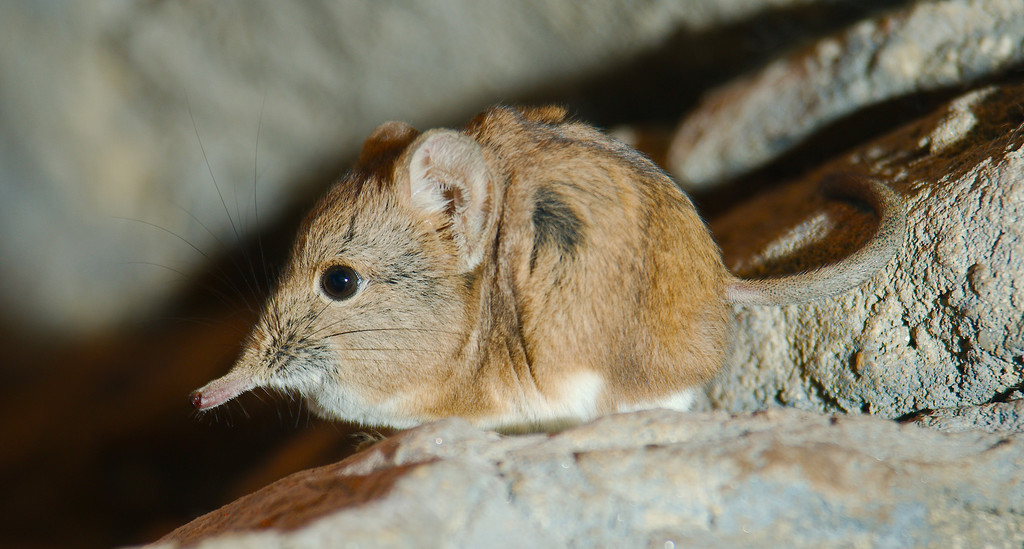
Karoo Round-eared Sengi
Macroscelides proboscideus
The round-eared sengi or round-eared elephant shrew (Macroscelides proboscideus), also called the Karoo round-eared sengi or Karoo round-eared sengi to distinguish it from its sister species, is a species of small mammal belonging to the sengi family (Macroscelididae), and distantly (ancestrally) related to elephants. It is found in Botswana, Namibia, and South Africa. Its natural habitats are subtropical or tropical dry shrubland, and grassland, and hot deserts. They eat insects, shoots, and roots. Their gestation period is 56 days. The species was formerly misleadingly called the short-eared sengi or short-eared elephant shrew.
Sengis are among only a handful of monogamous mammals, making them a model group for the study of monogamy. They have been studied for their mate guarding behavior. Mate guarding is considered a predominant male trait in round-eared sengis. This strategy is used to guard the female before and after heat to eliminate male competition, which makes male round-eared sengis monogamous and more vulnerable to their surroundings as they spent a majority of their time dedicated to this tactic.
From the article Karoo round-eared sengi on Wikipedia (CC BY-SA), quoted section by section
Range & habitat
The round-eared sengi are native to Southeast Africa where the temperature ranges from 18 to 6 °C (64 to 43 °F) in the winter and 30 to 22 °C (86 to 72 °F) during the summer.
Wikipedia: “Habitat”
What it does
Round-eared sengis are omnivores with their diet mainly consisting of insects and supplemented with plants. During the winter, this species consumes less insects than they do during the summer due to a decrease in the insect population.
Wikipedia: “Foraging and diet”
Listen
Looking for field recordings…
Where it lives
Recorded sightings
—
geo-referenced records in GBIF, from museums, herbaria and field observers.
Drag the globe to turn it. Dots are where records exist, not a range map; darker means more records.
In the stacks
Searching the stacks…
Every page naming Macroscelides proboscideus in the Biodiversity Heritage Library →
This page is assembled live from iNaturalist, GBIF, Wikipedia, the Source Library and the Internet Archive. It is not yet part of the hand-edited codex. iNaturalist taxon 43228.