- Animals
- ›Chordates
- ›Vertebrates
- ›Mammals
- ›Therians
- ›Placental Mammals
- ›Afromammals
- ›Sengis
- ›Sengis
- ›Soft-furred Sengis
- ›Round-eared and Four-toed Sengis
- ›Petrodromus
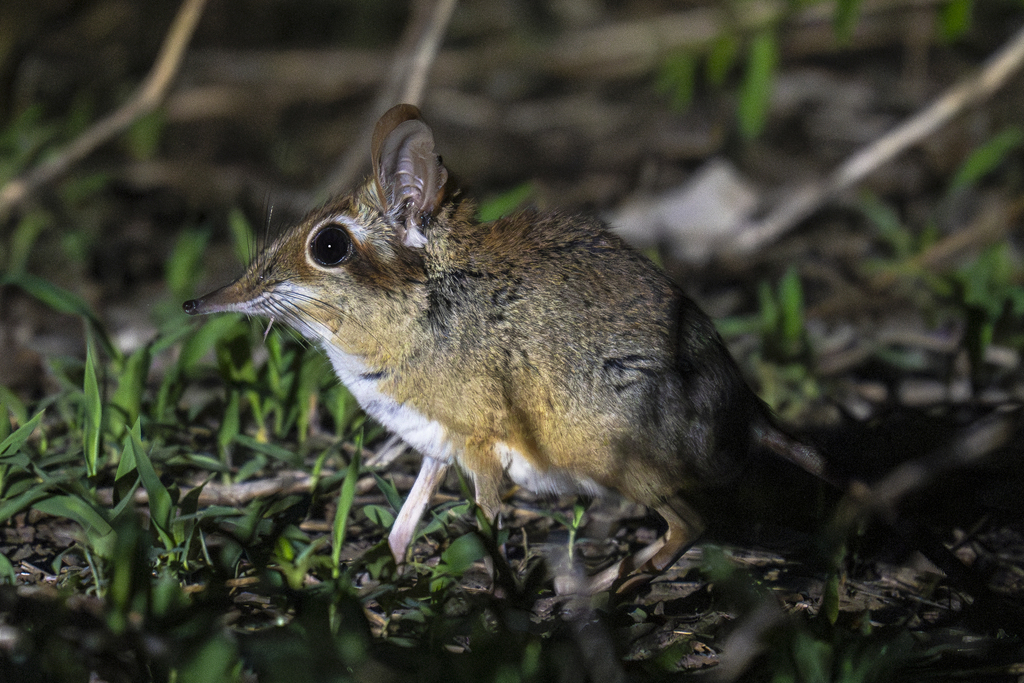
Four-toed Sengi
Petrodromus tetradactylus
The four-toed sengi or four-toed elephant shrew (Petrodromus tetradactylus) is the only living species in the genus Petrodromus, which together with five other extant genera Rhynchocyon, Macroscelides, Petrosaltator, Galegeeska and Elephantulus constitutes the order Macroscelidea. This species of sengi is only found in particular regions in Africa and is smaller than its relatives. A comprehensive record of this species is lacking.
As its name suggests, the species has four toes on its hind feet, and like other sengis, it has been named for its elephant-like, mobile proboscis.
From the article Four-toed sengi on Wikipedia (CC BY-SA), quoted section by section
Range & habitat
The four-toed sengi is found in Central and Southern East Africa, notably in Angola, Democratic Republic of the Congo, Kenya, Malawi, Mozambique, South Africa, Tanzania, Zambia, Zimbabwe, and possibly Namibia. Its natural habitats are subtropical or tropical dry forests, montane forests, and moist savannas. Throughout these countries, they are the second most widespread species, following the short-snouted sengi. Specifically, they thrive in dense forests (notably in dense evergreen growths), woodlands and thickets, with suitable cover and protection, as well as invertebrates for food. During the night, they prefer to sleep under dense brush (as opposed to a nest). In some areas, their habitats are being destroyed and four-toed sengis are being hunted, but their conservation status is of least concern.
Wikipedia: “Geographic location and habitat”
What it does
The four-toed sengi is mostly active during the day and early evening, whereas during the night or midday, it tends to be less active. When the four-toed sengi runs, its tail points upwards; it also makes a noise through its hind feet. Ants react to this sound, which helps the four-toed sengi to locate its prey. When four-toed sengis fight, they usually fight in pairs of the same gender. They fight in a "boxing" motion, supporting themselves on their rear legs and boxing with their front limbs to tackle one another. Four-toed sengis have good senses of sight, smell and hearing, but their vocal capacity is not well developed. In captivity, they make different kinds of sounds, such as screaming, purring or clucking for help.
Wikipedia: “Behaviour”
Listen
Looking for field recordings…
Where it lives
Recorded sightings
—
geo-referenced records in GBIF, from museums, herbaria and field observers.
Drag the globe to turn it. Dots are where records exist, not a range map; darker means more records.
In the stacks
Searching the stacks…
Every page naming Petrodromus tetradactylus in the Biodiversity Heritage Library →
This page is assembled live from iNaturalist, GBIF, Wikipedia, the Source Library and the Internet Archive. It is not yet part of the hand-edited codex. iNaturalist taxon 43226.