- Animals
- ›Chordates
- ›Vertebrates
- ›Mammals
- ›Therians
- ›Placental Mammals
- ›Ungulates, Carnivorans, and Allies
- ›Even-toed Ungulates and Cetaceans
- ›Cetaceans and Hippopotamuses
- ›Cetaceans
- ›Toothed Whales
- ›American River Dolphins
- ›South American River Dolphins
- ›Inia
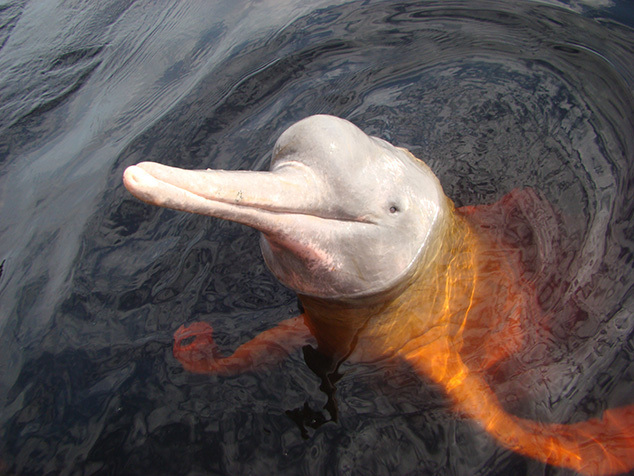
Amazon River Dolphin
Inia geoffrensis
The Amazon river dolphin (Inia geoffrensis), also known as the boto, bufeo or pink river dolphin, is a species of toothed whale endemic to South America and is classified in the family Iniidae. Three subspecies are currently recognized: I. g. geoffrensis (Amazon river dolphin), I. g. boliviensis (Bolivian river dolphin) and I. g. humboldtiana (Orinoco river dolphin). The position of the Araguaian river dolphin (I. araguaiaensis) within the clade is still unclear. The three subspecies are distributed in the Amazon basin, the upper Madeira River in Bolivia, and the Orinoco basin, respectively.
The Amazon river dolphin is the largest species of river dolphin, with many adult males reaching 185 kilograms (408 lb) in weight, and 2.5 metres (8.2 ft) in length. Adults acquire a pink color, more prominent in males, giving it its nickname "pink river dolphin". Sexual dimorphism is very evident, with males measuring 16% longer and weighing 55% more than females. Like other toothed whales, they have a melon, an organ that is used for bio sonar. The dorsal fin, although short in height, is regarded as long, and the pectoral fins are also large. The fin size, unfused vertebrae, and its relative size allow for improved maneuverability when navigating flooded forests and capturing prey.
From the article Amazon river dolphin on Wikipedia (CC BY-SA), quoted section by section
Description
The Amazon river dolphin is the largest river dolphin. Adult males reach a maximum length and weight of 2.55 metres (8.4 ft) (average 2.32 metres (7.6 ft)) and 185 kilograms (408 lb) (average 154 kilograms (340 lb)), while females reach a length and weight of 2.15 metres (7.1 ft) (mean 2 metres (6.6 ft)) and 150 kilograms (330 lb) (average 100 kilograms (220 lb)). It has very evident sexual dimorphism, with males measuring and weighing between 16% and 55% more than females, making it unique among river dolphins, where females are generally larger than males. The texture of the body is robust and strong but flexible. Unlike in oceanic dolphins, the cervical vertebrae are not fused, allowing the head to turn 90 degrees. The flukes are broad and triangular, and the dorsal fin, which is keel-shaped, is short in height but very long, extending from the middle of the body to the caudal region. The pectoral fins are large and paddle-shaped. The length of its fins allows the animal to perform a circular movement, allowing for exceptional maneuverability to swim through the flooded forest but decreasing its speed. The body color varies with age. Newborns and the young have a dark grey tint, which in adolescence transforms into light grey, and in adults turns pink as a result of repeated abrasion of the skin surface. …
Range & habitat
Amazon river dolphins are the most widespread river dolphins. They are present in six countries in South America: Bolivia, Brazil, Colombia, Ecuador, Peru, and Venezuela, in an area covering about 7 million square kilometres (2.7 million square miles). The boundaries are set by waterfalls, such as the Xingu and Tapajós rivers in Brazil, as well as very shallow water. A series of rapids and waterfalls in the Madeira River have isolated one population, recognized as the subspecies I. g. boliviensis, in the southern part of the Amazon basin in Bolivia. They are also distributed in the basin of the Orinoco River, except the Caroni River and the upper Caura River in Venezuela. The only connection between the Orinoco and the Amazon is through the Casiquiare canal. The distribution of dolphins in the rivers and surrounding areas depends on the time of year; in the dry season they are located in the river beds, but in the rainy season, when the rivers overflow, they disperse to the flooded areas, both the forests and the plains. Studies to estimate the population are difficult to analyze due to the difference in the methodology used. In a study conducted in the stretch of the Amazon called Solimões River, with a length of 1,200 kilometres (750 mi) between the cities of Manaus and Tabatinga, a total of 332 individuals was sighted ± 55 per inspection. …
Wikipedia: “Distribution and population”
What it does
The Amazon river dolphin are commonly seen singly or in pairs, but may also occur in pods that rarely contain more than eight individuals. Pods as large as 37 individuals have been seen in the Amazon, but the average is three. In the Orinoco, the largest observed groups number 30, but the average is just above five. During prey time, as many as 35 pink dolphins work together to obtain their prey. Typically, social bonds occur between mother and child, but may also been seen in heterogeneous groups or bachelor groups. The largest congregations are seen in areas with abundant food, and at the mouths of rivers. There is significant segregation during the rainy season, with males occupying the river channels, while females and their offspring are located in flooded areas. However, in the dry season, there is no such separation. Due to the high level of prey fish, larger group-sizes are seen in large sections that are directly influenced by whitewater (such as main rivers and lakes, especially during low water season) than in smaller sections influenced by blackwater (such as channels and smaller tributaries). …
Wikipedia: “Biology and ecology”
In human culture
In traditional Amazon River folklore, at night, an Amazon river dolphin becomes a handsome young man who seduces girls, impregnates them, and then returns to the river in the morning to become a dolphin again. Similarly, the female becomes a beautiful, well-dressed, wealthy-looking young woman. This dolphin shapeshifter is called an encantado. The myth has been suggested to have arisen partly because dolphin genitalia bear a resemblance to those of humans. Others believe the myth served (and still serves) as a way of hiding the incestuous relations which are quite common in some small, isolated communities along the river. In the area, tales relate it is bad luck to kill a dolphin. Legend also states that if a person makes eye contact with an Amazon river dolphin, they will have lifelong nightmares. According to the pink Amazon river dolphin myth, it is said that this creature takes form of a human and seduces men and women to the Underworld of Encante. This underworld place is said to be 'Atlantis-like Paradise', yet no one has come back from it alive. Myths say that whoever kills the amazon dolphin will have bad luck, but it's worse for whoever eats it. …
Wikipedia: “In mythology”
Listen
Looking for field recordings…
Where it lives
Recorded sightings
—
geo-referenced records in GBIF, from museums, herbaria and field observers.
Drag the globe to turn it. Dots are where records exist, not a range map; darker means more records.
In the stacks
Searching the stacks…
Every page naming Inia geoffrensis in the Biodiversity Heritage Library →
This page is assembled live from iNaturalist, GBIF, Wikipedia, the Source Library and the Internet Archive. It is not yet part of the hand-edited codex. iNaturalist taxon 41472.