- Animals
- ›Chordates
- ›Vertebrates
- ›Mammals
- ›Therians
- ›Placental Mammals
- ›Primates, Rodents, and Allies
- ›Rodents
- ›Mice, Rats, and Hamsters
- ›Muroids
- ›Old World Mice and Rats
- ›Murines
- ›Australasian Mice and Rats
- ›Notomys
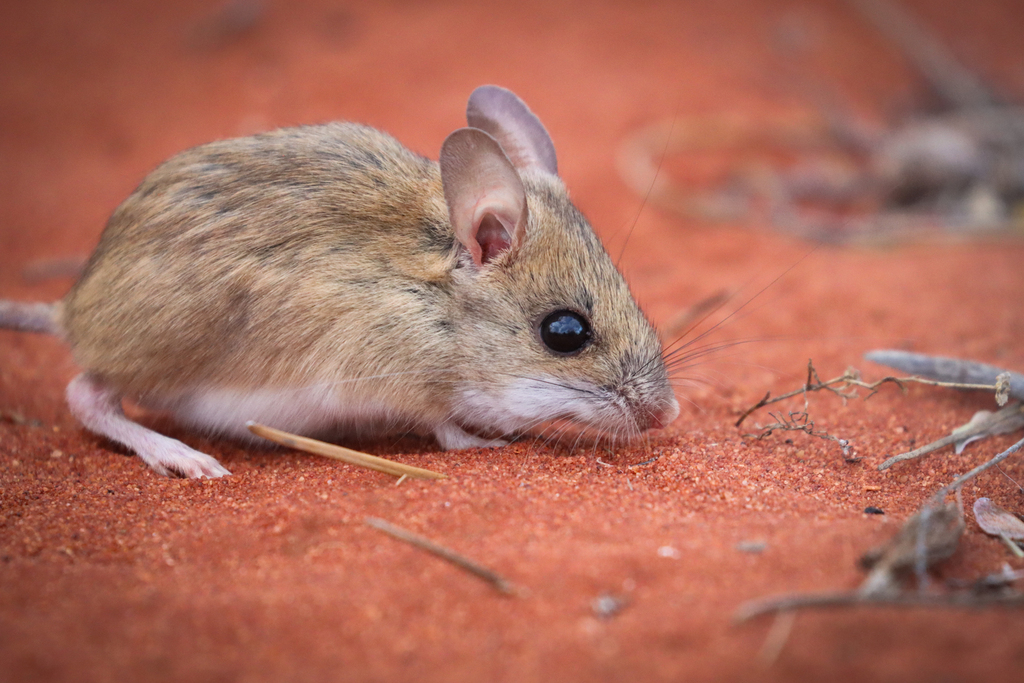
Spinifex Hopping Mouse
Notomys alexis
The spinifex hopping mouse (Notomys alexis), also known as the tarkawara or tarrkawarra, occurs throughout the central and western Australian arid zones, occupying both spinifex-covered sand flats and stabilised sand dunes, and loamy mulga and melaleuca flats.
The population fluctuates greatly: in normal years it is sparsely distributed and probably confined to sandy country; after rain the population explodes and spreads to other types of habitat for a time.
From the article Spinifex hopping mouse on Wikipedia (CC BY-SA), quoted section by section
Description
The appearance is very similar to the northern hopping mouse: slightly larger than a common house mouse at 95 to 115 mm (3.7 to 4.5 in) head-body length and an average weight of 35 g (1.2 oz). As with all hopping mice, the hind legs are greatly elongated, the fore limbs small, and the brush-tipped tail very long—about 140 mm (5.5 in). The fur is chestnut or fawn above, pale below, with a grey wash about the muzzle and between the eye and ear, and longer, coarse black guard hairs on the back. The tail is sparsely furred and pink, darker above than below. Spinifex hopping mice live in small family groups of up to 10 individuals in deep, humid burrow systems. Typically, there is a large nest chamber lined with small sticks and other plant material about a metre below the surface, from which several vertical shafts lead upwards. Shaft entrances do not have spoil heaps.
Wikipedia: “Appearance”
Listen
Looking for field recordings…
Where it lives
Recorded sightings
—
geo-referenced records in GBIF, from museums, herbaria and field observers.
Drag the globe to turn it. Dots are where records exist, not a range map; darker means more records.
In the stacks
Searching the stacks…
Every page naming Notomys alexis in the Biodiversity Heritage Library →
This page is assembled live from iNaturalist, GBIF, Wikipedia, the Source Library and the Internet Archive. It is not yet part of the hand-edited codex. iNaturalist taxon 45116.