- Animals
- ›Chordates
- ›Vertebrates
- ›Mammals
- ›Therians
- ›Placental Mammals
- ›Primates, Rodents, and Allies
- ›Rodents
- ›Mice, Rats, and Hamsters
- ›Muroids
- ›Old World Mice and Rats
- ›Murines
- ›Australasian Mice and Rats
- ›Mesembriomys
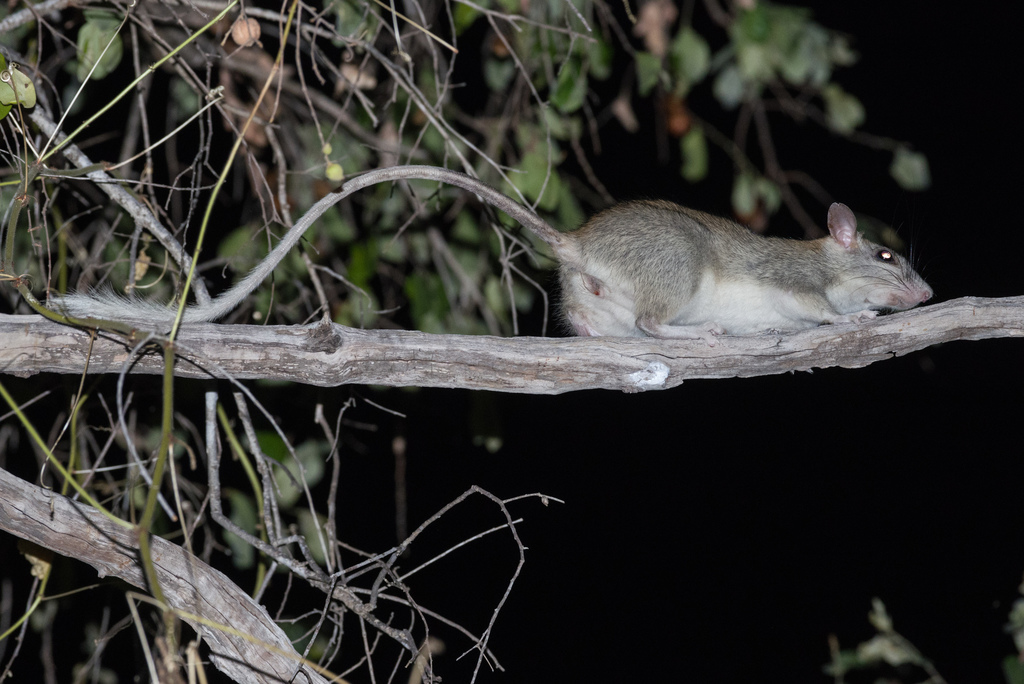
Golden-backed Tree Rat
Mesembriomys macrurus
The golden-backed tree rat (Mesembriomys macrurus) is a species of rodent in the family Muridae, found only in Australia.
Its native range was across Northern Australia, but it has since become extinct from these regions. It is now only found in remote near-coastal areas in the Kimberley, Western Australia. It is present in the Charnley River–Artesian Range Wildlife Sanctuary.
From the article Golden-backed tree-rat on Wikipedia (CC BY-SA), quoted section by section
Description
Golden-backed tree rats are named for their broad stripe of golden-coloured fur that runs from the top of its head to the base of their tail, of which has a white brush tip. They are nocturnal and arboreal. During day, they sleep in their nests made in hollow trees, dense foliage or among rocks. They range in size from 18 to 34 cm with a 29 to 36 cm tail, and weigh 200-330 grams. Golden-backed tree rats are thought to breed throughout the year, with a gestation period of 48 days and litter size of 2. Their young are weaned at either six or seven weeks old. In captivity, the maximum longevity of a golden-back tree rat is 7.1 years.
Diet. The golden-backed tree rat forages mainly on fruits, travelling through areas with recently burnt vegetation to reach them. Their diet also consists of flowers, grasses and insects.
Range & habitat
The golden-backed tree rat is endemic to Australia. Its range is known to have included parts of the Northern Territory, where only three historical records of its presence in the territory is known. These being the upper McArthur River in 1901, upper Mary River in 1903, and in the Deaf Adder George of Kakadu National Park in 1969. However, recent surveys have since failed to detect any signs of golden-backed tree rat populations in mainland NT. Local Australian Aboriginal knowledge from the Top End however suggests that the disappearance of golden-backed tree rats from the region occurred between the late 2000s and early 2010s. There is still however the possibility that the species is still present in the NT. In Western Australia, the golden-backed tree rat once had a range across parts of the Pilbara and the Kimberley. Subfossils of the species have been identified in the Pilbara, and the type specimen originally came from near Roebourne in the Pilbara when the species was identified in 1875. During the 1800s in Broome, the golden-backed tree rat was once so common that it was considered a pest. When Norwegian zoologist Knut Dahl visited Broome in 1896, he recorded that they raided bags of rice and flour around town. …
Wikipedia: “Range and habitat”
In human culture
The indigenous Wunambal people have traditionally used the tails of golden-backed tree rats to make special necklaces.
Name. Golden-backed tree rats are known as Koorrawal, Wunggangbarn, or Jari in Wunambal, and in the Yiiji dialect of Wunambal spoken by the Yeidji people, it is called Jari Manya. A synonym for Mesembriomys macrurus is Hapalotis boweri, named by Edward Pierson Ramsay in 1887 when he incorrectly identified specimens forwarded by his friend and colleague Thomas Henry Boyer-Bower as a new species. Ramsay named Hapalotis boweri in honour of Boyer-Bower who had recently died.
== References ==
Wikipedia: “In culture”
Listen
Looking for field recordings…
Where it lives
Recorded sightings
—
geo-referenced records in GBIF, from museums, herbaria and field observers.
Drag the globe to turn it. Dots are where records exist, not a range map; darker means more records.
In the stacks
Searching the stacks…
Every page naming Mesembriomys macrurus in the Biodiversity Heritage Library →
This page is assembled live from iNaturalist, GBIF, Wikipedia, the Source Library and the Internet Archive. It is not yet part of the hand-edited codex. iNaturalist taxon 45811.